2 Classical mechanics
Classical mechanics deals with mass points, i.e. masses without spatial extension, which move at speeds $\ll c$ (transition to relativity theory) and are not too light (transition to quantum mechanics).
2.1 Newtonian mechanics
Classical mechanics is based on Newton's axioms [18]. The most important axiom is Newton's Second Axiom:
The momentum is defined by
\[ \begin{align} \mathbf{p} \coloneqq m\frac{d\mathbf{r}}{dt}, \end{align} \]
where $\mathbf{r} = \mathbf{r}\left(t\right)$ is the trajectory of the mass point. The First Axiom is a special case of the Second and is therefore insignificant. Newton's Third Axiom is:
Let two masses $m_1$ and $m_2$ be given. Let $\mathbf{F}_1$ and $\mathbf{F}_2$ be the forces on the masses due to the pairwise interaction. Then the following holds
\[ \begin{align} \mathbf{F}_1 = -\mathbf{F}_2. \end{align} \]
To complete the theory, one further introduces two additions to Newton's axioms. First, one stipulates that if $N \geq 1$ forces $\mathbf{F}_j$ act on a mass point, the sum of these forces is to be inserted into Eq. (2.1):
\[ \begin{align} m\frac{d^2\mathbf{r}}{dt^2} = \sum_{j = 1}^{N}\mathbf{F}_j \end{align} \]
Furthermore, it is assumed that the force $\mathbf{F}_1$ is parallel to the connecting line $\mathbf{r}_1 - \mathbf{r}_2$:
\[ \begin{align} \mathbf{F}_1 \parallel \mathbf{r}_1 - \mathbf{r}_2 \end{align} \]
Let two point masses $m_1, m_2$ be given at the locations $\mathbf{r}_1, \mathbf{r}_2$. One defines the center of gravity $\mathbf{R}$ by
\[ \begin{align} \mathbf{R} \coloneqq \frac{m_1\mathbf{r}_1 + m_2\mathbf{r}_2}{M} \end{align} \]
with the total mass
\[ \begin{align} M \coloneqq m_1 + m_2. \end{align} \]
For the acceleration of the center of gravity, Newton's Second Axiom yields
\[ \begin{align} \frac{d^2\mathbf{R}}{dt^2} = \frac{m_1\frac{d^2\mathbf{r}_1}{dt^2} + m_2\frac{d^2\mathbf{r}_2}{dt^2}}{M} = \frac{1}{M}\left(\mathbf{F}_1 + \mathbf{F}_2\right), \end{align} \]
where $\mathbf{F}_1$ represents the total force acting on $m_1$ and $\mathbf{F}_2$ represents the total force acting on $m_2$. These can be divided into an internal and an external force:
\[ \begin{align} \mathbf{F}_1 &= \mathbf{F}_1^{\text{(int)}} + \mathbf{F}_1^{\text{(ext)}}, & {} & \mathbf{F}_2 = \mathbf{F}_2^{\text{(int)}} + \mathbf{F}_2^{\text{(ext)}} \end{align} \]
The internal force arises from interactions within the system. Due to Newton's third axiom,
\[ \begin{align} \mathbf{F}_1^{\text{(int)}} = -\mathbf{F}_2^{\text{(int)}}. \end{align} \]
One thus obtains
\[ \begin{align} \frac{d^2\mathbf{R}}{dt^2} = \frac{1}{M}\left(\mathbf{F}_1^{\text{(ext)}} + \mathbf{F}_2^{\text{(ext)}}\right). \end{align} \]
Thus a kind of Newton's Second Axiom holds
\[ \begin{align} M\frac{d^2\mathbf{R}}{dt^2} = \sum_{i}^{}\mathbf{F}_i^{\text{(ext)}} \end{align} \]
for the motion of the center-of-gravity coordinate. Analogously, one introduces the relative coordinate
\[ \begin{align} \mathbf{r} \coloneqq \mathbf{r}_2 - \mathbf{r}_1 \end{align} \]
This satisfies the equation of motion
\[ \begin{align} \frac{d^2\mathbf{r}}{dt^2} = \frac{d^2\mathbf{r}_2}{dt^2} - \frac{d^2\mathbf{r}_1}{dt^2} = \frac{\mathbf{F}_1}{m_1} - \frac{\mathbf{F}_2}{m_2}\Leftrightarrow \frac{m_1m_2}{m_1 + m_2}\frac{d^2\mathbf{r}}{dt^2} = \frac{m_2}{m_1 + m_2}\mathbf{F}_1 - \frac{m_1}{m_1 + m_2}\mathbf{F}_2. \end{align} \]
If one now assumes exclusively internal interactions, one obtains
\[ \begin{align} \mu\frac{d^2\mathbf{r}}{dt^2} = \mathbf{F}_1^{\text{(int)}}. \end{align} \]
Here, the reduced mass
\[ \begin{align} \mu \coloneqq \frac{m_1m_2}{M} \end{align} \]
was introduced. With vanishing external forces, a mass $\mu$ effectively moves in the force field of the pairwise interaction; its position vector is $\mathbf{r}$. Some of the results also hold for $N\in \mathbb{N}$ with $N\geq 1$ particles. One can first define a total mass
\[ \begin{align} M \coloneqq \sum_{i = 1}^{N}m_i \end{align} \]
and a center of gravity coordinate
\[ \begin{align} \mathbf{R} \coloneqq \frac{\sum_{i = 1}^{N}m_i\mathbf{r}_i}{M} \end{align} \]
One differentiates this twice with respect to time and obtains
\[ \begin{align} M\frac{d^2}{dt^2}\mathbf{R} = \sum_{i = 1}^{N}m_i\frac{d^2}{dt^2}\mathbf{r}_i = \sum_{i = 1}^{N}\mathbf{F}_i. \end{align} \]
Again one has
\[ \begin{align} \mathbf{F}_i = \mathbf{F}_i^{\text{(int)}} + \mathbf{F}_i^{\text{(ext)}} = \sum_{\substack{j = 1,\\j\not = i}}^{N}\mathbf{F}_i^{(j)} + \mathbf{F}_i^{\text{(ext)}}. \end{align} \]
Here $\mathbf{F}_i^{(j)}$ is the force that the $j$-th particle exerts on the $i$-th particle. One thus obtains
\[ \begin{align} \sum_{i = 1}^{N}\mathbf{F}_i = \sum_{\substack{i, j = 1,\\i\not = j}}^{N}\mathbf{F}_i^{(j)} + \sum_{i = 1}^{N}\mathbf{F}_i^{\text{(ext)}} = \sum_{\substack{i, j = 1,\\i>j}}^{N}\mathbf{F}_i^{(j)} + \mathbf{F}_j^{(i)} + \sum_{i = 1}^{N}\mathbf{F}_i^{\text{(ext)}} = \sum_{\substack{i, j = 1,\\i>j}}^{N}\mathbf{F}_i^{(j)} - \mathbf{F}_i^{(j)} + \sum_{i = 1}^{N}\mathbf{F}_i^{\text{(ext)}} = \sum_{i = 1}^{N}\mathbf{F}_i^{\text{(ext)}}. \end{align} \]
Here, Newton's Third Axiom
\[ \begin{align} \mathbf{F}_i^{(j)} = -\mathbf{F}_j^{(i)} \end{align} \]
was used. This means: the internal interactions have no influence on the trajectory of the center of gravity. If no external forces act, the total momentum is constant; one speaks of the law of conservation of momentum.
There is a formulation of Newtonian mechanics for rotations (rotational movements). The angular momentum $\mathbf{L}$ of a particle is defined by
\[ \begin{align} \mathbf{L} \coloneqq \mathbf{r}\times\mathbf{p}.\tag{2.23}\label{eq:def_angular_momentum} \end{align} \]
The torque $\mathbf{F}$ is defined as
\[ \begin{align} \mathbf{D} \coloneqq \mathbf{r}\times\mathbf{F}. \end{align} \]
Differentiating Eq. (2.23), it follows
\[ \begin{align} \frac{d}{dt}\mathbf{L} = \frac{d\mathbf{r}}{dt}\times\mathbf{p} + \mathbf{r}\times\frac{d\mathbf{p}}{dt} = \mathbf{r}\times\mathbf{F} = \mathbf{D}. \end{align} \]
This is also called Newton's Second Axiom of Rotation. For $N\in\mathbb{N}$ with $N\geq 1$ particles one obtains a total angular momentum of
\[ \begin{align} \mathbf{L} = \sum_{i = 1}^{N}\mathbf{L}_i = \sum_{i = 1}^{m}\mathbf{r}_i\times\mathbf{p}_i. \end{align} \]
For this, one has
\[ \begin{align} \frac{d\mathbf{L}}{dt} &= \sum_{i = 1}^{N}\mathbf{r}_i\times\left(\mathbf{F}_i^{\text{(int)}} + \mathbf{F}_i^{\text{(ext)}}\right) = \sum_{\substack{i, j = 1,\\i\not = j}}^{N}\mathbf{r}_i\times\mathbf{F}_i^{(j)} + \sum_{i = 1}^{N}\mathbf{r}_i\times\mathbf{F}_i^{\text{(ext)}}\nonumber\\ &= \sum_{\substack{i, j = 1,\\i>j}}^{N}\mathbf{r}_i\times\mathbf{F}_i^{(j)} + \mathbf{r}_j\times\mathbf{F}_j^{(i)} + \sum_{i = 1}^{N}\mathbf{r}_i\times\mathbf{F}_i^{\text{(ext)}} = \sum_{\substack{i, j = 1,\\i>j}}^{N}\mathbf{F}_i^{(j)}\times\left(\mathbf{r}_i - \mathbf{r}_j\right) + \sum_{i = 1}^{N}\mathbf{r}_i\times\mathbf{F}_i^{\text{(ext)}}\nonumber\\ &= \sum_{i = 1}^{N}\mathbf{r}_i\times\mathbf{F}_i^{\text{(ext)}}. \end{align} \]
Newton's third axiom was used again as well as the additional statement that the force between two particles acts along the line connecting them. If no external forces act, the angular momentum is conserved; one speaks of the law of conservation of angular momentum.
The concept of energy is now to be introduced. A force field is a function $\mathbf{F} = \mathbf{F}\left(\mathbf{r}\right)$, which assigns to each point $\mathbf{r}$ a force $\mathbf{F}\left(\mathbf{r}\right)$ acting there. Let a mass point move along the trajectory $\mathbf{r} = \mathbf{r}\left(t\right)$. Then one defines the work $W$ that the force field does on the mass point in the time interval $\left[t_1, t_2\right]$ by
\[ \begin{align} W \coloneqq \int_{t_1}^{t_2}\mathbf{F}\left(\mathbf{r}\left(t\right)\right)\cdot\frac{d\mathbf{r}}{dt}dt. \end{align} \]
Using Newton's Second Axiom and integration by parts, it follows
\[ \begin{align} W = \int_{t_1}^{t_2}m\frac{d^2\mathbf{r}}{dt^2}\cdot\frac{d\mathbf{r}}{dt}dt &= \left[m\frac{d\mathbf{r}}{dt}\cdot\frac{d\mathbf{r}}{dt}\right]_{t_1}^{t_2} - \int_{t_1}^{t_2}m\frac{d\mathbf{r}}{dt}\cdot\frac{d^2\mathbf{r}}{dt^2}dt\nonumber\\ \Leftrightarrow W &= \frac{1}{2}m\mathbf{v}\left(t_2\right)^2 - \frac{1}{2}m\mathbf{v}\left(t_1\right)^2. \end{align} \]
Defining the kinetic energy $E_{\text{kin}}$ by
\[ \begin{align} E_{\text{kin}} \coloneqq \frac{1}{2}m\mathbf{v}^2, \end{align} \]
one obtains
\[ \begin{align} W = \Delta E_{\text{kin}}. \end{align} \]
So the work done by the field becomes kinetic energy. Furthermore, a force field is called conservative, if a potential $U = U\left(\mathbf{r}\right)$ exists with
\[ \begin{align} \mathbf{F} = -\nabla U. \end{align} \]
In this case, according to Eq. (B.47)
\[ \begin{align} \nabla\times\mathbf{F} = \mathbf{0}, \end{align} \]
Thus, with Stokes' theorem, Eq. (15.26), it follows that
\[ \begin{align} \int_{\partial A}\mathbf{F}\cdot d\mathbf{s} = 0 \end{align} \]
for each surface $A$, so that the work done is independent of the path. If one defines the total energy of the particle by
\[ \begin{align} E \coloneqq E_{\text{kin}} + U, \end{align} \]
then this quantity is conserved:
\[ \begin{align} \frac{dE}{dt} &= \frac{dE_{\text{kin}}}{dt} + \frac{dU}{dt} = \frac{1}{2}m2\frac{d\mathbf{r}}{dt}\cdot\frac{d^2\mathbf{r}}{dt^2} + \nabla U\cdot\frac{d\mathbf{r}}{dt}\nonumber\\ &= \left(m\frac{d^2\mathbf{r}}{dt^2} + \nabla U\right)\cdot\frac{d\mathbf{r}}{dt} = \left(\mathbf{F} + \nabla U\right)\cdot\frac{d\mathbf{r}}{dt} = \left(-\nabla U + \nabla U\right)\cdot\frac{d\mathbf{r}}{dt} = 0 \end{align} \]
\[ \begin{align} \Rightarrow \frac{dE}{dt} = 0 \end{align} \]
The energy of a particle moving under the influence of a conservative force is therefore constant.
There are two other formulations of classical mechanics, the Lagrange formalism and the Hamilton formalism. Both can be derived from Newton's axioms.
2.2 Lagrange formalism
Newtonian mechanics is very convenient for freely moving mass points (atoms in a gas, planets in a solar system) or rigid bodies (ships, aircraft). In principle, such systems may move in any direction. In many situations, however, motion is restricted, for example for a marble in a track, a billiard ball on a table, or a train on rails. Such systems are subject to constraints. If the system consists of exactly one particle with trajectory $\mathbf{r} = \mathbf{r}\left(t\right)$, a constraint can be written in the form
\[ \begin{align} g\left(\mathbf{r}, t\right) = 0\tag{2.38}\label{eq:def_holonome_zwangsbedingung} \end{align} \]
where $g$ is a scalar field. The condition $g=0$ may be interpreted as a surface. This surface may itself depend explicitly on time, as in the case of a vertically accelerated billiard table. Equation (2.38) is called a holonomic constraint; all others are called nonholonomic. For example, this is the case if $g$ depends on $\frac{d\mathbf{r}}{dt}$. Explicitly time-dependent constraints are called rheonomic, whereas time-independent constraints are called scleronomic. In general, for $N$ particles one can formulate $R$ constraints,
\[ \begin{align} g_\alpha\left(\mathbf{r}_1, \dotsc, \mathbf{r}_N, t\right) = 0 \end{align} \]
with $1\leq\alpha\leq R$ and $R\leq 3N-1$. If $R=3N$, no motion would be possible, because each constraint eliminates one degree of freedom.
2.2.1 Lagrange equations of the first kind
Satisfaction of the constraints is enforced by so-called constraint forces. These are perpendicular to the surface defined by the constraint, which is easy to visualize for motion on a table. Friction acts tangentially to the table, but it does not enforce the constraint; therefore it is not a constraint force. For a constraint force $\mathbf{Z}$ one can write
\[ \begin{align} \mathbf{Z}\left(\mathbf{r}, t\right) = \lambda\left(t\right)\nabla g\left(\mathbf{r}, t\right). \end{align} \]
The multiplier $\lambda$ is time-dependent because the constraint force depends on the time-dependent trajectory. The equation of motion is then
\[ \begin{align} m\frac{d^2}{dt^2}\mathbf{r} = \mathbf{F} + \lambda\left(t\right)\nabla g\left(\mathbf{r}, t\right), \end{align} \]
where $\mathbf{F}$ is the sum of all non-constraint forces (gravity, friction, etc.). For two constraints, this generalizes to
\[ \begin{align} m\frac{d^2}{dt^2}\mathbf{r} = \mathbf{F} + \sum_{\alpha = 1}^{2}\lambda_\alpha\left(t\right)\nabla g_\alpha\left(\mathbf{r}, t\right). \end{align} \]
This is plausible: $g_1=0$ and $g_2=0$ define two surfaces on which the trajectory lies. $\nabla g_1$ and $\nabla g_2$ are perpendicular to their respective surfaces, hence also to the trajectory, and they are linearly independent. Therefore, $\sum_{\alpha=1}^{2}\lambda_\alpha\left(t\right)\nabla g_\alpha\left(\mathbf{r}, t\right)$ is a general ansatz for a force perpendicular to the trajectory, i.e. a general constraint force. Together with $g_1\left(\mathbf{r}, t\right)=g_2\left(\mathbf{r}, t\right)=0$, this yields five equations for the five unknown functions $x\left(t\right),y\left(t\right),z\left(t\right),\lambda_1\left(t\right),\lambda_2\left(t\right)$. The system is therefore, in principle, solvable. In general, consider $N$ particles with Cartesian coordinates $x_n$ ($1\le n\le 3N$), where $x_1,x_2,x_3$ are the coordinates of the first particle, $x_4,x_5,x_6$ those of the second, and so on. For $R\le 3N-1$ holonomic constraints, the equations of motion are
Here, $m_1=m_2=m_3$ is the mass of the first particle, and so forth. Together with the constraints, this yields $3N+R$ equations for the $3N+R$ unknown functions $x_n\left(t\right),\lambda_\alpha\left(t\right)$. These equations are called the Lagrange equations of the first kind.
2.2.2 Lagrange equations of the second kind
If one is not interested in the explicit constraint forces, they can be eliminated. This is done next.
As noted above, each constraint $g_\alpha$ removes one degree of freedom. Hence the number of degrees of freedom is
\[ \begin{align} f = 3N - R \end{align} \]
This is the number of quantities required to specify the positions of all $N$ particles. These quantities are called generalized coordinates $q_1,\dotsc,q_f$. They must satisfy two conditions:
They must determine the Cartesian coordinates, i.e. $x_n=x_n\left(q_1,\dotsc,q_f,t\right)$ for all $1\le n\le 3N$.
They must incorporate the constraints: $g_\alpha\left(q_1,\dotsc,q_f,t\right)=0$ for $1\le\alpha\le R$ and all admissible $q_i$.
The second condition can be expressed formally as
\[ \begin{align} \frac{dg_\alpha}{dq_k} = \sum_{n = 1}^{3N}\frac{\partial g_\alpha}{\partial x_n}\frac{\partial x_n}{\partial q_k} = 0. \end{align} \]
Multiplying Eq. (2.43) by $\frac{\partial x_n}{\partial q_k}$ yields
\[ \begin{align} m_n\frac{d^2x_n}{dt^2}\frac{\partial x_n}{\partial q_k} = F_n\frac{\partial x_n}{\partial q_k} + \sum_{\alpha = 1}^{R}\lambda_\alpha\left(t\right)\frac{\partial g_\alpha\left(x_1, \dotsc, x_{3N}, t\right)}{\partial x_n}\frac{\partial x_n}{\partial q_k}. \end{align} \]
Summing over $n$ gives
\[ \begin{align} \sum_{n = 1}^{3N}m_n\frac{d^2x_n}{dt^2}\frac{\partial x_n}{\partial q_k} = \sum_{n = 1}^{3N}F_n\frac{\partial x_n}{\partial q_k}.\tag{2.47}\label{eq:lagrange_deriv_3} \end{align} \]
This equation holds for all $1\le k\le f$. Constraint forces no longer appear. One introduces the following notation:
\[ \begin{align} x \coloneqq \left(x_1, \dotsc, x_n\right), & {} & \newdot{x} \coloneqq \left(\newdot{x}_1, \dotsc, \newdot{x}_n\right)\\ q \coloneqq \left(q_1, \dotsc, q_n\right), & {} & \newdot{q} \coloneqq \left(\newdot{q}_1, \dotsc, \newdot{q}_n\right) \end{align} \]
The quantities $\newdot{q}_i$ are called generalized velocities. One now takes the total time derivative of the transformation equation
\[ \begin{align} x_n = x_n\left(q, t\right) \end{align} \]
to obtain
\[ \begin{align} \newdot{x}_n = \frac{d}{dt}x_n\left(q, t\right) = \sum_{k = 1}^{f}\frac{\partial x_n}{\partial q_k}\newdot{q}_k + \frac{\partial x_n}{\partial t} = \newdot{x}_n\left(q, \newdot{q}, t\right)\tag{2.51}\label{eq:transformation_lagrange_geschwindigkeiten} \end{align} \]
Hence
\[ \begin{align} \frac{\partial\newdot{x}_n}{\partial\newdot{q}_k} = \frac{\partial x_n}{\partial q_k}. \end{align} \]
For the kinetic energy $T$, one has
\[ \begin{align} T = T\left(\newdot{x}\right) = \sum_{n = 1}^{3N}\frac{1}{2}m_n\newdot{x}_n^2.\tag{2.53}\label{eq:newton_kinetische_energie} \end{align} \]
Here one inserts Eq. (2.51):
\[ \begin{align} T = T\left(q, \newdot{q}, t\right) = \sum_{i, k = 1}^{f}m_{i, k}\left(q, t\right)\newdot{q}_i\newdot{q}_k + \sum_{k = 1}^{f}b_k\left(q, t\right)\newdot{q}_k + c\left(q, t\right) \end{align} \]
From Eq. (2.53),
\[ \begin{align} \frac{\partial T\left(q, \newdot{q}, t\right)}{\partial q_k} = \sum_{n = 1}^{3N}m_n\newdot{x}_n\frac{\partial\newdot{x}_n}{\partial q_k}.\tag{2.55}\label{eq:lagrange_deriv_2} \end{align} \]
and also
\[ \begin{align} \frac{\partial T\left(q, \newdot{q}, t\right)}{\partial\newdot{q}_k} = \sum_{n = 1}^{3N}m_n\newdot{x}_n\frac{\partial\newdot{x}_n}{\partial\newdot{q}_k} = \sum_{n = 1}^{3N}m_n\newdot{x}_n\frac{\partial x_n}{\partial q_k}. \end{align} \]
Taking the total time derivative gives
\[ \begin{align} \frac{d}{dt}\frac{\partial T}{\partial\newdot{q}_k} = \sum_{n = 1}^{3N}m_n\frac{d^2x_n}{dt^2}\frac{\partial x_n}{\partial q_k} + \sum_{n = 1}^{3N}m_n\newdot{x}_n\frac{\partial\newdot{x}_n}{\partial q_k}.\tag{2.57}\label{eq:lagrange_deriv_1} \end{align} \]
In the last term, the following identity was used:
\[ \begin{align} \frac{d}{dt}\frac{\partial x_n}{\partial q_k} = \sum_{l = 1}^{f}\frac{\partial^2x_n}{\partial q_l\partial q_k}\newdot{q}_l + \frac{\partial^2 x_n}{\partial t\partial q_k} = \frac{\partial}{\partial q_k}\left(\sum_{l = 1}^{f}\frac{\partial x_n}{\partial q_l}\newdot{ q_l} + \frac{\partial x_n}{\partial t}\right) = \frac{\partial}{\partial q_k}\frac{dx_n}{dt} \end{align} \]
Now define the generalized forces:
\[ \begin{align} Q_k \coloneqq \sum_{n = 1}^{3N}F_n\frac{\partial x_n}{\partial q_k} \end{align} \]
One inserts this definition, together with Eqs. (2.57) and (2.55), into Eq. (2.47):
\[ \begin{align} \sum_{n = 1}^{3N}m_n\frac{d^2x_n}{dt^2}\frac{\partial x_n}{\partial q_k} = \sum_{n = 1}^{3N}F_n\frac{\partial x_n}{\partial q_k} & {} & \Leftrightarrow \sum_{n = 1}^{3N}m_n\frac{d^2x_n}{dt^2}\frac{\partial x_n}{\partial q_k} = Q_k\nonumber\\ \Leftrightarrow\frac{d}{dt}\frac{\partial T}{\partial\newdot{q}_k} - \sum_{n = 1}^{3N}m_n\newdot{x}_n\frac{\partial\newdot{x}_n}{\partial q_k} = Q_k & {} & \Leftrightarrow \frac{d}{dt}\frac{\partial T}{\partial\newdot{q}_k} - \frac{\partial T}{\partial q_k} = Q_k \end{align} \]
Assume the forces to be of the form
\[ \begin{align} F_n = -\frac{\partial U\left(x, \newdot{x}, t\right)}{\partial x_n} + \frac{d}{dt}\frac{\partial U\left(x, \newdot{x}, t\right)}{\partial\newdot{x}_n}\tag{2.61}\label{eq:lagrange_kraefte} \end{align} \]
with a potential $U=U\left(x,\newdot{x},t\right)$. For velocity-independent conservative forces, this reduces to the familiar Newtonian form; the second term is included to account for velocity dependence. Since $\left(x,\newdot{x}\right)$ can be mapped bijectively to $\left(q,\newdot{q}\right)$, one may write
\[ \begin{align} U = U\left(q, \newdot{q}, t\right). \end{align} \]
Therefore,
\[ \begin{align} Q_k = \sum_{n = 1}^{3N}F_n\frac{\partial x_n}{\partial q_k} = -\sum_{n = 1}^{3N}\frac{\partial U}{\partial x_n}\frac{\partial x_n}{\partial q_k} + \frac{d}{dt}\sum_{n = 1}^{3N}\frac{\partial U}{\partial\newdot{x}_n}\frac{\partial x_n}{\partial q_k} = -\frac{\partial U}{\partial q_k} + \frac{d}{dt}\frac{\partial U}{\partial\newdot{q}_k}. \end{align} \]
Hence,
\[ \begin{align} \frac{d}{dt}\frac{\partial\left(T - U\right)}{\partial\newdot{q}_k} = \frac{\partial\left(T - U\right)}{\partial q_k}. \end{align} \]
One defines the Lagrangian $L$ by
\[ \begin{align} L\left(q, \newdot{q}, t\right) \coloneqq T\left(q, \newdot{q}, t\right) - U\left(q, \newdot{q}, t\right). \end{align} \]
Then
\[ \begin{align} \frac{d}{dt}\frac{\partial L\left(q, \newdot{q}, t\right)}{\partial\newdot{q}_k} = \frac{\partial L\left(q, \newdot{q}, t\right)}{\partial q_k}. \end{align} \]
for $1\leq k\leq f$. These are the Lagrange equations of the second kind.
2.3 Hamilton formalism
One first defines the canonical momenta by
\[ \begin{align} p_i \coloneqq\frac{\partial L}{\partial\newdot{q}_i} \end{align} \]
for $1\leq i\leq f$. One now eliminates the generalized velocities $\newdot{q}$:
\[ \begin{align} p_i = \frac{\partial L\left(q, \newdot{q}, t\right)}{\partial\newdot{q}_i}\to\newdot{q}_j = \newdot{q}_j\left(q, p, t\right) \end{align} \]
The Hamilton function $H$ is defined by
\[ \begin{align} H\left(q, p, t\right) \coloneqq \sum_{i = 1}^{f}\newdot{q}_i\left(q, p, t\right)p_i - L\left(q, \newdot{q}\left(q, p, t\right), t\right). \end{align} \]
The Hamilton equations or canonical equations follow by partial differentiation:
\[ \begin{align} \frac{\partial H}{\partial q_k} &= \sum_{i = 1}^{f}\frac{\partial\newdot{q}_i}{\partial q_k}p_i - \frac{\partial L}{\partial q_k} - \sum_{i = 1}^{f}\frac{\partial L}{\partial\newdot{q}_i}\frac{\partial\newdot{q}_i}{\partial q_k} = -\frac{\partial L}{\partial q_k} = -\frac{d}{dt}\left(\frac{\partial L}{\partial\newdot{q}_k}\right) = -\newdot{p}_k\tag{2.70}\label{eq:hamilton_0}\\ \frac{\partial H}{\partial p_k} &= \sum_{i = 1}^{f}\frac{\partial\newdot{q}_i}{\partial p_k}p_i + \newdot{q}_k - \sum_{i = 1}^{f}\frac{\partial L}{\partial\newdot{q}_i}\frac{\partial\newdot{q}_i}{\partial p_k} = \newdot{q}_k\tag{2.71}\label{eq:hamilton_1}\\ \frac{\partial H}{\partial t} &= \sum_{i = 1}^{f}\frac{\partial\newdot{q}_i}{\partial t}p_i - \sum_{i = 1}^{f}\frac{\partial L}{\partial\newdot{q}_i}\frac{\partial\newdot{q}_i}{\partial t} - \frac{\partial L}{\partial t} = -\frac{\partial L}{\partial t}\tag{2.72}\label{eq:hamilton_2} \end{align} \]
The space of $\left(q, p\right)$ is called phase space.
2.3.1 Poisson bracket
Any two quantities $F$, $K$ can only depend on $\left(q, p, t\right)$. One defines the Poisson bracket $\left\lbrace F, K\right\rbrace$ of $F$ and $K$ by
\[ \begin{align} \left\lbrace F, K\right\rbrace \coloneqq \sum_{i = 1}^f\left(\frac{\partial F}{\partial q_i}\frac{\partial K}{\partial p_i} - \frac{\partial F}{\partial p_i}\frac{\partial K}{\partial q_i}\right).\tag{2.73}\label{eq:poisson_bracket_def} \end{align} \]
The following are immediate consequences:
\[ \begin{align} \left\lbrace F + G, K\right\rbrace &= \left\lbrace F, K\right\rbrace + \left\lbrace G, K\right\rbrace,\tag{2.74}\label{eq:poisson_bracket_prop_1}\\ \left\lbrace F, K\right\rbrace &= -\left\lbrace K, F\right\rbrace,\tag{2.75}\label{eq:poisson_bracket_prop_2}\\ \left\lbrace F, F\right\rbrace &= 0.\tag{2.76}\label{eq:poisson_bracket_prop_3} \end{align} \]
In the Hamilton formalism, one has
\[ \begin{align} \frac{\partial q_i}{\partial q_j} = \delta_{i, j}, & {} & \frac{\partial q_i}{\partial p_j} = 0, & {} & \frac{\partial q_i}{\partial t} = 0,\\ \frac{\partial p_i}{\partial q_j} = 0, & {} & \frac{\partial p_i}{\partial p_j} = \delta_{i, j}, & {} & \frac{\partial p_i}{\partial t} = 0. \end{align} \]
Furthermore, one has
\[ \begin{align} \left\lbrace F, q_j\right\rbrace = -\frac{\partial F}{\partial p_j}, & {} & \left\lbrace F, p_j\right\rbrace = \frac{\partial F}{\partial q_j}. \end{align} \]
From these follow further
\[ \begin{align} \left\lbrace q_i, q_j\right\rbrace = 0, & {} & \left\lbrace p_i, p_j\right\rbrace = 0, & {} & \left\lbrace p_i, q_j\right\rbrace = -\delta_{i, j}. \end{align} \]
For the total time derivative of $F$, one now obtains
\[ \begin{align} \frac{dF}{dt} = \sum_{i = 1}^f\frac{\partial F}{\partial q_i}\newdot{q}_i + \sum_{i = 1}^f\frac{\partial F}{\partial p_i}\newdot{p}_i + \frac{\partial F}{\partial t} = \sum_{i = 1}^f\frac{\partial F}{\partial q_i}\frac{\partial H}{\partial p_i} - \sum_{i = 1}^f\frac{\partial F}{\partial p_i}\frac{\partial H}{\partial q_i} + \frac{\partial F}{\partial t} \end{align} \]
This implies
\[ \begin{align} \frac{dH}{dt} = \frac{\partial H}{\partial t}. \end{align} \]
The Hamilton function is therefore constant if and only if it does not depend explicitly on time. From Eq. (2.82), Eqs. (2.70) - (2.71) follow in the form
\[ \begin{align} \newdot{p}_i = \left\lbrace p_i, H\right\rbrace, & {} & \newdot{q}_i = \left\lbrace q_i, H\right\rbrace. \end{align} \]
2.4 Harmonic oscillator
The so-called harmonic oscillator is used as an example for the application of the theory of classical mechanics. It concerns the evolution of a generalized coordinate $x = x\left(t\right)$ according to the differential equation
\[ \begin{align} \frac{d^2x}{dt^2} = -kx.\tag{2.85}\label{eq:harm_osz_base} \end{align} \]
If $x$ is the Cartesian coordinate of a mass point with mass $m$ and $k$ is the quotient of the spring constant and mass, then it is an undamped spring, but there are also other examples.
2.4.1 Undamped case
Inserting a solution $x = x_0e^{-i\omega_0t}$ into Eq. (2.85), it follows
$\omega$ is called the eigenfrequency.
For the kinetic energy $K$ as a function of time, one has
\[ \begin{align} K = \frac{1}{2}m\left(\frac{dx}{dt}\right)^2 = \frac{1}{2}mx_0^2\omega_0^2\sin\left(\omega_0t\right)^2, \end{align} \]
here $m$ is the mass of the oscillating mass point. For the potential energy, one has
\[ \begin{align} U = \frac{1}{2}mkx^2 = \frac{1}{2}mkx_0^2\cos\left(\omega_0t\right)^2. \end{align} \]
For the total energy $E$, one thus has
\[ \begin{align} E &= K + U = \frac{1}{2}mx_0^2\omega_0^2\sin\left(\omega_0t\right)^2 + \frac{1}{2}mkx_0^2\cos\left(\omega_0t\right)^2\nonumber\\ &= \frac{1}{2}mkx_0^2\left[\sin\left(\omega_0t\right)^2 + \cos\left(\omega_0t\right)^2\right] = \frac{1}{2}mkx_0^2 = \frac{1}{2}m\omega_0^2x_0^2.\tag{2.89}\label{eq:e_tot_harm_osc} \end{align} \]
Furthermore, on average half of the energy is stored in kinetic and potential energy:
\[ \begin{align} \newoverline{K} &= \frac{1}{4}mx_0^2\omega_0^2 =\frac{1}{4}mx_0^2k = \frac{E}{2},\nonumber\\ \newoverline{U} &= \frac{1}{4}mkx_0^2 = \frac{1}{4}m\omega_0^2x_0^2 = \frac{E}{2}. \end{align} \]
2.4.2 Damped case
One now damps the oscillator linearly, thus modifying Eq. (2.85) accordingly
\[ \begin{align} x'' = -kx - 2dx'\tag{2.91}\label{eq:harm_osz_dampened} \end{align} \]
with a damping $d \geq 0$. Inserting a solution of the form $x = x_0e^{-i\omega t}$ here again, one obtains
\[ \begin{align} -\omega^2 = -k + 2id\omega \Leftrightarrow \omega^2 + 2id\omega - k = 0. \end{align} \]
From this it follows using the pq formula Eq. (A.5)
\[ \begin{align} \omega = -id \pm \sqrt{-d^2 + k}. \end{align} \]
In the case $d = 0$, Eq. (2.86) is recovered.
2.4.2.1 Oscillatory case
In the case
\[ \begin{align} -d^2 + k > 0 \Leftrightarrow d^2 < k \end{align} \]
one has
\[ \begin{align} x\left(t\right) = \underbrace{x_0}_{\text{initial amplitude}}\cdot\underbrace{\exp\left(-dt\right)}_{\text{envelope}}\cdot\underbrace{\exp\left(\mp it\sqrt{-d^2 + k}\right)}_{\text{oscillation}} \end{align} \]
or
\[ \begin{align} x\left(t\right) = x_0\exp\left(-dt\right)\exp\left(-it\sqrt{-d^2 + k}\right) + x_1\exp\left(-dt\right)\exp\left(it\sqrt{-d^2 + k}\right). \end{align} \]
$x_0$ and $x_1$ result from the initial conditions. In this case, the damping has two consequences:
The eigenfrequency is now
The initial amplitude decreases exponentially over time with the decay time $\tau = \frac{1}{d}$.
This case is called the oscillatory case.
2.4.2.2 Creeping case
In the case
\[ \begin{align} -d^2 + k < 0 \Leftrightarrow d^2 > k \end{align} \]
one has
\[ \begin{align} \omega = -id \pm \sqrt{-d^2 + k} = -id \pm \sqrt{\left(-1\right)\cdot\left(d^2 - k\right)} = -id \pm \sqrt{-1}\sqrt{\underbrace{d^2 - k}_{> 0}} = -id \pm i\sqrt{d^2 - k} = i\left(\underbrace{-d \pm \sqrt{d^2 - k}}_{< 0}\right). \end{align} \]
From this it follows
\[ \begin{align} x\left(t\right) = x_0\exp\left[-i^2\left(-d \pm \sqrt{d^2 - k}\right)t\right] = x_0\exp\left[\left(-d \pm \sqrt{d^2 - k}\right)t\right]. \end{align} \]
or
\[ \begin{align} x\left(t\right) = x_0\exp\left[\left(-d + \sqrt{d^2 - k}\right)t\right] + x_1\exp\left[\left(-d - \sqrt{d^2 - k}\right)t\right]. \end{align} \]
So there is no longer any oscillation. This case is called the creeping case.
2.4.2.3 Aperiodic limiting case
In the limiting case
\[ \begin{align} -d^2 + k = 0 \Leftrightarrow d^2 = k\tag{2.102}\label{eq:cond_ap} \end{align} \]
the two linearly independent solutions found in the oscillatory case and in the aperiodic limiting case merge into one. Since a second-order differential equation underlies this, there must be a further solution in this case. To this end, one makes the ansatz
\[ \begin{align} x\left(t\right) = x_1t\exp\left(-dt\right).\tag{2.103}\label{eq:harm_osz_ap_ansatz} \end{align} \]
This implies
\[ \begin{align} x'\left(t\right) &= x_1\exp\left(-dt\right) - dx_1t\exp\left(-dt\right),\\ x''\left(t\right) &= -dx_1\exp\left(-dt\right) - dx_1\exp\left(-dt\right) + d^2x_1t\exp\left(-dt\right) = -2dx_1\exp\left(-dt\right) + d^2x_1t\exp\left(-dt\right). \end{align} \]
From this it follows by inserting into Eq. (2.91)
\[ \begin{align} -2dx_1\exp\left(-dt\right) + d^2x_1t\exp\left(-dt\right) &= -kx_1t\exp\left(-dt\right) - x_12d\exp\left(-dt\right) + 2d^2x_1t\exp\left(-dt\right)\nonumber\\ \Leftrightarrow-2dx_1 + d^2x_1t &= -kx_1t - 2x_1d + 2d^2x_1t\nonumber\\ \Leftrightarrow-2d + d^2t &= -kt - 2d + 2d^2t\nonumber\\ \Leftrightarrow d^2t &= -kt + 2d^2t\nonumber\\ \Leftrightarrow d^2 &= -k + 2d^2\nonumber\\ \Leftrightarrow-d^2 &= -k\nonumber. \end{align} \]
This is satisfied according to Eq. (2.102). Eq. (2.103) therefore solves Eq. (2.91). The general solution in this case is thus:
\[ \begin{align} x\left(t\right) = x_0\exp\left(-dt\right) + x_1t\exp\left(-dt\right) = \left(x_0 + x_1t\right)\exp\left(-dt\right). \end{align} \]
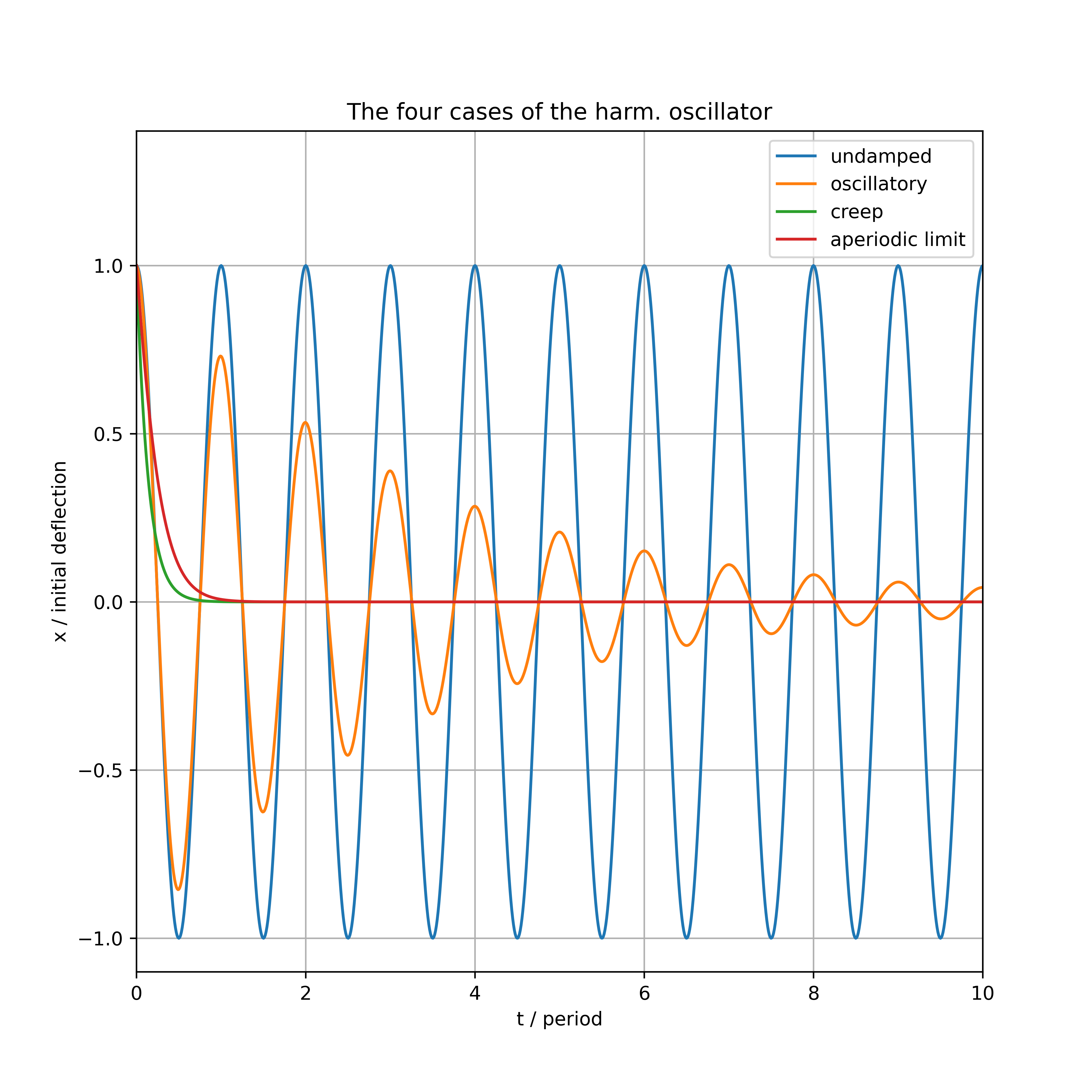
This case is called the aperiodic limiting case. The four cases of the harmonic oscillator are shown in Fig. 2.1.
2.4.3 Driven case
One now drives the system with the angular frequency $\omega$, thus modifying Eq. (2.91) to
\[ \begin{align} x'' + kx + 2dx' = y_0\exp\left(-i\omega t\right) \end{align} \]
with a real excitation amplitude $y_0 > 0$. Inserting the ansatz $x = x_0e^{-i\omega t}$ here again, one obtains
\[ \begin{align} -\omega^2x_0 + kx_0 - 2id\omega x_0 &= y_0\nonumber\\ \Leftrightarrow -\omega^2 + k - 2id\omega &= \frac{y_0}{x_0}\\ \Leftrightarrow \omega^2 - k + 2id\omega &= -\frac{y_0}{x_0}\\ \Leftrightarrow \omega^2 + 2id\omega + \left(\frac{y_0}{x_0} - k\right) &= 0.\tag{2.110}\label{eq_harm_osz_force_deriv_0} \end{align} \]
The amplitude is independent of time, therefore $\omega$ is real. For $x_0$, one now writes, in polar coordinates,
\[ \begin{align} x_0 = \left|x_0\right|\exp\left(i\phi\right), \end{align} \]
the real number $\phi$ is called the phase. If it is positive, the oscillator runs ahead of the excitation; if it is negative, the oscillator runs behind the excitation. Substituting this into Eq. (2.110), one obtains
\[ \begin{align} \omega^2 + 2id\omega + \left(\frac{y_0}{\left|x_0\right|}e^{-i\phi} - k\right) &= \omega^2 + 2id\omega + \left(\frac{y_0}{\left|x_0\right|}\cos\left(\phi\right) - \frac{y_0}{\left|x_0\right|}i\sin\left(\phi\right) - k\right) = 0.\tag{2.112}\label{eq_harm_osz_force_deriv_1} \end{align} \]
$\omega$ is not an unknown here, it is given by the excitation. The unknowns are the reaction of the system $\left|x_0\right|, \phi$. To determine these, one writes the real and imaginary parts of Eq. (2.112):
\[ \begin{align} \omega^2 + \left(\frac{y_0}{\left|x_0\right|}\cos\left(\phi\right) - k\right) &= 0,\tag{2.113}\label{eq_harm_osz_force_deriv_2}\\ 2d\omega - \frac{y_0}{\left|x_0\right|}\sin\left(\phi\right) &= 0 \Rightarrow 2d\omega = \frac{y_0}{\left|x_0\right|}\sin\left(\phi\right) \Rightarrow \left|x_0\right| = \frac{y_0}{2d\omega}\sin\left(\phi\right).\tag{2.114}\label{eq_harm_osz_force_deriv_3} \end{align} \]
If one substitutes Eq. (2.114) into Eq. (2.113), one obtains
\[ \begin{align} \omega^2 + \left(\frac{y_0}{\frac{y_0}{2d\omega}\sin\left(\phi\right)}\cos\left(\phi\right) - k\right) &= 0\nonumber\\ \Leftrightarrow\omega^2 + \left(\frac{2d\omega}{\tan\left(\phi\right)} - k\right) &= 0\nonumber\\ \Leftrightarrow\omega^2\tan\left(\phi\right) + 2d\omega - k\tan\left(\phi\right) &= 0\nonumber\\ \Leftrightarrow\tan\left(\phi\right)\left(k - \omega^2\right) &= 2d\omega\nonumber\\ \Leftrightarrow\tan\left(\phi\right) &= \frac{2d\omega}{k - \omega^2}. \end{align} \]
The function
is called the phase spectrum. Because $-\pi/2 < \phi < \pi/2$, one has
\[ \begin{align} \sin = \tan\cdot\cos = \tan\sqrt{1 - \sin^2} \Rightarrow \sin^2 = \tan^2 - \tan^2\sin^2 \Rightarrow \sin^2\left(1 + \tan^2\right) = \tan^2 \Rightarrow \sin = \frac{\tan}{\sqrt{1 + \tan^2}}. \end{align} \]
If one now substitutes Eq. (2.116) into Eq. (2.114), one obtains
\[ \begin{align} \left|x_0\right| = \frac{y_0}{2d\omega}\sin\left(\phi\right) = \frac{y_0}{2d\omega}\frac{\tan\left(\phi\right)}{\sqrt{1 + \tan\left(\phi\right)^2}} = \frac{y_0}{2d\omega}\frac{\frac{2d\omega}{k - \omega^2}}{\sqrt{1 + \frac{4d^2\omega^2}{\left(k - \omega^2\right)^2}}} = \frac{y_0}{\left(k - \omega^2\right)\sqrt{1 + \frac{4d^2\omega^2}{\left(k - \omega^2\right)^2}}}. \end{align} \]
From this it follows
\[ \begin{align} \left|x_0\right| = \frac{y_0}{\sqrt{\left(k - \omega^2\right)^2 + 4d^2\omega^2}}. \end{align} \]
This function is called the amplitude spectrum. One defines the auxiliary function $h$ by
\[ \begin{align} h\left(\omega\right) \coloneqq \left(k - \omega^2\right)^2 + 4d^2\omega^2 \Rightarrow h'\left(\omega\right) = -4\omega\left(k - \omega^2\right) + 8d^2\omega = -4\omega k + 4\omega^3 + 8d^2\omega. \end{align} \]
Setting the derivative to zero results in
\[ \begin{align} -4\omega k + 4\omega^3 + 8d^2\omega &\hastobe 0 \Rightarrow -4k + 4\omega^2 + 8d^2 = 0 \Rightarrow -k + \omega^2 + 2d^2 = 0\nonumber\\ \Rightarrow \omega^2 &= k - 2d^2. \end{align} \]
Here one restricts oneself to the case
\[ \begin{align} k - 2d^2 > 0 \Leftrightarrow d < \sqrt{\frac{k}{2}}. \end{align} \]
The frequency
is called the resonance frequency. For the second derivative of $h$ one obtains
\[ \begin{align} h''\left(\omega\right) = -4k + 12\omega^2 + 8d^2. \end{align} \]
From this it follows
\[ \begin{align} h''\left(\omega_\text{res}\right) = -4k + 12\left(k - 2d^2\right) + 8d^2 = -4k + 12k - 24d^2 + 8d^2 = 8k - 16d^2 = 8\left(k - 2d^2\right) > 0. \end{align} \]
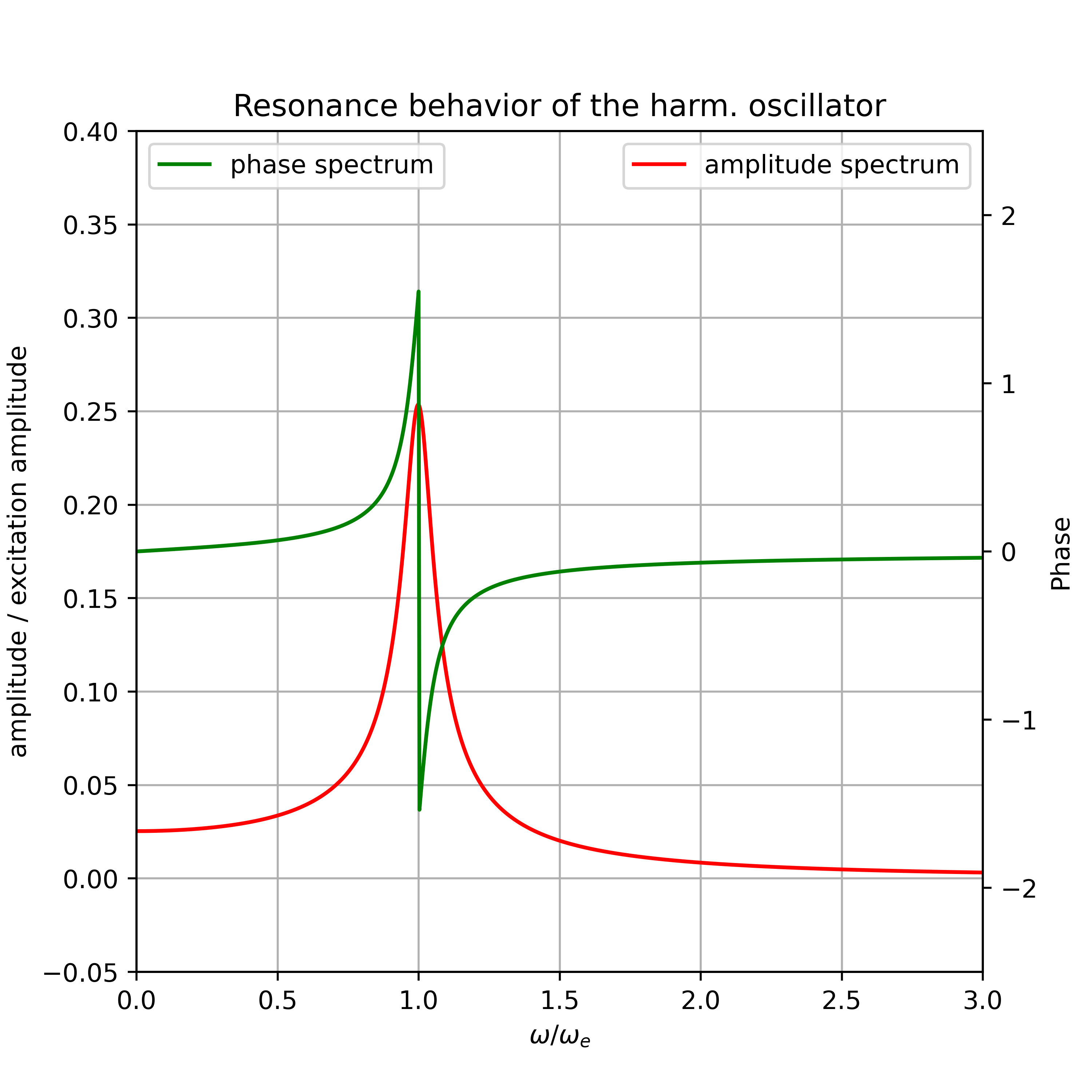
$\omega_\text{res}$ is therefore the frequency of maximum amplitude. Note the difference between the eigenfrequency, Eq. (2.97), and the resonance frequency, Eq. (2.123). The resonance behavior is shown in Fig. 2.2.
The system considered so far in this section has exactly one degree of freedom, namely the generalized deflection $x$. Conceptually, however, many of the findings can be generalized to systems with many degrees of freedom. Such complex systems (houses, circuits, the climate) also have eigenmodes.