15 Vorticity and divergence
Let an arbitrary vector field $\mathbf{v}$ be given. The ansatz
\[ \begin{align} \mathbf{v} = \Delta\mathbf{w} \end{align} \]
with the boundary conditions
\[ \begin{align} \lim\limits_{\left|\mathbf{r}\right|\to\infty}\mathbf{w} = \mathbf{0} \end{align} \]
with a vector field $\mathbf{v}$ is clearly solvable for continuous $\mathbf{v}$, namely there are three independent Poisson equations
\[ \begin{align} v_i = \Delta w_i. \end{align} \]
According to Eq. (B.54), one has
\[ \begin{align} \Delta\mathbf{w} = \nabla\left(\nabla\cdot\mathbf{w}\right) - \nabla\times\left(\nabla\times\mathbf{w}\right). \end{align} \]
One defines
\[ \begin{align} \chi \coloneqq\nabla\cdot\mathbf{w} \end{align} \]
as the velocity potential; one further defines
\[ \begin{align} \mathbf{A} \coloneqq -\nabla\times\mathbf{w} \end{align} \]
as the vector potential; then one has
\[ \begin{align} \mathbf{v} = \nabla\chi + \nabla\times\mathbf{A}. \end{align} \]
One thus has a unique decomposition
\[ \begin{align} \mathbf{v} = \mathbf{v}_\text{nonrot} + \mathbf{v}_\text{nondiv}, & {} & \nabla\times\mathbf{v}_\text{nonrot} = \mathbf{0}, & {} & \nabla\cdot\mathbf{v}_\text{nondiv} = 0 \end{align} \]
The fact that this is always possible is the fundamental theorem of vector analysis. $\chi$ and $\mathbf{A}$ have a total of four components, but the wind field only has three. Therefore one can impose another linear condition; here
\[ \begin{align} \nabla\cdot\mathbf{A} = 0 \end{align} \]
is chosen, from which it follows
\[ \begin{align} \nabla\times\mathbf{v} = \Delta\mathbf{A}. \end{align} \]
If one considers only the horizontal wind field
\[ \begin{align} \mathbf{v}_h \coloneqq\mathbf{v} - w\mathbf{k}, \end{align} \]
then of course this also holds. Instead of the condition $\nabla\cdot\mathbf{A}\hastobe0$, one places the algebraic condition on the vector potential
\[ \begin{align} \mathbf{A}\hastobe\left(\mathbf{k}\cdot {\mathbf{A}}\right)\mathbf{k} \end{align} \]
and defines a stream function $\psi = \psi\left(\varphi, \lambda\right) \coloneqq - \mathbf{k}\cdot \mathbf{A}$. Then one has
\[ \begin{align} \mathbf{v}_{h,{\text{nondiv}}} &= \nabla\times\left[-\mathbf{k}\psi\right]\stackrel{\href{ch-38-vector-analysis.html#eq:diff_op_rule_5}{\text{ Eq. (B.51)}}}{=} \mathbf{k}\times\nabla\psi.\tag{15.13}\label{eq:v_h_streamf} \end{align} \]
As a check, one computes
\[ \begin{align} \nabla\cdot\left(\mathbf{k}\times\nabla\psi\right)&\stackrel{\text{Eq. }\href{ch-38-vector-analysis.html#eq:diff_op_rule_9}{(B.55)}}{=} \nabla\psi\cdot\left(\nabla\times\mathbf{k}\right) - \mathbf{k}\cdot\left(\nabla\times\nabla\psi\right) = \mathbf{0}. \end{align} \]
One defines
\[ \begin{align} \zetabi \coloneqq \nabla\times\mathbf{v}. \end{align} \]
One has
\[ \begin{align} \zeta &\coloneqq \mathbf{k}\cdot\left(\nabla\times\mathbf{v}_h\right) = \mathbf{k}\cdot\left[\nabla\times\left(\mathbf{k}\times\nabla\psi\right)\right]\stackrel{\text{Eq. }\href{ch-38-vector-analysis.html#eq:diff_op_rule_7}{(B.53)}}{=}\Delta\psi. \end{align} \]
The divergence, one furthermore has
\[ \begin{align} \nabla\cdot\mathbf{v}_h = \Delta\chi. \end{align} \]
Note that $\zeta$ is not the magnitude of $\zetabi$, but its $z$-component.
15.1 Vorticity
The rotating base of the global coordinates is denoted by $\mathbf{e}_x, \mathbf{e}_y, \mathbf{e}_z$, so the velocity field is written as
\[ \begin{align} \mathbf{v} = u_x\mathbf{e}_x + u_y\mathbf{e}_y + u_z\mathbf{e}_z. \end{align} \]
If one writes
\[ \begin{align} \mathbf{U'} = \omegabi\times\mathbf{r} + \mathbf{v}, \end{align} \]
then $\mathbf{U'}$ is the field of particle velocities in coordinates at rest. It is composed of the contribution of the Earth's rotation $\omegabi\times\mathbf{r}$ and the wind field $\mathbf{v}$ measured relative to the rotating Earth. It thus follows
\[ \begin{align} \etabi \coloneqq\nabla\times\mathbf{v}' = \nabla\times\mathbf{v} + \nabla\times\left(\omegabi\times\mathbf{r}\right) = \zetabi + \mathbf{f}, \end{align} \]
where
\[ \begin{align} \nabla\times\left(\omegabi\times\mathbf{r}\right)\stackrel{\href{ch-38-vector-analysis.html#eq:diff_op_rule_7}{\text{Eq. (B.53)}}}{=}\omegabi\left(\nabla\cdot\mathbf{r}\right) - \left(\omegabi\cdot\nabla\right)\mathbf{r} = 3\omegabi - \left(\omega\frac{\partial}{\partial z}\right)\mathbf{r} = 3\omegabi - \omegabi = 2\omegabi = \mathbf{f} \end{align} \]
was used. The absolute vorticity $\eta$ is defined by the vertical component of the rotation of $\mathbf{v}'$. This is obtained as the scalar product of $\nabla\times\mathbf{v}'$ with the vertical unit vector $\mathbf{k}$:
\[ \begin{align} \eta \coloneqq\mathbf{k}\cdot\left(\nabla\times\mathbf{v}\right) + \mathbf{k}\cdot\mathbf{f} = \zeta + f \end{align} \]
Recall that the Coriolis parameter is the vertical component of the Coriolis vector, not its magnitude. The portion of the absolute vorticity that is caused by the Earth's rotation is also referred to as planetary vorticity, while the portion that is caused by the wind field measured in rotating coordinates is referred to as relative vorticity.
The vorticity also has a clear meaning that is not initially as obvious as that of the divergence. Two examples are considered here.
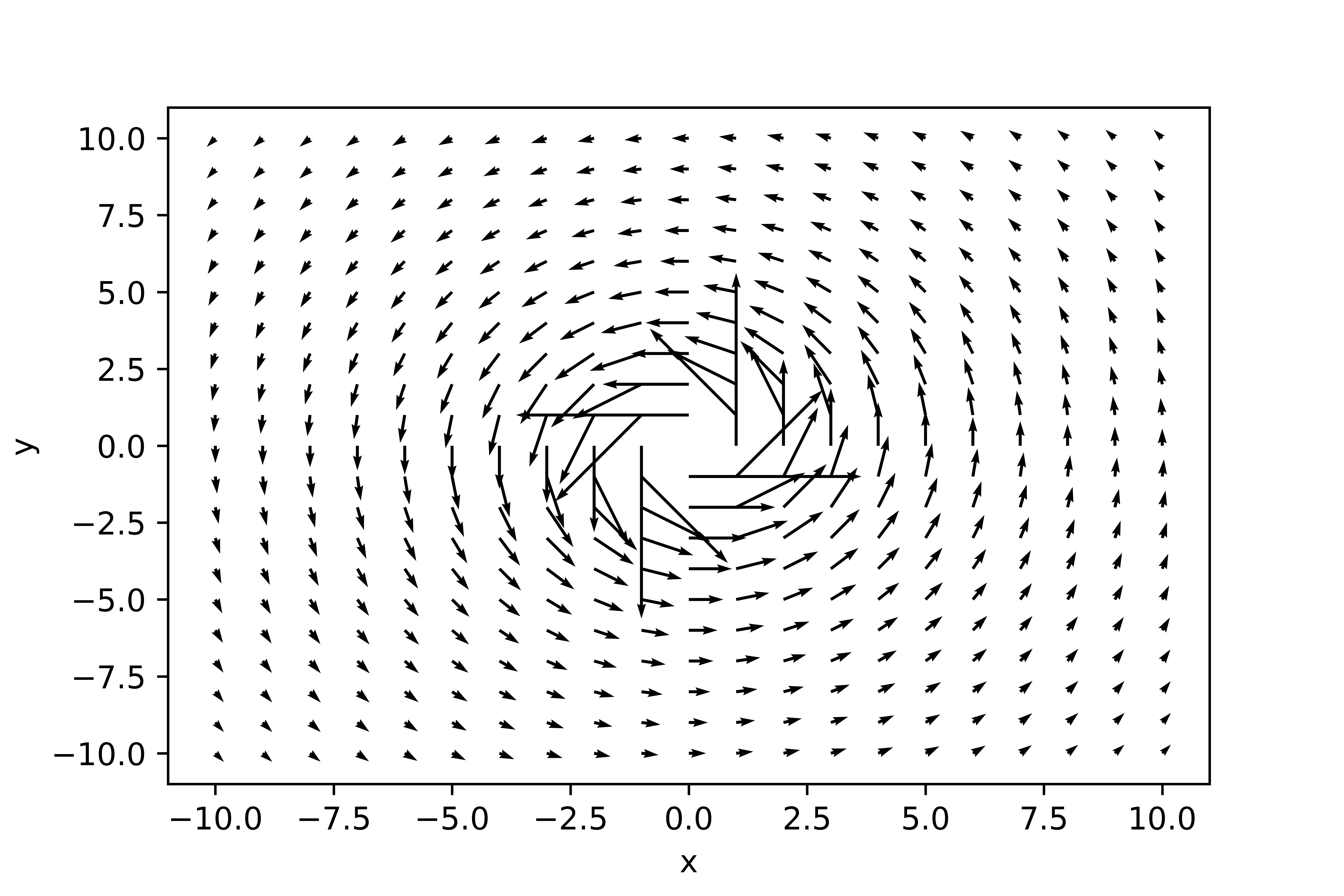
Take the field $\mathbf{v} = \left(y, 0, 0\right)^T$. The streamlines of this field are not curved. Nevertheless, $\nabla\times\mathbf{v} = \left(0, 0, - 1\right)^T\not = \mathbf{0}$.
Take the field $\mathbf{v} = \frac{1}{x^2 + y^2}\left(-y, x, 0\right)^T$. The field looks very much like a rotating field (see Fig. 15.1). Nevertheless,
\[ \begin{align} \nabla\times\mathbf{v} &= \left(\frac{\partial}{\partial x}\frac{x}{x^2 + y^2} + \frac{\partial}{\partial y}\frac{y}{x^2 + y^2} \right)\mathbf{e}_z\nonumber\\ &= \left(\frac{1}{x^2 + y^2} - x2x\frac{1}{\left(x^2 + y^2\right)^2} + \frac{1}{x^2 + y^2} - y2y\frac{1}{\left(x^2 + y^2\right)^2}\right)\mathbf{e}_z = \mathbf{0}. \end{align} \]
To understand the true meaning of vorticity, it is best to imagine a 2D vector field $\mathbf{v}_h = \left(u, v\right)^T$ (in Cartesian coordinates). Take a rectangle $\left[-a, a\right]\times\left[-b, b\right]$. Let $\mathbf{s}$ be a curve that encloses this set in the positive mathematical sense of rotation. Then approximately with $\left(u, v\right)$ as the vector at the origin
\[ \begin{align} \int_{\mathbf{s}}^{}\mathbf{v}_h\cdot d\mathbf{s} &\approx 2a\left(u - b\frac{\partial u}{\partial y}\right) + 2b\left(v + a\frac{\partial v}{\partial x}\right) - 2a\left(u + b\frac{\partial u}{\partial y}\right) - 2b\left(v - a\frac{\partial v}{\partial x}\right)\nonumber\\ &= -2ba\frac{\partial u}{\partial y} + 2ba\frac{\partial v}{\partial x} - 2ab\frac{\partial u}{\partial y} + 2ba\frac{\partial v}{\partial x} = -4ba\frac{\partial u}{\partial y} + 4ab\frac{\partial v}{\partial x} = 4ab\left(\frac{\partial v}{\partial x} - \frac{\partial u}{\partial y}\right). \end{align} \]
The area of the surface is $4ab$. If one considers the circulation of the vector field around a particle, i.e., forms
\[ \begin{align} \lim\limits_{a, b\to 0}\frac{\int_{\mathbf{s}}^{}{\mathbf{v}_h\cdot d\mathbf{s}}}{4ab} = \frac{\partial v}{\partial x} - \frac{\partial u}{\partial y}, \end{align} \]
the definition of the $z$-component of the vorticity results. The components of the rotation therefore indicate how a small area in a plane perpendicular to the respective component is flowed around. There is thus a connection between circulation and vorticity. In integral form, this is the statement of Stokes' theorem:
\[ \begin{align} \int_{A}^{}\nabla\times\mathbf{v}\cdot d\mathbf{f} = \int_{\partial A}^{}\mathbf{v}\cdot d\mathbf{s}.\tag{15.26}\label{eq:satz_von_stokes} \end{align} \]
Just like the above consideration, Stokes' theorem links the vectorial line integral along the boundary of a surface with the vorticity within the surface. A further illustration of vorticity is shown in the coming section.
15.1.1 Shear and curvature vorticity
Without loss of generality, define in plane geometry a right-handed orthonormal basis $\mathbf{s}, \mathbf{n}, \mathbf{k}$ in which $\mathbf{s}$ is parallel to the horizontal wind at the origin. Then one has
\[ \begin{align} \mathbf{v} = \left(\begin{array}{c} V\cos\left(\beta\right)\\ V\sin\left(\beta\right)\\ w \end{array}\right)\tag{15.27}\label{eq:wind_natuerlich} \end{align} \]
with the horizontal wind speed $V$ and the vertical wind $w$. Here $\beta$ is the horizontal wind direction relative to $\mathbf{s}$. For the vorticity, it thus follows
\[ \begin{align} \zeta &= \frac{\partial}{\partial s}V\sin\left(\beta\right) - \frac{\partial}{\partial n}V\cos\left(\beta\right) = \sin\left(\beta\right)\frac{\partial V}{\partial s} + V\frac{\partial\beta}{\partial s}\cos\left(\beta\right) - \cos\left(\beta\right)\frac{\partial V}{\partial n} + V\sin\left(\beta\right)\frac{\partial \beta}{\partial n}. \end{align} \]
At the coordinate origin $\beta = 0$, so there one has
\[ \begin{align} \zeta = V\frac{\partial\beta}{\partial s} - \frac{\partial V}{\partial n}. \end{align} \]
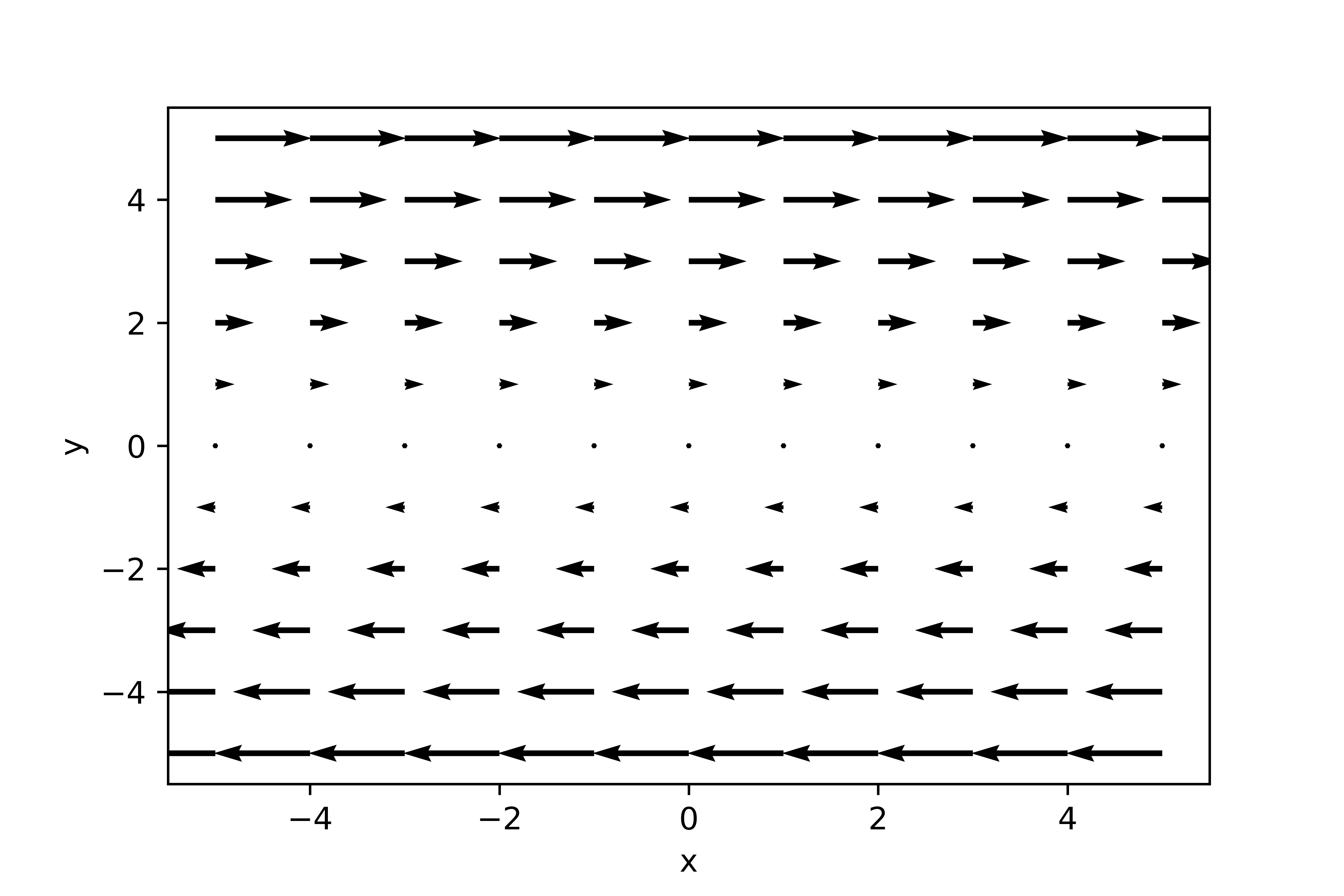
The first term $V\frac{\partial\beta}{\partial s}$ is called curvature vorticity. It is greater than zero if the streamline is curved to the left, equal to zero if the streamline is straight, and less than zero if the streamline is curved to the right. The term $-\frac{\partial V}{\partial n}$ is called shear vorticity. It is greater than zero if the wind speed increases to the right of the wind direction. In particular, one sees that a flow field with curved streamlines can be irrotational and one with straight streamlines rotational.
15.1.2 Circulation theorem
Let $A$ be an arbitrarily shaped surface in space, then the circulation $S$ of the wind field $\mathbf{v}$ around $A$ at time $t$ is defined by
\[ \begin{align} S\left(t\right) \coloneqq \int_{\partial A}\mathbf{v}\cdot d\mathbf{s} = \int_0^1\mathbf{v}\left(\mathbf{r}\left(\tau\right), t\right)\cdot\frac{d\mathbf{r}}{d\tau}d\tau, \end{align} \]
where $\mathbf{r}\left(\tau\right)$ is a function defined on the interval $\left[0, 1\right]$ that traverses the boundary of $A$. If the surface $A$ moves with the wind field, the circulation $S$ around $A$ also changes, i.e.,
\[ \begin{align} \md{S} = \md{}\int_0^1\mathbf{v}\left(\mathbf{r}\left(\tau\right), t\right)\cdot\frac{d\mathbf{r}}{d\tau}d\tau = \int_0^1\md{\mathbf{v}}\cdot\frac{d\mathbf{r}}{d\tau}d\tau + \int_0^1\mathbf{v}\cdot\md{}\left(\frac{d\mathbf{r}}{d\tau}\right)d\tau. \end{align} \]
In order to determine the second integral more closely, one establishes, as preparation,
\[ \begin{align} \frac{d\mathbf{r}}{d\tau} &= \lim_{\Delta \to 0}\frac{\mathbf{r}\left(\tau + \Delta\right) - \mathbf{r}\left(\tau\right)}{\Delta}\nonumber\\ \Rightarrow \md{}\frac{d\mathbf{r}}{d\tau} &= \lim_{\Delta \to 0}\frac{\md{\mathbf{r}}\left(\tau + \Delta\right) - \md{\mathbf{r}}\left(\tau\right)}{\Delta} = \lim_{\Delta \to 0}\frac{\mathbf{v}\left(\mathbf{r}\left(\tau + \Delta\right)\right) - \mathbf{v}\left(\mathbf{r}\left(\tau\right)\right)}{\Delta}\nonumber\\ &= \left(\frac{d\mathbf{r}}{d\tau}\cdot\nabla\right)\mathbf{v} \end{align} \]
Define $\mathbf{v}\left(\tau\right) \coloneqq \mathbf{v}\left(\mathbf{r}\left(\tau\right), t\right)$; then one has
\[ \begin{align} \left(\frac{d\mathbf{r}}{d\tau}\cdot\nabla\right)\mathbf{v} = \frac{d\mathbf{v}}{d\tau}, \end{align} \]
whereby one obtains
\[ \begin{align} \int_0^1\mathbf{v}\cdot\md{}\left(\frac{d\mathbf{r}}{d\tau}\right)d\tau = \int_0^1\mathbf{v}\cdot\frac{d\mathbf{v}}{d\tau}d\tau = \frac{1}{2}\left[\mathbf{v}^2\right]_0^1 = 0 \end{align} \]
since, owing to the closedness of the curve, $\mathbf{v}\left(0\right) = \mathbf{v}\left(1\right)$ holds. Using Stokes' theorem, it follows
\[ \begin{align} \md{S} = \int_A\nabla\times\mathbf{F}\cdot d\mathbf{n}, \end{align} \]
where $\mathbf{F}$ is the sum of all acting forces. Conservative forces thus do not change the circulation. With
\[ \begin{align} \nabla\times\left(-\frac{1}{\rho}\nabla p\right) & \stackrel{\href{ch-38-vector-analysis.html#eq:diff_op_rule_5}{\text{Eq. (B.51)}}}{=} \frac{1}{\rho^2}\nabla\rho\times\nabla p,\\ \nabla\times\mathbf{v}\times\mathbf{f} & \stackrel{\href{ch-38-vector-analysis.html#eq:diff_op_rule_7}{\text{Eq. (B.53)}}}{=} \left(\mathbf{f}\cdot\nabla\right)\mathbf{v} - \mathbf{f}\nabla\cdot\mathbf{v} \end{align} \]
it follows
In an IS, in barotropic ideal media, one thus has
\[ \begin{align} \md{S} = 0 \Leftrightarrow S = \text{const.}\tag{15.39}\label{eq:circ_theorem_mod_1} \end{align} \]
15.1.3 Vorticity equation
The momentum equation, Eq. (8.101), reads
\[ \begin{align} \frac{\partial\mathbf{v}}{\partial t} &= -\frac{1}{\rho}\nabla p + \mathbf{v}\times\etabi - \nabla k + \mathbf{g} + \mathbf{f}_R. \end{align} \]
Now one applies the operator $\nabla\times $ to the individual terms:
\[ \begin{align} \nabla\times\frac{\partial\mathbf{v}}{\partial t} &\stackrel{\href{ch-38-vector-analysis.html#eq:diff_op_rule_4}{\text{Eq. (B.50)}}}{=} \frac{\partial}{\partial t}\left(\nabla\times\mathbf{v}\right)\\ \nabla\times\left(-\frac{1}{\rho}\nabla p\right) &= -\nabla\times\left(\frac{1}{\rho}\nabla p\right) \stackrel{\href{ch-38-vector-analysis.html#eq:diff_op_rule_5}{\text{Eq. (B.51)}}}{=} -\frac{1}{\rho^2}\nabla p\times\nabla\rho\\ \nabla\times\left(\mathbf{v}\times\etabi\right) &\stackrel{\href{ch-38-vector-analysis.html#eq:diff_op_rule_7}{\text{Eq. (B.53)}}}{=} -\left(\mathbf{v}\cdot\nabla\right)\etabi - \etabi\nabla\cdot\mathbf{v} + \left(\etabi\cdot\nabla\right)\mathbf{v}\\ \nabla\times\nabla k &\stackrel{\href{ch-38-vector-analysis.html#eq:diff_op_rule_1}{\text{Eq. (B.47)}}}{=} \mathbf{0}\\ \nabla\times\mathbf{g} &= \nabla\times\left(-\nabla\Phi\right) \stackrel{\href{ch-38-vector-analysis.html#eq:diff_op_rule_1}{\text{Eq. (B.47)}}}{=} \mathbf{0} \end{align} \]
Thus one has
\[ \begin{align} \frac{\partial}{\partial t}\left(\nabla\times\mathbf{v}\right) &= \frac{1}{\rho^2}\nabla\rho\times\nabla p - \left(\mathbf{v}\cdot\nabla\right)\etabi - \etabi\nabla\cdot\mathbf{v} + \left(\etabi\cdot\nabla\right)\mathbf{v} + \nabla\times\mathbf{f}_R.\tag{15.46}\label{eq:vorticity_eq_3d} \end{align} \]
15.1.3.1 Formulation in geographical coordinates
By projecting onto the local perpendicular one obtains
\[ \begin{align} \frac{\partial\zeta}{\partial t} &= \mathbf{k}\cdot\left[\frac{1}{\rho^2}\nabla\rho\times\nabla p - \left(\mathbf{v}\cdot\nabla\right)\etabi - \etabi\nabla\cdot\mathbf{v} + \left(\etabi\cdot\nabla\right)\mathbf{v} + \nabla\times\mathbf{f}_R\right]\nonumber\\ \Leftrightarrow\frac{\partial\zeta}{\partial t} &= \mathbf{k}\cdot\left[\frac{1}{\rho^2}\nabla\rho\times\nabla p - \etabi\nabla\cdot\mathbf{v} - \left(\mathbf{v}\cdot\nabla\right)\etabi + \left(\etabi\cdot\nabla\right)\mathbf{v} + \nabla\times\mathbf{f}_R\right]\nonumber\\ \Leftrightarrow\frac{\partial\zeta}{\partial t} &= \mathbf{k}\cdot\left[\frac{1}{\rho^2}\nabla\rho\times\nabla p - \etabi\nabla\cdot\mathbf{v} + \left(\etabi\cdot\nabla\right)\mathbf{v} - \left(\mathbf{v}\cdot\nabla\right)\etabi + \nabla\times\mathbf{f}_R\right]\nonumber\\ \Rightarrow\frac{\partial\zeta}{\partial t} &= \frac{1}{\rho^2}\mathbf{k}\cdot\left(\nabla\rho\times\nabla p\right) - \eta\nabla\cdot\mathbf{v} + \mathbf{k}\cdot\left[\left(\etabi\cdot\nabla\right)\mathbf{v}\right] - \mathbf{k}\cdot\left[\left(\mathbf{v}\cdot\nabla\right)\etabi\right] + \mathbf{k}\cdot\nabla\times\mathbf{f}_R. \end{align} \]
One first calculates with Eq. (B.58)
\[ \begin{align} \left(\etabi\cdot\nabla\right)w = \left(\etabi\cdot\nabla\right)\left(\mathbf{v}\cdot\mathbf{k}\right) &= \mathbf{k}\cdot\left[\left(\etabi\cdot\nabla\right)\mathbf{v}\right] + \mathbf{v}\cdot\left[\left(\etabi\cdot\nabla\right)\mathbf{k}\right]\nonumber\\ \Rightarrow\mathbf{k}\cdot\left[\left(\etabi\cdot\nabla\right)\mathbf{v}\right] &= \left(\etabi\cdot\nabla\right)w - \mathbf{v}\cdot\left[\left(\etabi\cdot\nabla\right)\mathbf{k}\right],\\ \mathbf{v}\cdot\nabla\eta = \left(\mathbf{v}\cdot\nabla\right)\left(\etabi\cdot\mathbf{k}\right) &= \etabi\cdot\left[\left(\mathbf{v}\cdot\nabla\right)\mathbf{k}\right] + \mathbf{k}\cdot\left[\left(\mathbf{v}\cdot\nabla\right)\etabi\right]\nonumber\\ \Rightarrow\mathbf{k}\cdot\left[\left(\mathbf{v}\cdot\nabla\right)\etabi\right] &= \mathbf{v}\cdot\nabla\eta - \etabi\cdot\left[\left(\mathbf{v}\cdot\nabla\right)\mathbf{k}\right]. \end{align} \]
Thus one has
\[ \begin{align} \frac{\partial\zeta}{\partial t} &= \frac{1}{\rho ^2}\mathbf{k}\cdot\left(\nabla\rho\times\nabla p\right) - \eta\nabla\cdot\mathbf{v} + \left(\etabi\cdot\nabla\right)w - \mathbf{v}\cdot\left[\left(\etabi\cdot\nabla\right)\mathbf{k}\right] - \mathbf{v}\cdot\nabla\eta + \etabi\cdot\left[\left(\mathbf{v}\cdot\nabla\right)\mathbf{k}\right] + \mathbf{k}\cdot\nabla\times\mathbf{f}_R. \end{align} \]
With the findings in Sect. B.2.1, one has
\[ \begin{align} \frac{\partial\mathbf{k}}{\partial x} = \frac{\mathbf{i}}{r}, & {} & \frac{\partial\mathbf{k}}{\partial y} = \frac{\mathbf{j}}{r}, & {} & \frac{\partial\mathbf{k}}{\partial z} = \mathbf{0}. \end{align} \]
It thus follows
\[ \begin{align} \frac{\partial\zeta}{\partial t} &= \frac{1}{\rho ^2}\mathbf{k}\cdot\left(\nabla\rho\times\nabla p\right) - \eta\nabla\cdot\mathbf{v} + \etabi\cdot\nabla w - \mathbf{v}\cdot\left(\eta_x\frac{\partial\mathbf{k}}{\partial x} + \eta_y\frac{\partial\mathbf{k}}{\partial y}\right) - \mathbf{v}\cdot\nabla\eta + \etabi\cdot\left(u\frac{\partial\mathbf{k}}{\partial x} + v\frac{\partial\mathbf{k}}{\partial y}\right) + \mathbf{k}\cdot\nabla\times\mathbf{f}_R\nonumber\\ \Leftrightarrow\frac{\partial\zeta}{\partial t} &= \frac{1}{\rho ^2}\mathbf{k}\cdot\left(\nabla\rho\times\nabla p\right) - \eta\nabla\cdot\mathbf{v} + \etabi\cdot\nabla w \textcolor{blue}{- \frac{u\eta_x}{r}} \textcolor{red}{- \frac{v\eta_y}{r}} - \mathbf{v}\cdot\nabla\eta \textcolor{blue}{+ \frac{\eta_xu}{r}} \textcolor{red}{+ \frac{\eta_yv}{r}} + \mathbf{k}\cdot\nabla\times\mathbf{f}_R. \end{align} \]
The terms marked in color cancel each other out. Thus one has
\[ \begin{align} \frac{\partial\zeta}{\partial t} &= \frac{1}{\rho ^2}\mathbf{k}\cdot\left(\nabla\rho\times\nabla p\right) - \eta\nabla\cdot\mathbf{v} + \etabi\cdot\nabla w - \mathbf{v}\cdot\nabla\eta + \mathbf{k}\cdot\nabla\times\mathbf{f}_R. \end{align} \]
The vorticity equation finally reads
15.1.3.2 Interpretation of the terms
If one neglects friction, one obtains
\[ \begin{align} \frac{\partial\zeta}{\partial t} = -\mathbf{v}\cdot\nabla\eta - \eta\nabla\cdot\mathbf{v} + \etabi\cdot\nabla w + \frac{1}{\rho ^2}\mathbf{k}\cdot\left(\nabla\rho\times\nabla p\right). \end{align} \]
If one assumes a shallow geofluid and introduces a horizontal wind vector $\mathbf{v}_h$, it follows
\[ \begin{align} \frac{\partial\zeta}{\partial t} &= -\mathbf{v}\cdot\nabla\eta - \eta\nabla\cdot\mathbf{v}_h - \eta\frac{\partial w}{\partial z} + \etabi_h\cdot\nabla_hw + \eta\frac{\partial w}{\partial z} + \frac{1}{\rho ^2}\mathbf{k}\cdot\left(\nabla\rho\times\nabla p\right)\nonumber\\ &= \underbrace{-\mathbf{v}\cdot\nabla\eta - \eta\nabla\cdot\mathbf{v}_h + \etabi_h\cdot\nabla_hw}_\text{advection} + \underbrace{\frac{1}{\rho^2}\mathbf{k}\cdot\left(\nabla\rho\times\nabla p\right)}_\text{solenoid term}. \end{align} \]
The so-called solenoid term arises from the rotation of the pressure gradient acceleration. The rotation of $\nabla p$ is zero. A closed line integral over $-\nabla p\cdot d\mathbf{n}$ therefore disappears. However, due to the location dependence of the density, $\int_{\partial\Omega\subseteq\mathbb{R}^2}-\frac{1}{\rho}\nabla p\cdot d\mathbf{n} \not= 0$ can apply. A particle that moves on a closed path, for example a circular path, can be accelerated or decelerated by the pressure gradient, which changes the vorticity.
So apart from the solenoid term, vorticity is only generated by momentum advection. This can be broken down as follows:
\[ \begin{align} \frac{\partial\zeta}{\partial t}_\text{adv} &= \underbrace{-\mathbf{v}\cdot\nabla\eta}_\text{vorticity advection} \underbrace{- \eta\nabla\cdot\mathbf{v}_h}_\text{divergence term} \underbrace{+ \etabi_h\cdot\nabla_hw}_\text{rotation term} \end{align} \]
The rotation term describes the generation of vertical vorticity by horizontal vorticity and a horizontal gradient of the vertical velocity. One has
\[ \begin{align} \etabi_h\cdot\nabla_hw = \zeta_x\frac{\partial w}{\partial x} + \zeta_y\frac{\partial w}{\partial y}. \end{align} \]
Without loss of generality, the $y$-axis of the coordinate system is aligned with $\zetabi_h$, which leads to
\[ \begin{align} \etabi_h\cdot\nabla_hw = \zeta_y\frac{\partial w}{\partial y} \end{align} \]
Now assume a convective tube of amplitude $W$ and variance $\sigma^2$, i.e.,
\[ \begin{align} w = w\left(x, y\right) = W\exp\left(-\frac{x^2 + y^2}{2\sigma^2}\right). \end{align} \]
The coordinate system was again placed in the center of the tube. From this it follows
\[ \begin{align} \frac{\partial w}{\partial y} = -\frac{Wy}{\sigma^2}\exp\left(-\frac{x^2 + y^2}{2\sigma^2}\right). \end{align} \]
For the $y$-component of the relative vorticity, one has
\[ \begin{align} \zeta_y = \frac{\partial u}{\partial z} - \frac{\partial w}{\partial x}. \end{align} \]
From this it follows
\[ \begin{align} \etabi_h\cdot\nabla_hw &= \left(\frac{\partial u}{\partial z} - \frac{\partial w}{\partial x}\right)\frac{\partial w}{\partial y} = -\frac{Wy}{\sigma^2}\left[\frac{\partial u}{\partial z} + \frac{Wx}{\sigma^2}\exp\left(-\frac{x^2 + y^2}{2\sigma^2}\right)\right]\exp\left(-\frac{x^2 + y^2}{2\sigma^2}\right). \end{align} \]
If one inserts $x = 0$, $y = \pm\sigma$ and approximates all exponential terms by $1/2$, it follows
\[ \begin{align} \etabi_h\cdot\nabla_hw &= \mp\frac{W}{2\sigma}\frac{\partial u}{\partial z}. \end{align} \]
Most of the time $\frac{\partial u}{\partial z} > 0$. Thus, the rotation term produces cyclonic vorticity south of the convective tube and anticyclonic vorticity north of the tube. As a scale analysis, for the case of very strong convection with $\sigma \sim 50$ m, $W \sim 10 $m/s and $\frac{\partial u}{\partial z} \sim \frac{20\text{ m/s}}{2\text{ km}} = 1\cdot 10^{-2}$ 1/s, one obtains
\[ \begin{align} \etabi_h\cdot\nabla_hw \sim \frac{10}{100}10^{-2}\text{ 1/s}^2 = 10^{-3}\text{ 1/s}^2. \end{align} \]
This is seven orders of magnitude stronger than the synoptic-scale vorticity tendency. This mechanism is important for the formation of tornadoes. The rotation term is all the more effective,
the stronger the vertical shear of the horizontal wind is, and
the stronger the convection.
15.1.3.3 Barotropic vorticity equation
In the barotropic case, the solenoid term drops out; if one moreover neglects the vertical shear of the horizontal wind (see Sect. 13.8), it follows
This is the so-called barotropic vorticity equation. In the case of incompressibility, especially in the case of SWEs, $\nabla\cdot\mathbf{v} = 0$, from which it follows
\[ \begin{align} \frac{\partial\zeta}{\partial t} = -\mathbf{v}_h\cdot\nabla\eta + \etabi\cdot\nabla w\Rightarrow\frac{d\eta}{dt} = \etabi\cdot\nabla w. \end{align} \]
Neglecting the horizontal gradients of $w$, it follows
\[ \begin{align} \md{\eta} = \eta\frac{\partial w}{\partial z}.\tag{15.68}\label{eq:vorticit_z_baro_swes_pre} \end{align} \]
Substituting
\[ \begin{align} \nabla\cdot\mathbf{v} &= \nabla\cdot\mathbf{v}_h + \frac{\partial w}{\partial z} = 0 \end{align} \]
where a latitude-independent curvature term $\propto\frac{w}{r}$ was neglected, it follows
In the incompressible, horizontally divergence-free, barotropic case (in addition, the vertical shear of the horizontal wind was ignored), the absolute vorticity is a conserved quantity.
15.1.3.4 Vorticity equation in the p-system
Now the same thing should be done in the p-system. The momentum equations (13.132) - (13.133) in the p-system are vectorial
\[ \begin{align} \frac{\partial\mathbf{v}_h}{\partial t} &= -\nabla\phi - \frac{1}{2}\nabla\left(\mathbf{v}_h\cdot\mathbf{v}_h\right) + \mathbf{v}_h\times\etabi' - \omega\frac{\partial\mathbf{v}_h}{\partial p} + \nabla\times\mathbf{f}_R^{(H)}. \end{align} \]
Here, the modified absolute vorticity $\etabi'$ was defined by
\[ \begin{align} \etabi' \coloneqq f\mathbf{k} + \nabla\times\mathbf{v}_h \end{align} \]
Now one applies the operator $\nabla\times $ to the individual terms:
\[ \begin{align} \nabla\times\frac{\partial\mathbf{v}_h}{\partial t}&\stackrel{\href{ch-38-vector-analysis.html#eq:diff_op_rule_4}{\text{Eq. (B.50)}}}{=} \frac{\partial}{\partial t}\nabla\times\mathbf{v}_h\\ \nabla\times\nabla\phi&\stackrel{\href{ch-38-vector-analysis.html#eq:diff_op_rule_1}{\text{Eq. (B.47)}}}{=} \mathbf{0}\\ \nabla\times\mathbf{g}&\stackrel{\href{ch-38-vector-analysis.html#eq:diff_op_rule_1}{\text{Eq. (B.47)}}}{=} \mathbf{0}\\ \nabla\times\nabla\left(\mathbf{v}_h\cdot\mathbf{v}_h\right)&\stackrel{\href{ch-38-vector-analysis.html#eq:diff_op_rule_1}{\text{Eq. (B.47)}}}{=} \mathbf{0}\\ \nabla\times\left(\mathbf{v}_h\times\etabi'\right)&\stackrel{\href{ch-38-vector-analysis.html#eq:diff_op_rule_7}{\text{Eq. (B.53)}}}{=} -\left(\mathbf{v}_h\cdot\nabla\right)\etabi' - \etabi'\nabla\cdot\mathbf{v}_h + \left(\etabi'\cdot\nabla\right)\mathbf{v}_h\\ \nabla\times\left(\omega\frac{\partial\mathbf{v}_h}{\partial p}\right)&\stackrel{\href{ch-38-vector-analysis.html#eq:diff_op_rule_5}{\text{Eq. (B.51)}}}{=} \omega\nabla\times\frac{\partial\mathbf{v}_h}{\partial p} - \frac{\partial\mathbf{v}_h}{\partial p}\times\nabla\omega \end{align} \]
Thus one has
\[ \begin{align} \frac{\partial}{\partial t}\nabla\times\mathbf{v}_h &= -\left(\mathbf{v}_h\cdot\nabla\right)\etabi' - \etabi'\nabla\cdot\mathbf{v}_h + \left(\etabi'\cdot\nabla\right)\mathbf{v}_h + \omega\nabla\times\frac{\partial\mathbf{v}_h}{\partial p} - \frac{\partial\mathbf{v}_h}{\partial p}\times\nabla\omega + \nabla\times\mathbf{f}_R^{(H)}. \end{align} \]
15.1.3.5 Formulation in geographical coordinates
By projecting onto the local perpendicular $\mathbf{k}$ one obtains
\[ \begin{align} \frac{\partial\zeta}{\partial t} &= -\mathbf{k}\cdot\left[\left(\mathbf{v}_h\cdot\nabla\right)\etabi'\right] - \left(f + \zeta\right)\nabla\cdot\mathbf{v}_h + \mathbf{k}\cdot\left[\left(\etabi'\cdot\nabla\right)\mathbf{v}_h\right]\nonumber\\ & - \omega\frac{\partial\zeta}{\partial p} + \mathbf{k}\cdot\left[\frac{\partial\mathbf{v}_h}{\partial p}\times\nabla\omega\right] + \mathbf{k}\cdot\nabla\times\mathbf{f}_R^{(H)}. \end{align} \]
One first calculates with Eq. (B.58)
\[ \begin{align} 0 = \left(\etabi'\cdot\nabla\right)\left(\mathbf{v}_h\cdot\mathbf{k}\right) &= \mathbf{k}\cdot\left[\left(\etabi'\cdot\nabla\right)\mathbf{v}_h\right] + \mathbf{v}_h\cdot\left[\left(\etabi'\cdot\nabla\right)\mathbf{k}\right]\nonumber\\ \Rightarrow\mathbf{k}\cdot\left[\left(\etabi'\cdot\nabla\right)\mathbf{v}_h\right] &= -\mathbf{v}_h\cdot\left[\left(\etabi'\cdot\nabla\right)\mathbf{k}\right],\\ \mathbf{v}_h\cdot\nabla\eta = \left(\mathbf{v}_h\cdot\nabla\right)\left(\etabi'\cdot\mathbf{k}\right) &= \etabi'\cdot\left[\left(\mathbf{v}_h\cdot\nabla\right)\mathbf{k}\right] + \mathbf{k}\cdot\left[\left(\mathbf{v}_h\cdot\nabla\right)\etabi'\right]\nonumber\\ \Rightarrow\mathbf{k}\cdot\left[\left(\mathbf{v}_h\cdot\nabla\right)\etabi'\right] &= \mathbf{v}_h\cdot\nabla\eta - \etabi'\cdot\left[\left(\mathbf{v}_h\cdot\nabla\right)\mathbf{k}\right]. \end{align} \]
With the findings in Sect. B.2.1, one has
\[ \begin{align} \frac{\partial\mathbf{k}}{\partial x} = \frac{\mathbf{i}}{r}, & {} & \frac{\partial\mathbf{k}}{\partial y} = \frac{\mathbf{j}}{r}, & {} & \frac{\partial\mathbf{k}}{\partial z} = \mathbf{0}. \end{align} \]
It thus follows
\[ \begin{align} \mathbf{v}_h\cdot\left[\left(\etabi'\cdot\nabla\right)\mathbf{k}\right] &= \etabi'\cdot\left[\left(\mathbf{v}_h\cdot\nabla\right)\mathbf{k}\right]. \end{align} \]
The vorticity equation in the p-system thus reads
\[ \begin{align} \frac{\partial\zeta}{\partial t} &= -v\beta - \left(f + \zeta\right)\nabla\cdot\mathbf{v}_h - \mathbf{v}_h\cdot\nabla\zeta - \omega\frac{\partial\zeta}{\partial p} + \mathbf{k}\cdot\left[\frac{\partial\mathbf{v}_h}{\partial p}\times\nabla\omega\right] + \mathbf{k}\cdot\nabla\times\mathbf{f}_R^{(H)}.\tag{15.85}\label{eq:vorticity_p} \end{align} \]
Calculating the vorticity of the geostrophic wind field, one obtains
\[ \begin{align} \zeta_g = \frac{1}{f}\frac{\partial^2\phi}{\partial x^2} + \frac{1}{f}\frac{\partial^2\phi}{\partial y^2} - \frac{\beta}{f^2}\frac{\partial\phi}{\partial y} + \frac{\tan\left(\varphi\right)u}{r} = \frac{1}{f}\Delta_h\phi + \frac{\beta}{f}u + \frac{\tan\left(\varphi\right)u}{r}.\tag{15.86}\label{eq:geostro_vort_skal} \end{align} \]
For the first term, one has
\[ \begin{align} \mathcal{O}\left(\frac{1}{f}\Delta\phi\right) = \mathcal{O}\left(\frac{1}{f}\frac{\Delta p}{\rho L^2}\right) = 10^{-5}\:\frac{1}{\text{s}}. \end{align} \]
The term of the $\beta$-effect has an order of magnitude of $10^{-6}$ 1/s in mid-latitudes. Therefore, a common approximation in the extratropics is to approximate the vorticity by the geostrophic vorticity and to neglect the term of the $\beta$-effect.
15.1.3.6 Barotropic vorticity equation in the p-system
If one deletes in Eq. (15.85) the friction as well as all terms that contain vertical gradients, one obtains
\[ \begin{align} \frac{\partial\zeta}{\partial t} &= -v\beta - \left(f + \zeta\right)\nabla\cdot\mathbf{v}_h - \mathbf{v}_h\cdot\nabla\zeta. \end{align} \]
In the barotropic medium, $\partial w/\partial z \sim \partial\omega/\partial p$ is now constant in height. Under kinematic boundary conditions
\[ \begin{align} \omega\left(p = 0\right) = \omega\left(p_\text{surface}\right) = 0 \end{align} \]
it thus follows
\[ \begin{align} \frac{\partial\omega}{\partial p} = \frac{\omega\left(p_\text{surface}\right) - \omega\left(p = 0\right)}{p_\text{surface}} = 0. \end{align} \]
Owing to Eq. (13.129), one now also has
\[ \begin{align} \nabla\cdot\mathbf{v}_h = -\frac{\partial\omega}{\partial p} = 0.\tag{15.91}\label{eq:div_free_baro_vort} \end{align} \]
From this, one obtains the barotropic vorticity equation in the p-system
Other forms of this equation are:
\[ \begin{align} \frac{\partial\eta}{\partial t} &= -v\beta - \mathbf{v}_h\cdot\nabla\zeta,\\ \frac{D_h\zeta}{Dt} &= -v\beta,\\ \frac{D_h\eta}{Dt} &= 0. \end{align} \]
Owing to Eq. (15.91), $\mathbf{v}_h$ can be represented by a stream function $\psi = \psi\left(\phi, \lambda\right)$, i.e.,
\[ \begin{align} \mathbf{v}_h &\stackrel{\href{#eq:v_h_streamf}{\text{Eq. (15.13)}}}{=} \mathbf{k}\times\nabla\psi = -\frac{\partial\psi}{\partial y}\mathbf{i} + \frac{\partial\psi}{\partial x}\mathbf{j} = -\frac{\partial\psi}{a\partial\phi}\mathbf{i} + \frac{\partial\psi}{a\cos\left(\phi\right)\partial\lambda}\mathbf{j}\nonumber\\ \Rightarrow u &= -\frac{\partial\psi}{a\partial\phi},\\ v &= \frac{\partial\psi}{a\cos\left(\phi\right)\partial\lambda}. \end{align} \]
From this it follows
\[ \begin{align} \zeta = \Delta\psi. \end{align} \]
Substituting this into Eq. (15.92), one obtains
\[ \begin{align} \frac{\partial\zeta}{\partial t} &= -v\beta - u\frac{\partial\zeta}{a\cos\left(\phi\right)\partial\lambda} - v\frac{\partial\zeta}{a\partial\phi}\nonumber\\ \Leftrightarrow\Delta\frac{\partial\psi}{\partial t} &= -\frac{\partial\psi}{a\cos\left(\phi\right)\partial\lambda}\beta + \frac{\partial\psi}{a\partial\phi}\frac{\partial\zeta}{a\cos\left(\phi\right)\partial\lambda} - \frac{\partial\psi}{a\cos\left(\phi\right)\partial\lambda}\frac{\partial\zeta}{a\partial\phi}\nonumber\\ \Leftrightarrow\Delta\frac{\partial\psi}{\partial t} &= -\frac{\partial\psi}{a\cos\left(\phi\right)\partial\lambda}\beta + \frac{1}{a^2\cos\left(\phi\right)}\left(\frac{\partial\psi}{\partial\phi}\frac{\partial\zeta}{\partial\lambda} - \frac{\partial\psi}{\partial\lambda}\frac{\partial\zeta}{\partial\phi}\right)\nonumber\\ \Leftrightarrow\Delta\frac{\partial\psi}{\partial t} &= -\frac{\partial\psi}{a\cos\left(\phi\right)\partial\lambda}\beta + \frac{1}{a^2\cos\left(\phi\right)}\left(\frac{\partial\psi}{\partial\phi}\Delta\frac{\partial\psi}{\partial\lambda} - \frac{\partial\psi}{\partial\lambda}\Delta\frac{\partial\psi}{\partial\phi}\right). \end{align} \]
The operator
\[ \begin{align} J\left(\zeta, \psi\right) \coloneqq \frac{\partial\zeta}{\partial\lambda}\frac{\partial\psi}{\partial\phi} - \frac{\partial\zeta}{\partial\phi}\frac{\partial\psi}{\partial\lambda} \end{align} \]
is called the Jacobi operator. With it, the barotropic vorticity equation can be written in the form
\[ \begin{align} \Delta\frac{\partial\psi}{\partial t} &= -\frac{\partial\psi}{a\cos\left(\phi\right)\partial\lambda}\beta + \frac{1}{a^2\cos\left(\phi\right)}J\left(\Delta\psi, \psi\right)\tag{15.101}\label{eq:baro_vort_p_mod} \end{align} \]
This can be simplified further by formulating it as an equation for the absolute vorticity
\[ \begin{align} \eta = \zeta + f = \Delta\psi + f \end{align} \]
Then one obtains
\[ \begin{align} \frac{\partial\eta}{\partial t} &= \frac{1}{a^2\cos\left(\phi\right)}J\left(\eta, \psi\right). \end{align} \]
15.1.4 Helicity
One defines the helicity $Z$ by
\[ \begin{align} Z \coloneqq \mathbf{v}\cdot\zetabi.\tag{15.104}\label{eq:def_helicity} \end{align} \]
The momentum equation, Eq. (8.101), reads
\[ \begin{align} \frac{\partial\mathbf{v}}{\partial t} &= -\frac{1}{\rho}\nabla p + \mathbf{v}\times\mathbf{f} + \mathbf{v}\times\zetabi - \nabla k + \mathbf{g} + \mathbf{f}_R. \end{align} \]
Projecting this onto $\zetabi$ gives
\[ \begin{align} \zetabi\cdot\frac{\partial\mathbf{v}}{\partial t} &= -\frac{\zetabi}{\rho}\cdot\nabla p + \zetabi\cdot\left(\mathbf{v}\times\mathbf{f}\right) - \zetabi\cdot\nabla k + \zetabi\cdot\mathbf{g} + \zetabi\cdot\mathbf{f}_R. \end{align} \]
The three-dimensional vorticity equation, Eq. (15.46), reads
\[ \begin{align} \frac{\partial\zetabi}{\partial t} &= \frac{1}{\rho^2}\nabla\rho\times\nabla p - \left(\mathbf{v}\cdot\nabla\right)\zetabi - \mathbf{f}\nabla\cdot\mathbf{v} - \zetabi\nabla\cdot\mathbf{v} + \left(\mathbf{f}\cdot\nabla\right)\mathbf{v} + \left(\zetabi\cdot\nabla\right)\mathbf{v} + \nabla\times\mathbf{f}_R. \end{align} \]
Projecting this onto $\mathbf{v}$ gives
\[ \begin{align} \mathbf{v}\cdot\frac{\partial\zetabi}{\partial t} &= \frac{\mathbf{v}}{\rho^2}\cdot\left(\nabla\rho\times\nabla p\right) - \mathbf{v}\cdot\left[\left(\mathbf{v}\cdot\nabla\right)\zetabi\right] - \mathbf{v}\cdot\mathbf{f}\nabla\cdot\mathbf{v} - \mathbf{v}\cdot\zetabi\nabla\cdot\mathbf{v} + \mathbf{f}\cdot\nabla k + \zetabi\cdot\nabla k + \mathbf{v}\cdot\left(\nabla\times\mathbf{f}_R\right)\nonumber\\ \Leftrightarrow\mathbf{v}\cdot\frac{\partial\zetabi}{\partial t} &= \frac{\mathbf{v}}{\rho^2}\cdot\left(\nabla\rho\times\nabla p\right) - \left(\mathbf{v}\cdot\nabla\right)\left(\mathbf{v}\cdot\zetabi\right) + \zetabi\cdot\left[\left(\mathbf{v}\cdot\nabla\right)\mathbf{v}\right] - \mathbf{v}\cdot\mathbf{f}\nabla\cdot\mathbf{v} - \mathbf{v}\cdot\zetabi\nabla\cdot\mathbf{v} + \mathbf{f}\cdot\nabla k + \zetabi\cdot\nabla k + \mathbf{v}\cdot\left(\nabla\times\mathbf{f}_R\right)\nonumber\\ \Leftrightarrow\mathbf{v}\cdot\frac{\partial\zetabi}{\partial t} &= \frac{\mathbf{v}}{\rho^2}\cdot\left(\nabla\rho\times\nabla p\right) - \left(\mathbf{v}\cdot\nabla\right)\left(\mathbf{v}\cdot\zetabi\right) + \zetabi\cdot\nabla k - \mathbf{v}\cdot\mathbf{f}\nabla\cdot\mathbf{v} - \mathbf{v}\cdot\zetabi\nabla\cdot\mathbf{v} + \mathbf{f}\cdot\nabla k + \zetabi\cdot\nabla k + \mathbf{v}\cdot\left(\nabla\times\mathbf{f}_R\right)\nonumber\\ \Leftrightarrow\mathbf{v}\cdot\frac{\partial\zetabi}{\partial t} &= \frac{\mathbf{v}}{\rho^2}\cdot\left(\nabla\rho\times\nabla p\right) - \left(\mathbf{v}\cdot\nabla\right)Z + 2\zetabi\cdot\nabla k - \mathbf{v}\cdot\mathbf{f}\nabla\cdot\mathbf{v} - \mathbf{v}\cdot\zetabi\nabla\cdot\mathbf{v} + \mathbf{f}\cdot\nabla k + \mathbf{v}\cdot\left(\nabla\times\mathbf{f}_R\right). \end{align} \]
Thus one obtains
\[ \begin{align} \frac{\partial Z}{\partial t} &= \frac{\partial\mathbf{v}}{\partial t}\cdot\zetabi + \mathbf{v}\cdot\frac{\partial\zetabi}{\partial t}\nonumber\\ &= -\frac{\zetabi}{\rho}\cdot\nabla p + \zetabi\cdot\left(\mathbf{v}\times\mathbf{f}\right) - \zetabi\cdot\nabla k + \zetabi\cdot\mathbf{g} + \zetabi\cdot\mathbf{f}_R\nonumber\\ &+ \frac{\mathbf{v}}{\rho^2}\cdot\left(\nabla\rho\times\nabla p\right) - \left(\mathbf{v}\cdot\nabla\right)Z + 2\zetabi\cdot\nabla k - \mathbf{v}\cdot\mathbf{f}\nabla\cdot\mathbf{v} - \mathbf{v}\cdot\zetabi\nabla\cdot\mathbf{v} + \mathbf{f}\cdot\nabla k + \mathbf{v}\cdot\left(\nabla\times\mathbf{f}_R\right). \end{align} \]
The helicity equation therefore reads
\[ \begin{align} \frac{\partial Z}{\partial t} &= -\left(\mathbf{v}\cdot\nabla\right)Z - \frac{\zetabi}{\rho}\cdot\nabla p + \zetabi\cdot\left(\mathbf{v}\times\mathbf{f}\right) + \left(\mathbf{f} + \zetabi\right)\cdot\nabla k + \zetabi\cdot\mathbf{g} + \zetabi\cdot\mathbf{f}_R\nonumber\\ &+ \frac{\mathbf{v}}{\rho^2}\cdot\left(\nabla\rho\times\nabla p\right) - \mathbf{v}\cdot\left(\mathbf{f} + \zetabi\right)\nabla\cdot\mathbf{v} + \mathbf{v}\cdot\left(\nabla\times\mathbf{f}_R\right). \end{align} \]
15.1.5 Enstrophy
The square $\zetabi^2$ of the relative vorticity $\zetabi$ is called the local enstrophy. One has
\[ \begin{align} \frac{\partial\zetabi^2}{\partial t} = 2\zetabi\cdot\frac{\partial\zetabi}{\partial t} \end{align} \]
At this point, one restricts oneself to two-dimensional, incompressible flows. In this case, one has
\[ \begin{align} \frac{\partial\eta}{\partial t} + \mathbf{v}_h\cdot\nabla\eta \stackrel{\href{#eq:vorticit_z_baro_swes}{\text{Eq. (15.70)}}}{=} 0 \Rightarrow \frac{\partial\eta}{\partial t} + \mathbf{v}_h\cdot\nabla\eta + \eta\nabla\cdot\mathbf{v}_h = \frac{\partial\eta}{\partial t} + \nabla\cdot\left(\eta\mathbf{v}_h\right) = 0.\tag{15.112}\label{eq:enstropy_deriv_1} \end{align} \]
Under kinematic or periodic boundary conditions, one then has
\[ \begin{align} \newoverline{\eta} = \newoverline{\zeta} + \newoverline{f} = \text{const.} \Rightarrow \newoverline{\zeta} = \text{const.}\tag{15.113}\label{eq:enstropy_deriv_0} \end{align} \]
Multiplying Eq. (15.112) by $2\eta$, one obtains
\[ \begin{align} &\frac{\partial\eta^2}{\partial t} + \mathbf{v}_h\cdot\nabla\eta^2 + 2\eta^2\nabla\cdot\mathbf{v}_h = \frac{\partial\eta^2}{\partial t} + \mathbf{v}_h\cdot\nabla\eta^2 + \eta^2\nabla\cdot\mathbf{v}_h = 0\nonumber\\ &\Leftrightarrow\frac{\partial\eta^2}{\partial t} = -\nabla\cdot\left(\eta^2\mathbf{v}_h\right). \end{align} \]
Integrating this under kinematic or periodic boundary conditions, one obtains on the f-plane
\[ \begin{align} \newoverline{\eta^2} = \newoverline{\zeta^2} + \newoverline{f_0^2} + 2\newoverline{f_0\zeta} = \newoverline{\zeta^2} + f_0^2 + 2f_0\newoverline{\zeta} = \text{const.} \end{align} \]
With Eq. (15.113), this further implies
\[ \begin{align} \newoverline{\zeta^2} = \text{const.} \end{align} \]
The quantity $\newoverline{\zeta^2}$ is called the enstrophy.
15.2 Divergence
The divergence of the horizontal wind is denoted by
\[ \begin{align} \delta \coloneqq \nabla\cdot\mathbf{v}_h.\tag{15.117}\label{eq:divergenz_horiz_def} \end{align} \]
According to Eq. (B.112), one has
\[ \begin{align} \delta = \frac{\partial u}{\partial x} + \frac{\partial v}{\partial y} - v\frac{\tan\left(\varphi\right)}{a + z}. \end{align} \]
The divergence of the total wind field is denoted by
\[ \begin{align} D \coloneqq \nabla\cdot\mathbf{v} \end{align} \]
With Eq. (B.112), one can write
\[ \begin{align} D = \frac{\partial u}{\partial x} + \frac{\partial v}{\partial y} + \frac{\partial w}{\partial z} - v\frac{\tan\left(\varphi\right)}{a + z} + \frac{2w}{a + z} \end{align} \]
In the case of irrotational, non-viscous, incompressible flows, one has with Eq. (8.101) for a stream function $\chi$ in the IS
\[ \begin{align} \nabla\left(\frac{\partial\chi}{\partial t} + k + \phi + \frac{p}{\rho}\right) &= \mathbf{0},\\ \Leftrightarrow \frac{\partial\chi}{\partial t} + \frac{1}{2}\mathbf{v}^2 + gz + \frac{p}{\rho} &= \text{homogen}\tag{15.122}\label{eq:bernoulli_t_dependant}, \end{align} \]
which is called the time-dependent Bernoulli equation.
15.2.1 Velocity and directional divergence
Analogous to vorticity, the horizontal divergence can also be split into two illustrative parts. One again uses the coordinate system from Sect. 15.1.1. This time, one differentiates the first component of Eq. (15.27) with respect to $s$ and the second with respect to $n$:
\[ \begin{align} \delta &= \frac{\partial}{\partial s}\left(V\cos\left(\beta\right)\right) + \frac{\partial}{\partial n}\left(V\sin\left(\beta\right)\right)\nonumber\\ &= \cos\left(\beta\right)\frac{\partial V}{\partial s} - V\sin\left(\beta\right)\frac{\partial\beta}{\partial s} + \sin\left(\beta\right)\frac{\partial V}{\partial n} + V\cos\left(\beta\right)\frac{\partial\beta}{\partial n} \end{align} \]
If one considers the coordinate origin, it follows with $\beta = 0$
\[ \begin{align} \delta = \frac{\partial V}{\partial s} + V\frac{\partial\beta}{\partial n}. \end{align} \]
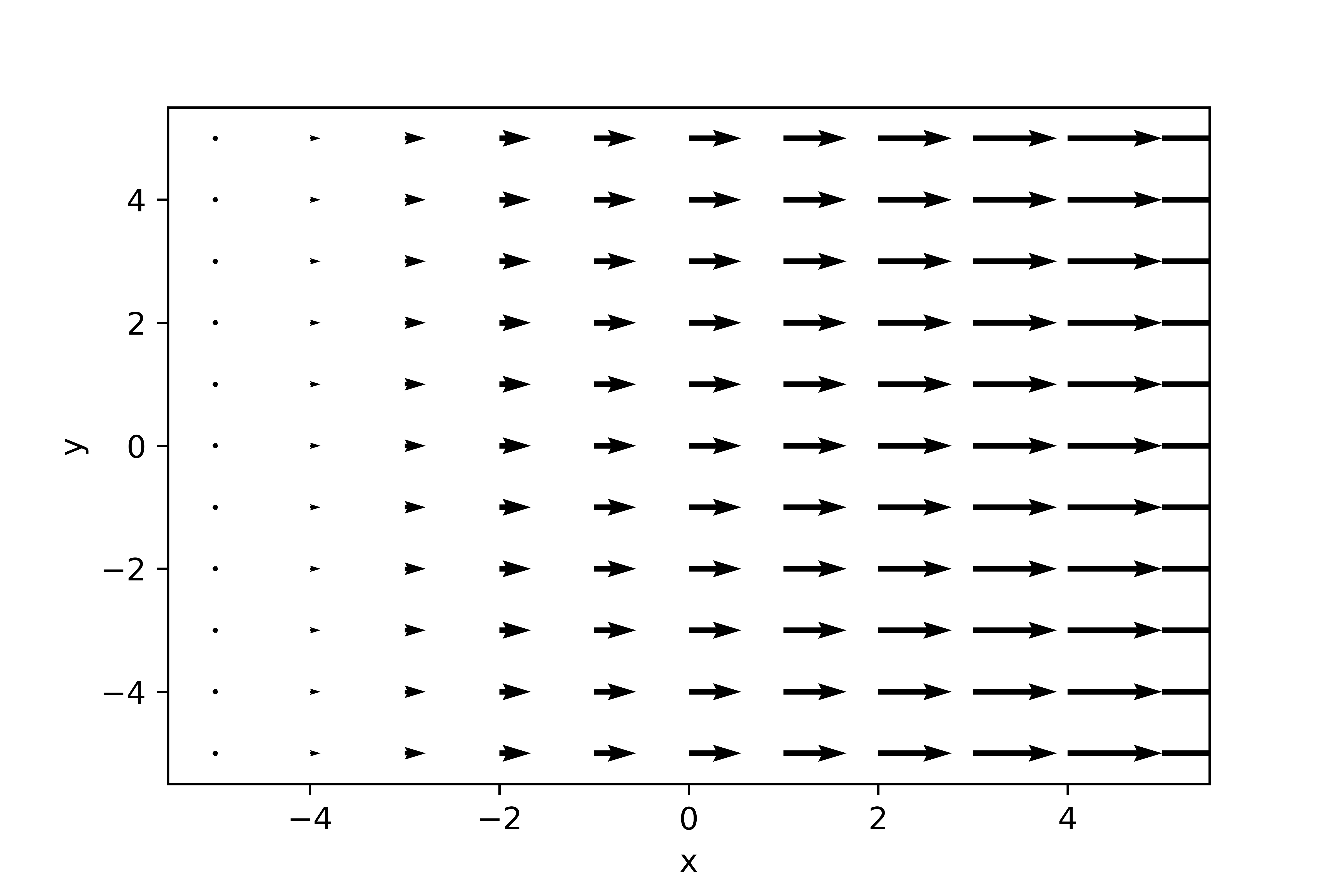
The first term describes a divergence due to velocity differences in the direction of flow; this is called velocity divergence. The second term denotes a directional fanning-out perpendicular to the direction of flow; this is directional divergence.
15.2.2 Divergence equation
There is also a prognostic equation for divergence, the so-called divergence equation. The momentum equation, Eq. (8.101), reads
\[ \begin{align} \frac{\partial\mathbf{v}}{\partial t} &= -\frac{1}{\rho}\nabla p + \mathbf{v}\times\mathbf{f} - \left(\mathbf{v}\cdot\nabla\right)\mathbf{v} + \mathbf{g} + \mathbf{f}_R. \end{align} \]
Applying the operator $\nabla\cdot $ to the individual terms gives:
\[ \begin{align} \nabla\cdot\frac{\partial\mathbf{v}}{\partial t} & \stackrel{\href{ch-38-vector-analysis.html#eq:diff_op_rule_4}{\text{Eq. (B.50)}}}{=} \frac{\partial D}{\partial t}\\ \nabla\cdot\left(-\frac{1}{\rho}\nabla p\right) & \stackrel{\href{ch-38-vector-analysis.html#eq:diff_op_rule_3}{\text{Eq. (B.49)}}}{=} \frac{1}{\rho^2}\nabla\rho\cdot\nabla p -\frac{1}{\rho}\Delta p\\ \nabla\cdot\left(\mathbf{v}\times\mathbf{f}\right) & \stackrel{\href{ch-38-vector-analysis.html#eq:diff_op_rule_9}{\text{Eq. (B.55)}}}{=} \mathbf{f}\cdot\zetabi \end{align} \]
By the Poisson equation, the divergence of $\mathbf{g}$ consists only of the centrifugal contribution. In meteorology, however, analytical derivations usually assume a radially symmetric gravity field, so this contribution is neglected as well. Hence,
This is the divergence equation. Using the Lamb transformation, one obtains
\[ \begin{align} \nabla\cdot\left[\left(\mathbf{v}\cdot\nabla\right)\mathbf{v}\right] &= \Delta k - \nabla\cdot\left[\mathbf{v}\times\left(\nabla\times\mathbf{v}\right)\right] \stackrel{\href{ch-38-vector-analysis.html#eq:diff_op_rule_9}{\text{Eq. (B.55)}}}{=} \Delta k - \zetabi^2 + \mathbf{v}\cdot\left(\nabla\times\zetabi\right)\nonumber\\ &\stackrel{\href{ch-38-vector-analysis.html#eq:diff_op_rule_8}{\text{Eq. (B.54)}}}{=} \Delta k - \zetabi^2 - \mathbf{v}\cdot\left(\Delta\mathbf{v}\right) + \mathbf{v}\cdot\nabla D. \end{align} \]
This yields another form of the divergence equation:
\[ \begin{align} \frac{\partial D}{\partial t} &= \frac{1}{\rho^2}\nabla\rho\cdot\nabla p -\frac{1}{\rho}\Delta p + \mathbf{f}\cdot\zetabi - \Delta k + \zetabi^2\nonumber\\ & +\mathbf{v}\cdot\left(\Delta\mathbf{v}\right) - \mathbf{v}\cdot\nabla D + \nabla\cdot\mathbf{f}_R\tag{15.131}\label{eq:divergence_equation_2} \end{align} \]
15.2.2.1 Divergence equation in the p-system
In vector form, the momentum equations (13.132) - (13.133) in the p-system are
\[ \begin{align} \frac{\partial\mathbf{v}_h}{\partial t} &= -\nabla\Phi - f\mathbf{k}\times\mathbf{v}_h - \left(\mathbf{v}_h\cdot\nabla\right)\mathbf{v}_h - \omega\frac{\partial\mathbf{v}_h}{\partial p} + \nabla\cdot\mathbf{f}_R^{(H)}. \end{align} \]
For the derivation, it is useful to add a $\mathbf{g}$ here and to interpret $-\nabla\Phi$ as a three-dimensional vector with $-g$ in the $z$-component. Thus, applying $\nabla\cdot $ to $-\nabla\Phi + \mathbf{g}$ yields $-\Delta_h\Phi$, for which, however, one simply writes $\Delta\Phi$ in the further derivation. Applying the operator $\nabla\cdot $ term by term gives
\[ \begin{align} \nabla\cdot\frac{\partial\mathbf{v}_h}{\partial t}&\stackrel{\href{ch-38-vector-analysis.html#eq:diff_op_rule_4}{\text{Eq. (B.50)}}}{=} \frac{\partial\delta}{\partial t}, \nonumber\\ - \nabla\cdot\nabla\Phi &= -\Delta\Phi, \nonumber\\ - \nabla\cdot\left(f\mathbf{k}\times\mathbf{v}_h\right)&\stackrel{\href{ch-38-vector-analysis.html#eq:diff_op_rule_9}{\text{Eq. (B.55)}}}{=} -\mathbf{v}_h\cdot\left[\nabla\times\left(f\mathbf{k}\right)\right] + f\mathbf{k}\cdot\left(\nabla\times\mathbf{v}_h\right)\stackrel{\href{ch-38-vector-analysis.html#eq:diff_op_rule_5}{\text{Eq. (B.51)}}}{=} - \mathbf{v}_h\cdot\left[-\mathbf{k}\times\nabla f + f\nabla\times\mathbf{k}\right] + f\zeta\nonumber\\ &= \mathbf{v}_h\cdot\left(\mathbf{k}\times\beta\mathbf{j}\right) + f\zeta = -u\beta + f\zeta, \nonumber\\ \nabla\cdot\left(-\omega\frac{\partial\mathbf{v}_h}{\partial p}\right)&\stackrel{\href{ch-38-vector-analysis.html#eq:diff_op_rule_3}{\text{Eq. (B.49)}}}{=} -\omega\frac{\partial\delta}{\partial p} - \frac{\partial\mathbf{v}_h}{\partial p}\cdot\nabla\omega. \end{align} \]
It thus follows
\[ \begin{align} \frac{\partial\delta}{\partial t} &= -\Delta\Phi - u\beta + f\zeta - \nabla\cdot\left[\left(\mathbf{v}_h\cdot\nabla\right)\mathbf{v}_h\right] - \omega\frac{\partial\delta}{\partial p} - \frac{\partial\mathbf{v}_h}{\partial p}\cdot\nabla\omega + \nabla\cdot\mathbf{f}_R^{(H)}.\tag{15.134}\label{eq:divergence_equation_p_1} \end{align} \]
This is the divergence equation in the p-system. Using the Lamb transformation, one obtains
\[ \begin{align} \nabla\cdot\left[\left(\mathbf{v}_h\cdot\nabla\right)\mathbf{v}_h\right] &= \Delta k - \nabla\cdot\left[\mathbf{v}_h\times\left(\nabla\times\mathbf{v}_h\right)\right] \stackrel{\href{ch-38-vector-analysis.html#eq:diff_op_rule_9}{\text{Eq. (B.55)}}}{=} \Delta k - \left(\nabla\times\mathbf{v}_h\right)^2 + \mathbf{v}_h\cdot\left(\nabla\times\left(\nabla\times\mathbf{v}_h\right)\right)\nonumber\\ &\stackrel{\href{ch-38-vector-analysis.html#eq:diff_op_rule_8}{\text{Eq. (B.54)}}}{=} \Delta k - \left(\nabla\times\mathbf{v}_h\right)^2 - \mathbf{v}_h\cdot\left(\Delta\mathbf{v}_h\right) + \mathbf{v}_h\cdot\nabla\delta. \end{align} \]
This yields another form of the divergence equation:
\[ \begin{align} \frac{\partial\delta}{\partial t} &= -\Delta\Phi - u\beta + f\zeta - \Delta k + \left(\nabla\times\mathbf{v}_h\right)^2 + \mathbf{v}_h\cdot\left(\Delta\mathbf{v}_h\right) - \mathbf{v}_h\cdot\nabla\delta\nonumber\\ & - \omega\frac{\partial\delta}{\partial p} - \frac{\partial\mathbf{v}_h}{\partial p}\cdot\nabla\omega + \nabla\cdot\mathbf{f}_R^{(H)}\tag{15.136}\label{eq:divergence_equation_p_2} \end{align} \]
15.2.2.2 Balance equation
Setting $\delta = \omega = 0$ here yields the balance equation
Neglecting the non-linear terms, one obtains the linear balance equation
\[ \begin{align} \Delta\Phi = -u\beta + f\zeta.\tag{15.138}\label{eq:balance_equation_linear} \end{align} \]
Using a stream function $\psi$, it follows
\[ \begin{align} \Delta\Phi = \beta\frac{\partial\psi}{\partial y} + f\Delta\psi.\tag{15.139}\label{eq:balance_equation_linear_stream} \end{align} \]
15.3 Potential vorticity
15.3.1 Ertel's vortex theorem
One defines a preliminary form of the potential vorticity $P_\psi$ by
\[ \begin{align} P_\psi \coloneqq \alpha\etabi\cdot\nabla\psi, \tag{15.140}\label{eq:def_pot_vorticity_gen} \end{align} \]
where $\alpha$ is the specific volume and $\psi$ an arbitrary function of space and time. Differentiating this partially with respect to time, one obtains
\[ \begin{align} \frac{\partial P_\psi}{\partial t} = \frac{\partial\alpha}{\partial t}\etabi\cdot\nabla\psi + \alpha\frac{\partial\left(\nabla\times\mathbf{v}\right)}{\partial t}\cdot\nabla\psi + \alpha\etabi\cdot\nabla\frac{\partial\psi}{\partial t}. \end{align} \]
First, Eq. (15.46) is written in terms of $\alpha$
\[ \begin{align} \frac{\partial}{\partial t}\text{rot}\left(\mathbf{v}\right) &= \nabla p\times\nabla \alpha - \left(\mathbf{v}\cdot\nabla\right)\etabi - \etabi\nabla\cdot\mathbf{v} + \left(\etabi\cdot\nabla\right)\mathbf{v} + \nabla\times\mathbf{f}_R \end{align} \]
In Sect. 15.1, an equation for $\frac{\partial\zeta}{\partial t}$ was derived by projecting this equation onto the local perpendicular $\mathbf{k}$; the same procedure is used here with a projection onto $\nabla\psi$. One first calculates with Eq. (B.58)
\[ \begin{align} \left(\etabi\cdot\nabla\right)\left(\mathbf{v}\cdot\nabla\psi\right) &= \nabla\psi\cdot\left[\left(\etabi\cdot\nabla\right)\mathbf{v}\right] + \mathbf{v}\cdot\left[\left(\etabi\cdot\nabla\right)\nabla\psi\right]\nonumber\\ \Rightarrow\nabla\psi\cdot\left[\left(\etabi\cdot\nabla\right)\mathbf{v}\right] &= \left(\etabi\cdot\nabla\right)\left(\mathbf{v}\cdot\nabla\psi\right) - \mathbf{v}\cdot\left[\left(\etabi\cdot\nabla\right)\nabla\psi\right],\\ \left(\mathbf{v}\cdot\nabla\right)\left(\etabi\cdot\nabla\psi\right) &= \etabi\cdot\left[\left(\mathbf{v}\cdot\nabla\right)\nabla\psi\right] + \nabla\psi\cdot\left[\left(\mathbf{v}\cdot\nabla\right)\etabi\right]\nonumber\\ \Rightarrow\nabla\psi\cdot\left[\left(\mathbf{v}\cdot\nabla\right)\etabi\right] &= \left(\mathbf{v}\cdot\nabla\right)\left(\etabi\cdot\nabla\psi\right) - \etabi\cdot\left[\left(\mathbf{v}\cdot\nabla\right)\nabla\psi\right]. \end{align} \]
One thus obtains
\[ \begin{align} \alpha\frac{\partial\left(\nabla\times\mathbf{v}\right)}{\partial t}\cdot\nabla\psi &= \alpha\left(\nabla p\times\nabla\alpha\right)\cdot\nabla\psi - \alpha\left(\mathbf{v}\cdot\nabla\right)\left(\etabi\cdot\nabla\psi\right) + \alpha\etabi\cdot\left[\left(\mathbf{v}\cdot\nabla\right)\nabla\psi\right]\nonumber\\ & -\alpha\left(\nabla\psi\cdot\etabi\right)\nabla\cdot\mathbf{v} + \alpha\left(\etabi\cdot\nabla\right)\left(\mathbf{v}\cdot\nabla\psi\right) - \alpha\mathbf{v}\cdot\left[\left(\etabi\cdot\nabla\right)\nabla\psi\right] + \alpha\mathbf{f}_R\cdot\nabla\psi. \end{align} \]
It follows
\[ \begin{align} \frac{\partial P_\psi}{\partial t} &= \alpha\etabi\cdot\nabla\left(\frac{\partial\psi}{\partial t}\right) + \alpha\left(\nabla p\times\nabla\alpha\right)\cdot\nabla\psi - \alpha\left(\mathbf{v}\cdot\nabla\right)\left(\etabi\cdot\nabla\psi\right) + \alpha\etabi\cdot\left[\left(\mathbf{v}\cdot\nabla\right)\nabla\psi\right]\nonumber\\ & -\alpha\left(\nabla\psi\cdot\etabi\right)\nabla\cdot\mathbf{v} + \alpha\left(\etabi\cdot\nabla\right)\left(\mathbf{v}\cdot\nabla\psi\right) - \alpha\mathbf{v}\cdot\left[\left(\etabi\cdot\nabla\right)\nabla\psi\right]\nonumber\\ & +\frac{\partial\alpha}{\partial t}\etabi\cdot\nabla\psi + \alpha\mathbf{f}_R\cdot\nabla\psi\nonumber\\ &= \alpha\etabi\cdot\nabla\left(\frac{\partial\psi}{\partial t}\right) + \alpha\left(\nabla p\times\nabla\alpha\right)\cdot\nabla\psi - \alpha\left(\mathbf{v}\cdot\nabla\right)\left(\etabi\cdot\nabla\psi\right) + \alpha\etabi\cdot\left[\left(\mathbf{v}\cdot\nabla\right)\nabla\psi\right]\nonumber\\ & +\alpha\left(\etabi\cdot\nabla\right)\left(\mathbf{v}\cdot\nabla\psi\right) - \alpha\mathbf{v}\cdot\left[\left(\etabi\cdot\nabla\right)\nabla\psi\right] - \left(\mathbf{v}\cdot\nabla\alpha\right)\left(\etabi\cdot\nabla\psi\right) + \alpha\mathbf{f}_R\cdot\nabla\psi. \end{align} \]
With Eq. (B.56), it follows
\[ \begin{align} \etabi\cdot\left[\left(\mathbf{v}\cdot\nabla\right)\nabla\psi\right] - \mathbf{v}\cdot\left[\left(\etabi\cdot\nabla\right)\nabla\psi\right] = 0. \end{align} \]
The Ertel vortex theorem therefore reads
\[ \begin{align} \frac{\partial P_\psi}{\partial t} &= \alpha\etabi\cdot\nabla\left(\frac{\partial\psi}{\partial t}\right) + \alpha\left(\nabla p\times\nabla\alpha\right)\cdot\nabla\psi - \alpha\left(\mathbf{v}\cdot\nabla\right)\left(\etabi\cdot\nabla\psi\right)\nonumber\\ & +\alpha\left(\etabi\cdot\nabla\right)\left(\mathbf{v}\cdot\nabla\psi\right) - \left(\mathbf{v}\cdot\nabla\alpha\right)\left(\etabi\cdot\nabla\psi\right) + \alpha\mathbf{f}_R\cdot\nabla\psi.\tag{15.148}\label{eq:ertel_vorticity_theorem} \end{align} \]
Using the material derivative, this can be reformulated as
15.3.2 Definition and properties of PV
The potential vorticity $P$ is defined by
\[ \begin{align} P \coloneqq\alpha\etabi\cdot\nabla\theta, \end{align} \]
It is thus obtained by substituting the potential temperature $\theta$ for $\psi$ in Eq. (15.140). Since this is a function of pressure and specific volume, the term with the vector product in Eq. (15.148) vanishes. For adiabatic processes, one thus has:
\[ \begin{align} \frac{\partial P}{\partial t} &= -\alpha\left(\mathbf{v}\cdot\nabla\right)\left(\etabi\cdot\nabla\psi\right) - \left(\etabi\cdot\nabla\psi\right)\left(\mathbf{v}\cdot\nabla\alpha\right) + \alpha\mathbf{f}_R\cdot\nabla\theta \end{align} \]
\[ \begin{align} \Leftrightarrow\frac{\partial P}{\partial t} &= -\left(\mathbf{v}\cdot\nabla\right)\left(\alpha\etabi\cdot\nabla\psi\right) + \alpha\mathbf{f}_R\cdot\nabla\theta, \end{align} \]
In this case, the potential vorticity is thus a conserved quantity apart from friction:
\[ \begin{align} \md{P} &= \alpha\mathbf{f}_R\cdot\nabla\theta \end{align} \]
For the potential vorticity, one has with Eq. (B.115)
\[ \begin{align} P &= \alpha\etabi\cdot\nabla\theta = \alpha\mathbf{f}\cdot\nabla\theta\nonumber\\ &+ \alpha\left[\left(\frac{\partial w}{\partial y} - \frac{\partial v}{\partial z} - \frac{v}{r}\right)\frac{\partial\theta}{\partial x} + \left(\frac{\partial u}{\partial z} - \frac{\partial w}{\partial x} + \frac{u}{r}\right)\frac{\partial\theta}{\partial y} + \left(\frac{\partial v}{\partial x} - \frac{\partial u}{\partial y} - \frac{u\tan\left(\varphi\right)}{r}\right)\frac{\partial\theta}{\partial z}\right]. \end{align} \]
Here, one now makes the following approximations:
shallow atmosphere (see Sect. 13.3)
Neglecting the vertical velocity when calculating the rotation of the wind field
The quantity obtained in this way is denoted by $P_i$. Then one obtains
In a hydrostatic atmosphere, one can transform the vertical derivatives in Eq. (15.155) into the p-system:
\[ \begin{align} P_i &= -gf\frac{\partial\theta}{\partial p} - g\left(\frac{\partial v}{\partial x} - \frac{\partial u}{\partial y} - \frac{u\tan\left(\varphi\right)}{a}\right)\frac{\partial\theta}{\partial p} + g\left[\frac{\partial v}{\partial p}\frac{\partial\theta}{\partial x} - \frac{\partial u}{\partial p}\frac{\partial\theta}{\partial y}\right]\tag{15.156}\label{eq:pot_vort_approx_hydrostat} \end{align} \]
If one transforms the horizontal derivatives here onto a generalized vertical coordinate $\mu$ with Eq. (12.7), it follows
\[ \begin{align} \frac{P_i}{g} &= \dotsc\newvline_\mu - \left(\frac{\partial\mu}{\partial x}\right)_z\frac{\partial v}{\partial \mu}\frac{\partial\theta}{\partial p} + \left(\frac{\partial\mu}{\partial y}\right)_z\frac{\partial u}{\partial \mu}\frac{\partial\theta}{\partial p} + \frac{\partial v}{\partial p}\frac{\partial\theta}{\partial\mu}\left(\frac{\partial\mu}{\partial x}\right)_z - \frac{\partial u}{\partial p}\frac{\partial\theta}{\partial \mu}\left(\frac{\partial\mu}{\partial y}\right)_z, \end{align} \]
where the terms formally identical to Eq. (15.156) were abbreviated. The formally new terms vanish in the two cases $\mu = p, \theta$. Thus, one can write for the potential vorticity
where the index $p$ means that partial derivatives are to be formed in the p-system. In isentropic coordinates only the first term remains,
where the hydrostatic stability in the $\theta-$system, defined by
\[ \begin{align} \sigma_\theta \coloneqq -\frac{1}{g}\frac{\partial p}{\partial\theta}, \end{align} \]
was introduced. Owing to the simple form of Eq. (15.159), $P_i$ is also called the isentropic potential vorticity. In the barotropic case, the terms between the square brackets in Eq. (15.158) vanish, and one obtains
\[ \begin{align} P_{i, b} &= -g\eta_p\frac{\partial\theta}{\partial p} \end{align} \]
for the so-called barotropic potential vorticity $P_{i, b}$.
15.3.3 Incompressible potential vorticity
In the dynamics of SWEs, the incompressible potential vorticity (incompressible PV) $q$ is defined by
\[ \begin{align} q \coloneqq\frac{\eta}{h} = \frac{\zeta + f}{h} = \frac{\mathbf{k}\cdot\left(\nabla\times\mathbf{v}\right) + f}{h}, \end{align} \]
where $h$ is the depth. According to Eq. (B.57), one has
\[ \begin{align} \left(\mathbf{v}\cdot\nabla\right)\mathbf{v} &= \nabla k - \mathbf{v}\times\left(\nabla\times\mathbf{v}\right) \end{align} \]
with the specific kinetic energy $k = \frac{1}{2}\mathbf{v}^2$. For the second term, one has with Eq. (13.17)
\[ \begin{align} \mathbf{v}\times\left(\nabla\times\mathbf{v}\right) &= \mathbf{v}\times\left[\frac{u\tan\left(\varphi\right)}{r}\mathbf{k} + \mathbf{k}\left(\frac{\partial v}{\partial x} - \frac{\partial u}{\partial y}\right) + \mathbf{j}\frac{\partial u}{\partial z} - \mathbf{i}\frac{\partial v}{\partial z}\right]. \end{align} \]
Owing to the vanishing of vertical shear in the barotropic case, one has
\[ \begin{align} \mathbf{v}\times\left(\nabla\times\mathbf{v}\right) &= \mathbf{v}\times\left[\frac{u\tan\left(\varphi\right)}{r}\mathbf{k} + \mathbf{k}\left(\frac{\partial v}{\partial x} - \frac{\partial u}{\partial y}\right)\right] = \mathbf{v}\times\mathbf{k}\left(\frac{\partial v}{\partial x} - \frac{\partial u}{\partial y} + \frac{u\tan\left(\varphi\right)}{r}\right) = \mathbf{v}\times\mathbf{k}\zeta = -\mathbf{k}\times\zeta\mathbf{v}. \end{align} \]
The vertical component is of no further interest here. For the momentum equation of the shallow water equations, Eq. (13.171), one can now write, neglecting friction,
\[ \begin{align} \frac{\partial\mathbf{v}}{\partial t} + \mathbf{k}\times\zeta\mathbf{v} &= -g\nabla\left(h + b\right) - \nabla k - f\mathbf{k}\times\mathbf{v}\nonumber\\ \Leftrightarrow\frac{\partial\mathbf{v}}{\partial t} + qh\mathbf{k}\times\mathbf{v} &= -g\nabla\left(h + b\right) - \nabla k.\tag{15.166}\label{eq:momentum_eq_shallow_nonl} \end{align} \]
One has
\[ \begin{align} \md{q} &= \frac{1}{h}\md{\eta} - \frac{\eta}{h^2}\md{h}\stackrel{\href{ch-12-important-approximations.html#eq:swe_1}{\text{Eq. (13.172)}}}{=} - \frac{\eta}{h}\nabla\cdot\mathbf{v} - \frac{\eta}{h^2}\left(-h\nabla\cdot\mathbf{v}\right) = 0.\tag{15.167}\label{eq:pv_conservation_incompress} \end{align} \]
The incompressible PV is therefore a conserved quantity. In the mid-latitudes, the planetary vorticity is an order of magnitude larger than the relative one; it thus follows from the fact that the incompressible potential vorticity is conserved
\[ \begin{align} h\text{ decreases} \Rightarrow \left(\zeta + f\right)\text{ decreases} \Rightarrow \zeta\text{ decreases}, \end{align} \]
where a positive sign of $f$ and therefore also of $\eta$ was assumed. If $f$ is negative, then $\zeta$ must grow. If a westerly flow encounters an orographic obstacle, anticyclonic relative vorticity arises. This is called the orographic $\beta-$effect. An important example is the formation of planetary waves in the Rocky Mountains.
Eq. (15.167) can be written in the form
\[ \begin{align} \frac{\partial q}{\partial t} + \mathbf{v}\cdot\nabla q = 0 \end{align} \]
Combining this with Eq. (13.172), one obtains
\[ \begin{align} h\frac{\partial q}{\partial t} + h\mathbf{v}\cdot\nabla q + q\frac{\partial h}{\partial t} + qh\nabla\cdot\mathbf{v} + q\mathbf{v}\cdot\nabla h = 0\nonumber \end{align} \]