9 First law in the atmosphere
9.1 Ideal monatomic gas
This section is about the thermodynamics of an atmosphere that consists of an ideal, monatomic gas with the individual gas constant $R_s$.
9.1.1 First law as a temperature equation
The starting point is Eq. (5.82). Differentiating with respect to time yields:
\[ \begin{align} \frac{dE}{dt} + p\frac{dV}{dt} = \frac{dQ_T}{dt} + \mu\frac{dN}{dt}. \end{align} \]
With Eqs. (5.149) and (5.154), it follows
\[ \begin{align} c^{(V)}m\frac{dT}{dt} + c^{(V)}T\frac{dm}{dt} + p\frac{dV}{dt} &= \frac{dQ_T}{dt} + T\left(\frac{C^{(v)}}{N} - \frac{S}{N} + k_B\right)\frac{dN}{dt}\nonumber\\ &= \frac{dQ_T}{dt} + T\left(\frac{C^{(v)}}{N} - \frac{S}{N} + \frac{pV}{NT}\right)\frac{dN}{dt}. \end{align} \]
Division by the mass $m$ of the particle under consideration yields, using
\[ \begin{align} \frac{1}{m}p\frac{dV}{dt} = p\frac{d}{dt}\left(\frac{V}{m}\right) + \frac{pV}{m^2}\frac{dm}{dt} = -\frac{p}{\rho^2}\frac{d\rho}{dt} + \frac{p}{m\rho}\frac{dm}{dt} \end{align} \]
the equation
\[ \begin{align} c^{(V)}\frac{dT}{dt} - \frac{p}{\rho^2}\frac{d\rho}{dt} &= \frac{dq_T}{dt} - \frac{p}{m\rho}\frac{dm}{dt} + T\left(c^{(V)} - c^{(V)} - s + \frac{p}{\rho T}\right)\frac{1}{N}\frac{dN}{dt}\nonumber\\ &= \frac{dq_T}{dt} - \frac{p}{m\rho}\frac{dm}{dt} + T\left(R_s - s\right)\frac{1}{N}\frac{dN}{dt}\nonumber\\ &= \frac{dq_T}{dt} - \frac{p}{m\rho}\frac{dm}{dt} + R_sT\frac{1}{N}\frac{dN}{dt} - Ts\frac{1}{N}\frac{dN}{dt}, \end{align} \]
where $s \coloneqq \frac{S}{m}$ represents the specific entropy and $q_T \coloneqq \frac{Q_T}{m}$ represents the specific heat. By expanding with the particle mass one obtains
\[ \begin{align} c^{(V)}\frac{dT}{dt} - \frac{p}{\rho^2}\frac{d\rho}{dt} &= \frac{dq_T}{dt} - \frac{p}{m\rho}\frac{dm}{dt} + R_sT\frac{1}{m}\frac{dm}{dt} - sT\frac{1}{m}\frac{dm}{dt}, \end{align} \]
Owing to the equation of state of ideal gases, one has
\[ \begin{align} -\frac{p}{\rho}\frac{1}{m}\frac{dm}{dt} + R_sT\frac{1}{m}\frac{dm}{dt} = 0. \end{align} \]
One defines
\[ \begin{align} \frac{dq_\rho}{dt} \coloneqq \frac{1}{m}\frac{dm}{dt}. \end{align} \]
Usually, however, the heat and mass fluxes are referred to the volume; one defines
\[ \begin{align} q_\rho^{(V)} \coloneqq \rho\frac{dq_\rho}{dt}, & {} & q_T^{(V)} \coloneqq \rho\frac{dq_T}{dt} \end{align} \]
It then follows
\[ \begin{align} c^{(V)}\frac{dT}{dt} - \frac{p}{\rho^2}\frac{d\rho}{dt} = \frac{q_T^{(V)}}{\rho} - \frac{sT}{\rho}q_\rho^{(V)} \end{align} \]
It should be noted here that the time derivatives are material derivatives
Another form of this equation is
\[ \begin{align} p\md{\alpha} = -c^{(V)}\md{T} + \frac{q_T^{(V)}}{\rho} - \frac{sT}{\rho}q_\rho^{(V)}.\tag{9.11}\label{eq:td1_ideal_gas_alpha} \end{align} \]
Using the continuity equation in the form
\[ \begin{align} \md{\rho} = -\rho\nabla\cdot\mathbf{v} \end{align} \]
this can be transformed into
With $p = \rho R_sT$, it follows
\[ \begin{align} \frac{\partial T}{\partial t} + \mathbf{v}\cdot\nabla T + \frac{R_sT}{c^{(V)}}\nabla\cdot\mathbf{v} = \frac{\partial T}{\partial t} + \nabla\cdot\left(T\mathbf{v}\right) + \left(\frac{R_s}{c^{(V)}} - 1\right)T\nabla\cdot\mathbf{v} = \frac{q_T^{(V)}}{c^{(V)}\rho} - \frac{sT}{c^{(V)}\rho}q_\rho^{(V)}.\tag{9.14}\label{eq:td_1_ideal_gas_partial} \end{align} \]
which can thus be rewritten.
9.1.2 Adiabat
A process is adiabatic if no heat is transferred, $dQ = 0$. The first law then reads with the state variables of the ideal gas
\[ \begin{align} c^{(V)}m\md{T} = -p\md{v}. \end{align} \]
A process coordinate is a quantity as a function of which all other state variables can be written. Time is always a possible process coordinate, but volume is used here. Using the chain rule, one obtains:
\[ \begin{align} c^{(V)}m\frac{dT}{dp}\frac{dp}{dV} = -p.\tag{9.16}\label{eq:ad_proz} \end{align} \]
From the equation of state $pV = nRT$ it follows $T = \frac{pV}{nR}$, so the total derivative of the temperature with respect to the pressure for this process is
\[ \begin{align} \frac{dT}{dp} = \frac{\partial T}{\partial p} + \frac{\partial T}{\partial V}\frac{dV}{dp} = \frac{V}{nR} + \frac{p}{nR}\frac{dV}{dp}. \end{align} \]
Putting this into Eq. (9.16), one obtains
\[ \begin{align} c^{(V)}m\frac{dp}{dV}\left(\frac{V}{nR} + \frac{p}{nR}\frac{dV}{dp}\right) &= -p\Leftrightarrow \frac{c^{(V)}}{R_s}V\frac{dp}{dV} + \frac{c^{(V)}}{R_s}p = -p\nonumber\\ \Leftrightarrow V\frac{dp}{dV} &= -p\left(1 + \frac{R_s}{c^{(V)}}\right). \end{align} \]
Making the ansatz with some $\kappa > 0$
it follows
\[ \begin{align} \frac{dp}{dV} = -\kappa p_0V_0^\kappa V^{-\kappa - 1} = -\kappa p_0\left(\frac{V_0}{V}\right)^\kappa \frac{1}{V} = -\kappa\frac{p}{V} \end{align} \]
and by comparing coefficients one obtains
\[ \begin{align} -\kappa p &= -p\left(1 + \frac{R_s}{c^{(V)}}\right)\Leftrightarrow\kappa = 1 + \frac{R_s}{c^{(V)}} = \frac{c^{(p)}}{c^{(V)}}. \end{align} \]
From this it follows
\[ \begin{align} \kappa = \frac{c^{(p)}}{c^{(V)}}. \end{align} \]
$\kappa > 1$ is called the adiabatic exponent or isentropic exponent. Eq. (9.19) is called the adiabat.
9.1.3 Entropy as a prognostic variable
Substituting the equations of state (5.144) and (5.146) into Eq. (5.142), one obtains, neglecting the approximate-equality sign,
\[ \begin{align} S\left(E, V, N\right) &= k_B\frac{3N}{2}\ln\left(c\right) + k_BN\ln\left(\frac{V}{N}\right) + k_B\frac{3N}{2}\ln\left(\frac{E}{N}\right)\nonumber\\ &= k_B\frac{3N}{2}\ln\left(c\right) + k_BN\ln\left(\frac{k_BT}{p}\right) + k_B\frac{3N}{2}\ln\left(\frac{3}{2}k_BT\right)\nonumber\\ &= k_BN\ln\left(k_BT\right) + k_B\frac{3N}{2}\ln\left(\frac{3}{2}k_BT\right) - Nk_B\ln\left(p\right) + k_B\frac{3N}{2}\ln\left(c\right)\nonumber\\ &= k_B\frac{5N}{2}\ln\left(k_BT\right) + k_B\frac{3N}{2}\ln\left(\frac{3}{2}\right) - Nk_B\ln\left(p\right) + k_B\frac{3N}{2}\ln\left(c\right)\nonumber\\ &= k_B\frac{5N}{2}\ln\left(T\right) - Nk_B\ln\left(p\right) + k_B\frac{5N}{2}\ln\left(k_B\right) + k_B\frac{3N}{2}\ln\left(\frac{3}{2}\right) + k_B\frac{3N}{2}\ln\left(c\right)\nonumber\\ &= k_B\frac{5N}{2}\ln\left(T\right) - Nk_B\ln\left(p\right) + Nk_B\ln\left(k_B^{\frac{5}{2}}\right) + Nk_B\ln\left[\left(\frac{3}{2}\right)^\frac{3}{2}\right] + Nk_B\ln\left(c^\frac{3}{2}\right)\nonumber\\ &= k_B\frac{5N}{2}\ln\left(T\right) - Nk_B\ln\left(p\right) + Nk_B\ln\left[k_B^{\frac{5}{2}}\left(\frac{3}{2}\right)^\frac{3}{2}c^\frac{3}{2}\right]\nonumber\\ &= k_B\frac{5N}{2}\ln\left(T\right) - Nk_B\ln\left(p\right) + Nk_B\ln\left[\left(\frac{3k_B}{2}c\right)^\frac{3}{2}k_B\right].\tag{9.23}\label{eq:entropy_id_gas_deriv_0} \end{align} \]
From Eq. (5.143), one knows
\[ \begin{align} c = \frac{Me^{5/3}}{3\pi\hbar^2}, \end{align} \]
where $M$ denotes the mass of the particles. From this it follows
\[ \begin{align} S\left(E, V, N\right) &= k_B\frac{5N}{2}\ln\left(T\right) - Nk_B\ln\left(p\right) + Nk_B\ln\left[\left(\frac{3k_B}{2}\frac{Me^{5/3}}{3\pi\hbar^2}\right)^\frac{3}{2}k_B\right]\nonumber\\ &= k_B\frac{5N}{2}\ln\left(T\right) - Nk_B\ln\left(p\right) + Nk_B\ln\left[\left(\frac{Me^{5/3}k_B}{2\pi\hbar^2}\right)^\frac{3}{2}k_B\right]. \end{align} \]
With
\[ \begin{align} c' \coloneqq k_B\ln\left[\left(\frac{Me^{5/3}k_B}{2\pi\hbar^2}\right)^\frac{3}{2}k_B\right] \end{align} \]
one can write, in abbreviated form,
\[ \begin{align} S\left(E, V, N\right) &= k_B\frac{5N}{2}\ln\left(T\right) - Nk_B\ln\left(p\right) + Nc' \end{align} \]
Thus one obtains
\[ \begin{align} S\left(E, V, N\right) &= C^{(p)}\ln\left(T\right) - Nk_B\ln\left(p\right) + Nc'\nonumber\\ &= C^{(p)}\ln\left[\theta\left(\frac{p}{p_0}\right)^{\frac{R_s}{c^{(p)}}}\right] - Nk_B\ln\left(p\right) + Nc'\nonumber\\ &= C^{(p)}\ln\left(\theta\right) + R_sm\ln\left(\frac{p}{p_0}\right) - Nk_B\ln\left(p\right) + Nc'\nonumber\\ &= C^{(p)}\ln\left(\theta\right) + k_BN\ln\left(p\right) - Nk_B\ln\left(p\right) - Nk_B\ln\left(p_0\right) + Nc'\nonumber\\ &= C^{(p)}\ln\left(\theta\right) - Nk_B\ln\left(p_0\right) + Nk_B\ln\left[\left(\frac{k_BMe^{5/3}}{2\pi\hbar^2}\right)^\frac{3}{2}k_B\right]\nonumber\\ &= C^{(p)}\ln\left(\theta\right) + Nk_B\ln\left[\frac{k_B}{p_0}\left(\frac{k_BMe^{5/3}}{2\pi\hbar^2}\right)^\frac{3}{2}\right] = C^{(p)}\ln\left(\theta\right) + \frac{2C^{(p)}}{5}\ln\left[\frac{k_B}{p_0}\left(\frac{k_BMe^{5/3}}{2\pi\hbar^2}\right)^\frac{3}{2}\right]\nonumber\\ &= C^{(p)}\ln\left(\theta\right) + mc''. \end{align} \]
With
\[ \begin{align} c'' \coloneqq \frac{2c^{(p)}}{5}\ln\left[\frac{k_B}{p_0}\left(\frac{k_BMe^{5/3}}{2\pi\hbar^2}\right)^\frac{3}{2}\right]. \end{align} \]
For the specific entropy $s$, one thus has
\[ \begin{align} s = c^{(p)}\ln\left(\theta\right) + c''\tag{9.30}\label{eq:entropy_spec_id_gas} \end{align} \]
with the molar mass $M$.
You can also use $s$ as a state variable. Indeed, the following holds
\[ \begin{align} \rho\md{s} = c^{(p)}\frac{\rho}{\theta}\md\theta = \frac{1}{T}\left(q_T^{(V)} - sTq_\rho^{(V)}\right). \end{align} \]
Add the product of the entropy $s$ to the continuity equation
\[ \begin{align} s\frac{\partial\rho}{\partial t} + s\mathbf{v}\cdot\nabla\rho + s\rho\nabla\cdot\mathbf{v} = sq_\rho^{(V)} \end{align} \]
one obtains, with the definition
\[ \begin{align} \newtilde{s} \coloneqq \rho s.\tag{9.33}\label{eq:def_entropy_density} \end{align} \]
the equation
It should be clear at this point that the constant $c''$ is not irrelevant. Namely, replace
\[ \begin{align} s \to s - \newtilde{c} \end{align} \]
with an arbitrary constant $\newtilde{c}$, then Eq. (9.34) becomes
\[ \begin{align} \frac{\partial\newtilde{s}}{\partial t} + \nabla\cdot\left(\newtilde{s}\mathbf{v}\right) &= \frac{q_T^{(V)}}{T} + \newtilde{c}q_\rho^{(V)}. \end{align} \]
If one wants to get rid of $c''$, i.e. to use $c^{(p)}\ln\left(\theta\right)$ directly as an expression for the entropy, this is only possible by neglecting mass source terms. These do not contribute to the evolution of the entropy density.
With the change of notation
\[ \begin{align} c \to \frac{c''}{M} \end{align} \]
one obtains, as a diagnostic for the potential temperature,
\[ \begin{align} \theta = \exp\left(\frac{s - c}{c^{(p)}}\right) = \exp\left(\frac{\frac{\newtilde{s}}{\rho} - c}{c^{(p)}}\right) = \exp\left(-\frac{c}{c^{(p)}}\right)\exp\left(\frac{\newtilde{s}}{c^{(p)}\rho}\right).\tag{9.38}\label{eq:pot_temp_entropy_diagnostics} \end{align} \]
With
\[ \begin{align} \theta = T\left(\frac{p_0}{p}\right)^{R_s/c^{(p)}} = T\left(\frac{p_0}{\rho R_sT}\right)^{R_s/c^{(p)}} = \left(\frac{p_0}{R_s}\right)^{R_s/c^{(p)}}T^{c^{(V)}/c^{(p)}}\rho^{-R_s/c^{(p)}} \end{align} \]
one further obtains
\[ \begin{align} T = \left(\frac{R_s}{p_0}\right)^{R_s/c^{(V)}}\exp\left(-\frac{c}{c^{(V)}}\right)\rho^{R_s/c^{(V)}}\exp\left(\frac{\newtilde{s}}{c^{(V)}\rho}\right). \end{align} \]
With
\[ \begin{align} \beta \coloneqq \left(\frac{R_s}{p_0}\right)^{R_s/c^{(V)}}\exp\left(-\frac{c}{c^{(V)}}\right) \end{align} \]
one can write this more concisely as
This is the equation of state of ideal gases in the entropy formulation.
The forms of the first law of thermodynamics derived in this section are evolution equations for the entropy and therefore look more like a formulation of the second law. However, they were derived purely from the first law and the thermal equation of state of ideal gases. However, the equation of state itself was derived from the state function, which contains the same information as the entropy. Accordingly, it is to be expected that the equations derived in this section are closely related to the second law. However, this should not obscure the fact that the first and second laws are independent statements and that one cannot be proven from the other. In Sect. 10.1 it will be shown that a thermodynamic quantity, which is conserved in adiabatic processes in the ideal gas, is a bijection of the specific entropy.
9.1.3.1 Potential temperature as a prognostic variable
The potential temperature $\theta$ is the temperature that a gas parcel would have if it were brought adiabatically to an arbitrary reference pressure $p_0$. If, by means of the equation of state, one replaces the volume in the adiabat Eq. (9.19) by the temperature, one obtains
\[ \begin{align} p_0 = p\left(\frac{V}{V_0}\right)^\kappa = p\left(\frac{Tp_0}{p\theta}\right)^\kappa\Leftrightarrow T_0^\kappa = T^\kappa\left(\frac{p_0}{p}\right)^{\kappa - 1}\Leftrightarrow \theta = T\left(\frac{p_0}{p}\right)^\frac{R_s}{c^{(p)}}\tag{9.43}\label{eq:pot_temp} \end{align} \]
One obtains the expression for the potential density $\rho_\theta$
\[ \begin{align} \rho_\theta = \rho\left(\frac{p_0}{p}\right)^\frac{1}{\kappa}.\tag{9.44}\label{eq:pot_dichte} \end{align} \]
In meteorology, $p_0 \coloneqq 1000\:\text{hPa}$. The dry adiabatic temperature gradient refers to the decrease in temperature with height during adiabatic ascent of a dry air particle. With the help of the potential temperature, this value can easily be derived. Indeed, one has
\[ \begin{align} \frac{dT}{dz} = \theta\frac{dp}{dz}\frac{R_s}{c^{(p)}}\frac{1}{p_0}\left(\frac{p}{p_0}\right)^{\frac{R_s}{c^{(p)}} - 1}, \end{align} \]
since one assumes an adiabatic process and the potential temperature does not change. $p_0$ is the reference pressure, which is here simultaneously meant to denote the level at which differentiation is carried out. If one uses the hydrostatic approximation and the equation of state of ideal gases, it follows
\[ \begin{align} \frac{dT}{dz} = -\theta g\rho _0\frac{R_s}{c^{(p)}}\frac{1}{p_0} = -\frac{g}{c^{(p)}} \approx - 0, 98\:\frac{\text{K}}{100\:\text{m}}, \end{align} \]
one defines the dry adiabatic gradient $\Gamma_d$ as the magnitude of the decrease
\[ \begin{align} \Gamma_d \coloneqq \frac{g}{c^{(p)}} \approx 0, 98\:\frac{\text{K}}{100\:\text{m}}.\tag{9.47}\label{eq:trockenad_tempgradient} \end{align} \]
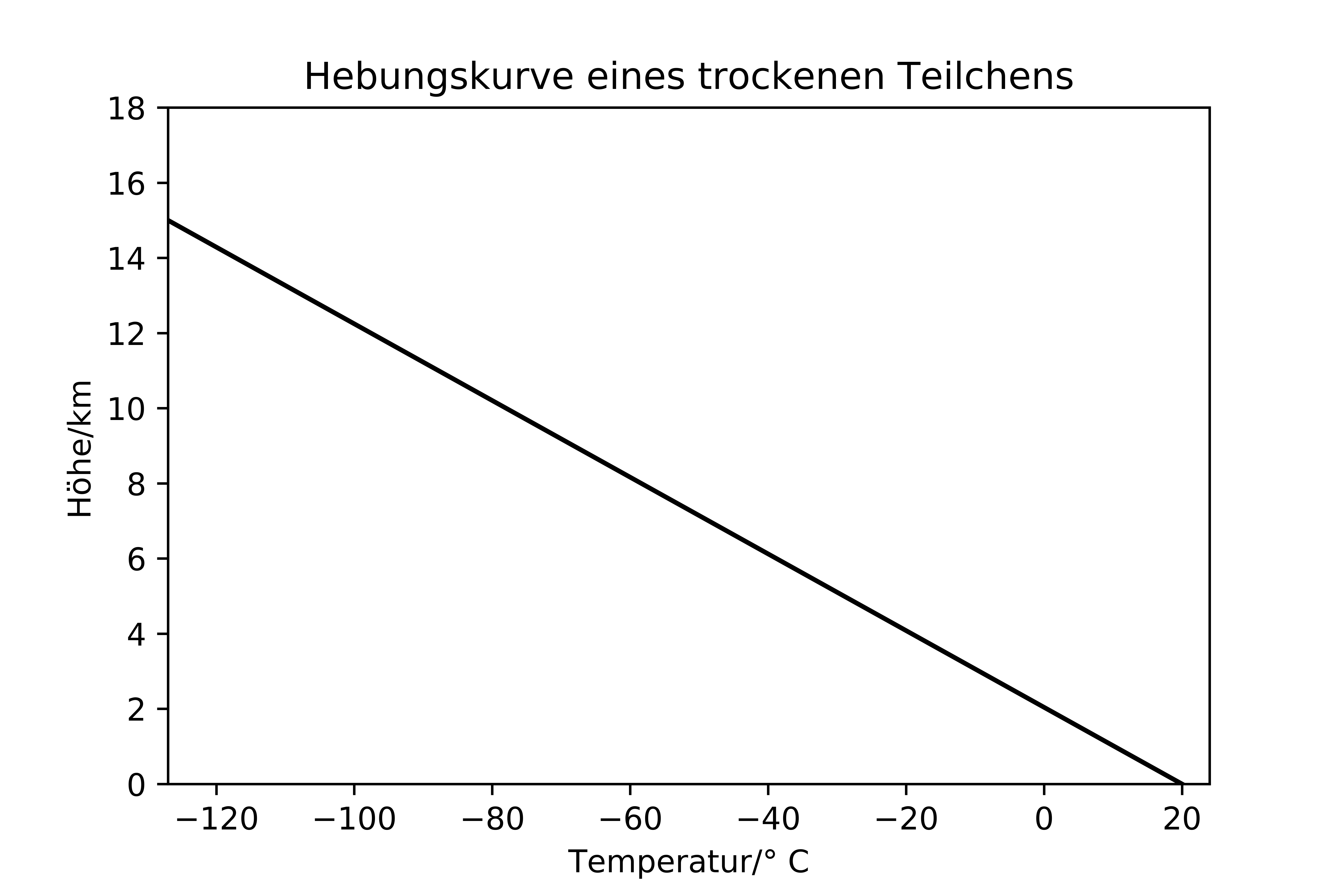
The dry adiabatic temperature gradient is not a temperature gradient in the true sense, it is the derivative of the function $T = T(z)$, which describes the adiabatic uplift of a particle. This function is also called the dry adiabat. It is not the vertical component of the atmospheric temperature gradient $\nabla T$. The latter need not agree at all, not even approximately, with the dry adiabat. Indeed, one has
\[ \begin{align} \frac{\partial T}{\partial z} &= \theta\frac{\partial p}{\partial z}\frac{R_s}{c^{(p)}}\frac{1}{p_0}\left(\frac{p}{p_0}\right)^{\frac{R_s}{c^{(p)}} - 1} + \frac{\partial\theta}{\partial z}\left(\frac{p}{p_0}\right)^{\frac{R_s}{c^{(p)}}} = -\frac{g}{c^{(p)}} - g\frac{p}{R_sT}\frac{\partial\theta}{\partial p}\left(\frac{p}{p_0}\right)^{\frac{R_s}{c^{(p)}}}\nonumber\\ \Rightarrow g\frac{p}{R_s\theta}\frac{\partial\theta}{\partial p} &= -\left(\Gamma_d - \Gamma\right)\tag{9.48}\label{eq:vert_temp_gradient} \end{align} \]
with
\[ \begin{align} \Gamma \coloneqq -\frac{\partial T}{\partial z}. \end{align} \]
The material derivative of Eq. (9.43) is
\[ \begin{align} \md{T} &= \md{\theta}\left(\frac{p}{p_0}\right)^{R_s/c^{(p)}} + \theta\frac{dp}{dt}\frac{1}{p_0}\frac{R_s}{c^{(p)}}\left(\frac{p}{p_0}\right)^{R_s/c^{(p)} - 1} = \frac{T}{\theta}\md{\theta} + \frac{T}{p}\omega\frac{R_s}{c^{(p)}} = \frac{T}{\theta}\md{\theta} + \frac{\omega}{\rho c^{(p)}}. \end{align} \]
From this it follows
\[ \begin{align} c^{(V)}\frac{T}{\theta}\md{\theta} + \frac{T}{p}\omega\frac{R_s}{c^{(p)}}c^{(V)} + p\md{}\frac{R_sT}{p} &= \frac{q_T^{(V)}}{\rho} - \frac{sT}{\rho}q_\rho^{(V)}\nonumber\\ \Leftrightarrow \md{\theta}\frac{T}{\theta} + \frac{\omega T}{p}\frac{R_s}{c^{(p)}} - \frac{R_sT}{pc^{(V)}}\omega + \frac{R_s}{c^{(V)}}\md{T} &= \frac{q_T^{(V)}}{c^{(V)}\rho} - \frac{sT}{c^{(V)}\rho}q_\rho^{(V)}\nonumber\\ \Leftrightarrow \frac{T}{\theta}\md{\theta} + \frac{\omega R_sT}{p}\left(\frac{1}{c^{(p)}} - \frac{1}{c^{(V)}}\right)\nonumber\\ + \frac{R_s}{c^{(V)}}\left(\frac{T}{\theta}\md{\theta} + \frac{T}{p}\omega\frac{R_s}{c^{(p)}}\right) &= \frac{q_T^{(V)}}{c^{(V)}\rho} - \frac{sT}{c^{(V)}\rho}q_\rho^{(V)}\nonumber\\ \Leftrightarrow \frac{T}{\theta}\md{\theta}\frac{c^{(p)}}{c^{(V)}} + \frac{\omega R_sT}{p}\frac{c^{(V)} - c^{(p)} + R_s}{c^{(V)}c^{(p)}} &= \frac{q_T^{(V)}}{c^{(V)}\rho} - \frac{sT}{c^{(V)}\rho}q_\rho^{(V)}. \end{align} \]
This means that the first law of thermodynamics for a gas reads, in terms of the potential temperature,
Multiplying this equation by $\rho$ gives
\[ \begin{align} \rho\frac{\partial\theta}{\partial t} + \rho\mathbf{v}\cdot\nabla\theta = \frac{\theta}{Tc^{(p)}}\left(q_T^{(V)} - sTq_\rho^{(V)}\right). \end{align} \]
Add the product of the potential temperature to the continuity equation
\[ \begin{align} \theta\frac{\partial\rho}{\partial t} + \theta\mathbf{v}\cdot\nabla\rho + \theta\rho\nabla\cdot\mathbf{v} = \theta q_\rho^{(V)} = \frac{\theta}{Tc^{(p)}}Tc^{(p)}q_\rho^{(V)} \end{align} \]
it follows
This form is also referred to as the flux form, whereas Eq. (9.52) has advection form. The flux form can be understood as a formal continuity equation.
9.2 The isentropic dry atmosphere
In an isentropic atmosphere (atmosphere of homogeneous specific entropy), according to Eq. (9.30) the potential temperature is also homogeneous. This leads to a different dependence of pressure on altitude than in the case of the isothermal atmosphere. If $\Gamma_d > 0$ is the dry adiabatic temperature gradient, the temperature is $T(z) = T_0 - \Gamma_d z$ with $T_0 \coloneqq T(z = 0)$. It thus follows
\[ \begin{align} \frac{\partial p}{\partial z} = -g\rho = -g\frac{p}{R_dT} = -\frac{g}{R_d}\frac{p}{T_0 - \Gamma_d z} = \frac{gp}{R_d(\Gamma_d z - T_0)} \end{align} \]
as the differential equation to be solved for $p = p(z)$. Making the ansatz
\[ \begin{align} p(z) = C\exp\left[f(z)\right] \end{align} \]
with a continuously differentiable function $f = f(z)$ and a constant $C > 0$, it follows
\[ \begin{align} \frac{\partial p}{\partial z} = \frac{\partial f}{\partial z}p, \end{align} \]
one thus obtains for $f$
\[ \begin{align} \frac{\partial f}{\partial z} = \frac{g}{R_d\left(\Gamma_d z - T_0\right)}, \end{align} \]
which is solved by
\[ \begin{align} f = \frac{g}{R_d\Gamma_d}\ln\left(T_0 - \Gamma_d z\right). \end{align} \]
Thus, for the pressure, it follows
\[ \begin{align} p(z) = C\exp\left(\frac{g}{R_d\Gamma_d}\ln\left(T_0 - \Gamma_d z\right)\right) = C\left(T_0 - \Gamma_d z\right)^{\frac{g}{R_d\Gamma_d}}, \end{align} \]
with $p(0) = p_0$ it follows $C = \frac{p_0}{T_0^{\frac{g}{\Gamma_d R_d}}}$. One thus has
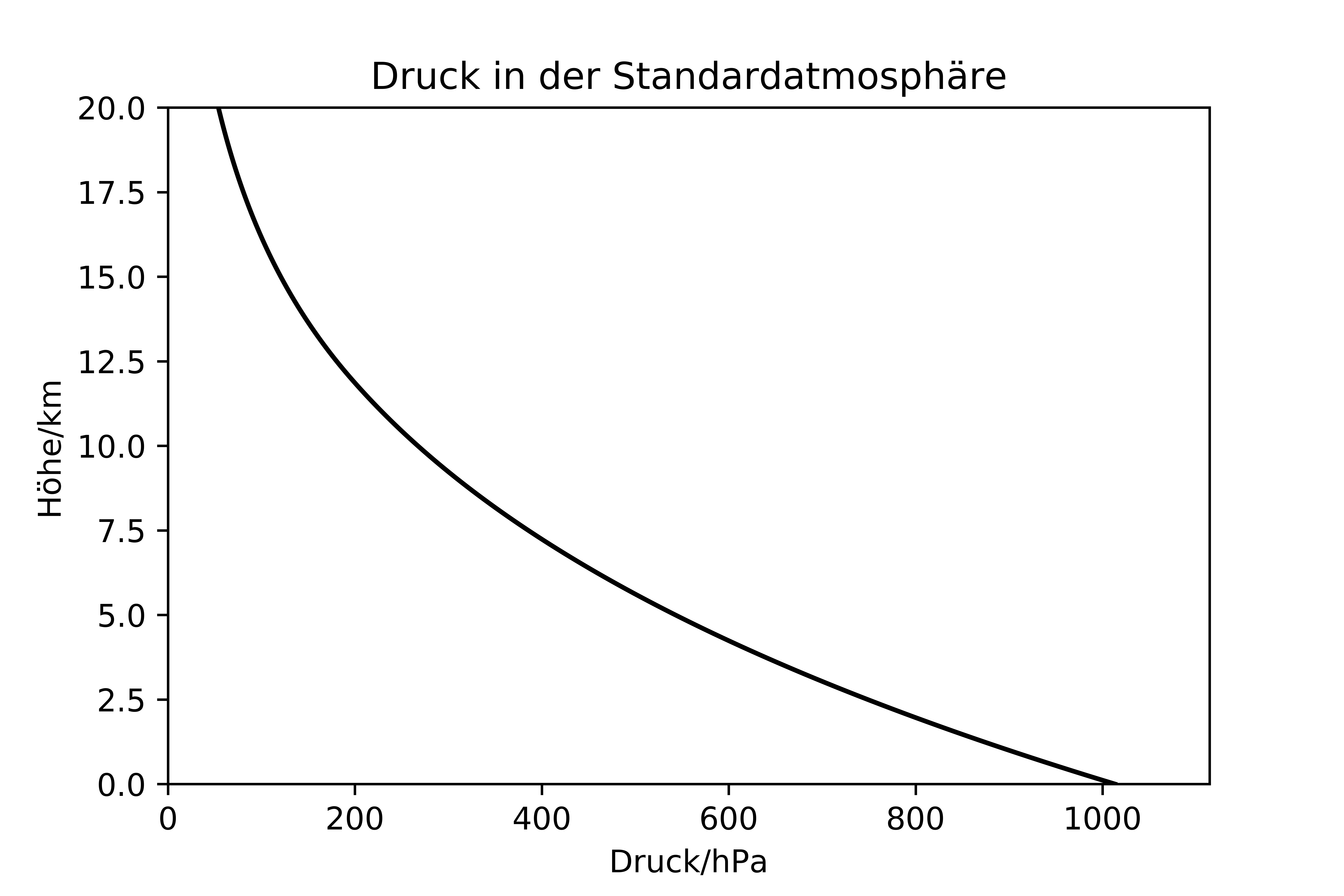
In the troposphere, a linear decrease in temperature with altitude is more realistic than isothermy. However, the dry adiabatic gradient is climatologically too extreme. The standard atmosphere is assumed to be an atmosphere with a temperature of $T_0 = 290$ K $ = 16.85^\circ$ C reduced to the geopotential surface zero and a linear temperature decrease $k = 0.65$ K/100m up to an altitude $H = 12$ km. Above that, isothermy is assumed. If, in the formula for the isentropic atmosphere, Eq. (9.62), one replaces the dry adiabatic gradient $\Gamma_d$ by $k$ and, above that, uses the barometric height formula, it follows
\[ \begin{align} p(z) &= \left\lbrace\begin{array}{c} p_0\left(1 - \frac{kz}{T_0}\right)^\frac{g}{R_dk}, \:z < H\\ p(H)\exp\left(-g\frac{z - H}{R_dT_T}\right) , \:z\geq H \end{array}\right. \end{align} \]
with $T_T \coloneqq T_0 - kH$ as the temperature of the tropopause.
In a stable atmosphere, $\theta$ is a possible vertical coordinate, one speaks of isentropic coordinates, since the surfaces with the same vertical coordinate are surfaces with the same entropy.
9.3 Further forms of the first law in the atmosphere
9.3.1 Pressure as a prognostic variable
Now the definition of the potential temperature is to be inserted into the equation of state:
\[ \begin{align} p &= \rho R_s\theta\left(\frac{p}{p_0}\right)^{R_s/c^{(p)}}\Rightarrow p^{1 - R_s/c^{(p)}} = \rho R_s\theta\frac{1}{p_0^{R_s/c^{(p)}}}\tag{9.64}\label{eq:state_theta_deriv_0}\\ \Rightarrow p^{1/\kappa} &= \rho R_s\theta\frac{1}{p_0^{R_s/c^{(p)}}}\Rightarrow p = \left(\rho R_s\theta\right)^\kappa\left(\frac{1}{p_0}\right)^{\kappa - 1}\tag{9.65}\label{eq:state_theta} \end{align} \]
A prognostic equation can also be derived for $p$:
\[ \begin{align} p &= \rho R_sT \Rightarrow \md{p} = R_s\left(T\md{\rho} + \rho\md{T}\right) \end{align} \]
With
\[ \begin{align} \md{\rho} = -\rho\nabla\cdot\mathbf{v} + q_\rho^{(V)}, & {} & \md{T} = \frac{T}{\theta}\md{\theta} + \frac{TR_s}{c^{(p)}p}\md{p} \end{align} \]
follows
\[ \begin{align} \md{p} &= R_sT\left(-\rho\nabla\cdot\mathbf{v} + q_{\rho}\right) + R_s\rho\left(\frac{T}{\theta}\md{\theta} + \frac{TR_s}{c^{(p)}p}\md{p}\right)\nonumber\\ &= -p\nabla\cdot\mathbf{v} + R_sTq_\rho^{(V)} + \frac{p}{\theta}\md{\theta} + \frac{R_s}{c^{(p)}}\md{p}\nonumber\\ \Leftrightarrow \frac{c^{(V)}}{c^{(p)}}\md{p} &= -p\nabla\cdot\mathbf{v} + R_sTq_\rho^{(V)} + \frac{p}{\theta}\md{\theta}\nonumber\\ \Leftrightarrow \frac{\partial p}{\partial t} &= -\mathbf{v}\cdot\nabla p - \frac{c^{(p)}}{c^{(V)}}p\nabla\cdot\mathbf{v} + \frac{c^{(p)}}{c^{(V)}}R_sTq_\rho^{(V)} + \frac{p}{T\rho c^{(V)}}\left(q_T^{(V)} - sTq_\rho^{(V)}\right) \end{align} \]
\[ \begin{align} \Leftrightarrow \frac{\partial p}{\partial t} = -\mathbf{v}\cdot\nabla p - \frac{c^{(p)}}{c^{(V)}}p\nabla\cdot\mathbf{v} + \frac{c^{(p)}}{c^{(V)}}R_sTq_\rho^{(V)} + \frac{R_s}{c^{(V)}}\left(q_T^{(V)} - sTq_\rho^{(V)}\right).\tag{9.69}\label{eq:pressure_prognostic_equation} \end{align} \]
9.3.2 Exner pressure as a prognostic variable
Defining the Exner pressure $\Pi$ by
\[ \begin{align} \Pi \coloneqq \frac{T}{\theta} = \left(\frac{p}{p_0}\right)^{R_s/c^{(p)}} \Leftrightarrow p = \Pi^{c^{(p)}/R_s}p_0,\tag{9.70}\label{eq:def_exner-druck} \end{align} \]
the following relation holds
\[ \begin{align} p &= \rho R_s\theta\Pi \Leftrightarrow \Pi^{c^{(p)}/R_s} = \frac{\rho R_s\theta}{p_0}\Pi \Leftrightarrow \Pi^{c^{(V)}/R_s} = \frac{\rho R_s\theta}{p_0}\nonumber\\ \Leftrightarrow\Pi &= \left(\frac{\rho R_s\theta}{p_0}\right)^{R_s/c^{(V)}}.\tag{9.71}\label{eq:exner_pressure_diag} \end{align} \]
From this it follows
\[ \begin{align} \nabla p = R_s \theta\rho\nabla\Pi + R_s\Pi\nabla\left(\rho\theta\right) = c^{(p)}\theta\rho\nabla\Pi - c^{(V)}\theta\rho\nabla\Pi + R_s\Pi\nabla\left(\rho\theta\right). \end{align} \]
One finds:
\[ \begin{align} -c^{(V)}\theta\rho\nabla\Pi + R_s\Pi\nabla\left(\rho\theta\right) &= -\left(\frac{R_s}{p_0}\right)^{R_s/c^{(V)}}c^{(V)}\theta\rho\nabla\left(\rho\theta\right)^{R_s/c^{(V)}} + R_s\Pi\nabla\left(\rho\theta\right)\nonumber\\ &\stackrel{\text{Eq. }\href{#eq:exner_pressure_diag}{(9.71)}}{=} R_s\left(\Pi - \left(\frac{R_s}{p_0}\right)^{R_s/c^{(V)}}\left(\rho\theta\right)^{R_s/c^{(V)}}\right)\nabla\left(\rho\theta\right) = 0 \end{align} \]
Thus, for the pressure gradient acceleration, one can write
\[ \begin{align} -\frac{1}{\rho}\nabla p = -c^{(p)}\theta\nabla\Pi.\tag{9.74}\label{eq:exner_pressure_gradient_acc} \end{align} \]
With Eq. (B.49), it follows
\[ \begin{align} \nabla\cdot\left(\rho c^{(p)}\Pi\theta\mathbf{v}\right) &= \rho c^{(p)}\theta\mathbf{v}\cdot\nabla\Pi + \Pi\nabla\cdot\left(\rho c^{(p)}\theta\mathbf{v}\right)\nonumber\\ \Leftrightarrow -\rho\mathbf{v}\cdot c^{(p)}\theta\nabla\Pi &= -\nabla\cdot\left(\rho c^{(p)}T\mathbf{v}\right) + c^{(p)}\Pi\nabla\cdot\left(\rho\theta\mathbf{v}\right)\nonumber\\ \Leftrightarrow -\rho\mathbf{v}\cdot c^{(p)}\theta\nabla\Pi &= -\nabla\cdot\left(\rho h\mathbf{v}\right) + c^{(p)}\Pi\nabla\cdot\left(\rho\theta\mathbf{v}\right)\ \end{align} \]
with the specific enthalpy $h$. From this, one can read off:
If the pressure gradient has an accelerating effect, the flow of potential temperature diverges more than the flow of enthalpy.
If the pressure gradient has a braking effect, the flow of enthalpy diverges more than the flow of potential temperature.
Now two further prognostic equations for $\Pi$ are derived. The local time derivative of Eq. (9.71) reads, in the adiabatic case,
\[ \begin{align} \frac{\partial\Pi}{\partial t} &= \frac{R_s}{c^{(V)}}\left(\frac{\rho R_s\theta}{p_0}\right)^{\frac{R_s}{c^{(V)}} - 1}\frac{\rho R_s\theta}{p_0}\left(\frac{1}{\theta}\frac{\partial\theta}{\partial t} + \frac{1}{\rho}\frac{\partial\rho}{\partial t}\right) = \frac{R_s}{c^{(V)}\theta\rho}\left(\frac{\rho R_s\theta}{p_0}\right)^{\frac{R_s}{c^{(V)}}}\left(\rho\frac{\partial\theta}{\partial t} + \theta\frac{\partial\rho}{\partial t}\right)\nonumber\\ &= \frac{R_s\Pi}{c^{(V)}\theta\rho}\left(\rho\frac{\partial\theta}{\partial t} + \theta\frac{\partial\rho}{\partial t}\right) = \frac{R_s\Pi}{c^{(V)}\theta\rho}\left(-\rho\mathbf{v}\cdot\nabla\theta - \theta\nabla\cdot\left(\rho\mathbf{v}\right)\right) = -\frac{R_s\Pi}{c^{(V)}\theta\rho}\nabla\cdot\left(\rho\theta\mathbf{v}\right). \end{align} \]
Adding the diabatic terms, it follows
\[ \begin{align} \frac{\partial\Pi}{\partial t} &= -\frac{R_s\Pi}{c^{(V)}\theta\rho}\left[\nabla\cdot\left(\rho\theta\mathbf{v}\right) - \frac{\theta}{Tc^{(p)}}\left(q_T^{(V)} + T\left(c^{(p)} - s\right)q_\rho^{(V)}\right)\right].\tag{9.77}\label{eq:def_exner-pressure_local_derivative} \end{align} \]
For the material derivative of Eq. (9.71), one obtains
\[ \begin{align} \md{\Pi} = \frac{R_s}{c^{(V)}}\left(\frac{\rho R_s\theta}{p_0}\right)^{R_s/c^{(V)} - 1}\frac{R_s}{p_0}\md{\left(\rho\theta\right)} = \frac{R_s}{c^{(V)}\rho\theta}\left(\frac{\rho R_s\theta}{p_0}\right)^{R_s/c^{(V)}}\md{\left(\rho\theta\right)} = \frac{R_s\Pi}{c^{(V)}\rho\theta}\md{\left(\rho\theta\right)}. \end{align} \]
With Eq. (9.55), it follows
9.4 Ideal gas mixture with a homogeneous composition
N-atomic ideal gases have additional rotational and vibrational degrees of freedom compared to monatomic gases. These additional degrees of freedom increase the heat capacities and an analytical expression for the entropy is then no longer available. A monatomic ideal gas with the same average molar mass as the original gas is used as a model for this complex system, with measured values or products of a more fundamental theory being used for the heat capacities. This means that the results listed in the previous section can also be transferred to dry air.
9.5 Ideal gas mixture with variable composition
Here one starts from a gas mixture of $N \geq 1$ ideal monatomic gases. Eq. (9.34) can be applied to each of these components and superimposed. Here, the following holds
\[ \begin{align} \newtilde{s}_i = s_i\rho_i \end{align} \]
for $1 \leq i \leq N$ and
\[ \begin{align} s = \sum_{i = 1}^N\newtilde{s}_i. \end{align} \]
In principle, each type of gas gets its own temperature source term $q_{T, i}$. However, to simplify matters, it is assumed that the subsequent exchange of energy between the types of gas is so fast that it can be assumed to be instantaneous. In this case, one can write
\[ \begin{align} q_{T, i}^{(V)} = \frac{\rho_ic_i^{(V)}}{\sum_{j = 1}^N\rho_jc_j^{(V)}}q_T^{(V)} \end{align} \]
Thus, Eq. (9.34)
holds also with these definitions.
9.5.1 Example: moist air
One defines the so-called virtual potential temperature $\theta_v$ by
\[ \begin{align} \theta_v \coloneqq T_v\left(\frac{p_0}{p}\right)^{R_d/c_d^{(p)}}, \end{align} \]
here,
\[ \begin{align} T_v = T\left[1 + \frac{\rho_v}{\rho_h}\left(\frac{M_d}{M_v} - 1\right)\right] \end{align} \]
is the virtual temperature defined in Eq. (5.164). The virtual potential temperature is not the potential temperature of moist air $\theta_h$, since for the latter
\[ \begin{align} \theta_h \coloneqq T\left(\frac{p_0}{p}\right)^{R_h/c_h^{(p)}} \end{align} \]
would hold. The virtual potential temperature is the potential temperature that dry air would have to have in order to have the same density after adiabatic compression to the reference pressure $p_0$ like the moist air under consideration.
For the specific isochoric heat capacity of moist air $c_h^{(v)}$, one has
\[ \begin{align} c_h^{(v)} = \frac{\rho_dc_d^{(v)} + \rho_vc_v^{(v)}}{\rho_d + \rho_v} = c_d^{(v)}\frac{\rho_d + \rho_v\frac{c_v^{(v)}}{c_d^{(v)}}}{\rho_d + \rho_v} = c_d^{(v)}\frac{\rho_h - \rho_v + \rho_v\frac{c_v^{(v)}}{c_d^{(v)}}}{\rho_h} = c_d^{(v)}\left[1 + \frac{\rho_v}{\rho_h}\left(\frac{c_v^{(v)}}{c_d^{(v)}} - 1\right)\right] \end{align} \]
According to Eq. (5.148), in an ideal gas one has
\[ \begin{align} \frac{c_v^{(v)}}{c_d^{(v)}} = \frac{M_d}{M_v}. \end{align} \]
Inserting the actual values, however, one obtains
\[ \begin{align} \frac{c_v^{(v)}}{c_d^{(v)}} = 1,945 \not= 1,608 = \frac{M_d}{M_v}.\tag{9.89}\label{eq:theta_v_not_accurate} \end{align} \]
This shows that although real gases can be described very well under atmospheric conditions by the thermal equation of state of ideal gases, their material properties cannot. If one ignores this deviation, however, it follows
\[ \begin{align} c_h^{(v)} = c_d^{(v)}\left[1 + \frac{\rho_v}{\rho_h}\left(\frac{M_d}{M_v} - 1\right)\right] \end{align} \]
The adiabatic form of the first law of thermodynamics, Eq. (9.14), can now be formulated in terms of the virtual temperature:
\[ \begin{align} c_h^{(v)}\md{T} + R_hT\nabla\cdot\mathbf{v} &= 0\nonumber\\ \Leftrightarrow c_d^{(v)}\left[1 + \frac{\rho_v}{\rho_h}\left(\frac{M_d}{M_v} - 1\right)\right]\md{T} + R_dT_v\nabla\cdot\mathbf{v} &= 0\nonumber\\ \Leftrightarrow c_d^{(v)}\md{\left\lbrace T\left[1 + \frac{\rho_v}{\rho_h}\left(\frac{M_d}{M_v} - 1\right)\right]\right\rbrace} + R_dT_v\nabla\cdot\mathbf{v} &= 0\nonumber\\ \Leftrightarrow c_d^{(v)}\md{T_v} + R_dT_v\nabla\cdot\mathbf{v} &= 0 \end{align} \]
The prefactor $1 + \frac{\rho_v}{\rho_h}\left(\frac{M_d}{M_v} - 1\right)$, which turns the temperature into the virtual temperature, can be drawn into the derivative, since the term $\propto \md{q}$ resulting from the product rule according to Eq. (7.28) is equal to zero for adiabatic processes. Thus, in moist air, for adiabatic processes, one can use the equations for dry air with the substitution
\[ \begin{align} T \to T_v \end{align} \]
if one accepts the inaccuracy according to Ineq. (9.89).
9.6 Thermodynamic significance of heat conduction
Eq. (9.83)
\[ \begin{align} \frac{\partial\newtilde{s}}{\partial t} + \nabla\cdot\left(\newtilde{s}\mathbf{v}\right) &= \frac{q_T^{(V)}}{T}\tag{9.93}\label{eq:td_1_2_entropy_id_gas_repeat} \end{align} \]
is a combination of the first and second laws of thermodynamics. For $q_T^{(V)}$, in the absence of radiation and condensates, one has
\[ \begin{align} q_T^{(V)} = -\nabla\cdot\mathbf{j}_q + \epsilon, \end{align} \]
here $\mathbf{j}_q$ is the heat flux density due to heat conduction. According to Eq. (5.219), one has
\[ \begin{align} \mathbf{j}_q = -\rho c_d^{(v)}\kappa\nabla T. \end{align} \]
One can now compute
\[ \begin{align} \frac{\nabla\cdot\left(\rho\kappa\nabla T\right)}{T} = \nabla\cdot\frac{\rho c_d^{(v)}\kappa\nabla T}{T} + \frac{\rho c_d^{(v)}\kappa}{T^2}\left(\nabla T\right)^2 = -\nabla\cdot\frac{\mathbf{j}_q}{T} + \frac{\rho c_d^{(v)}\kappa}{T^2}\left(\nabla T\right)^2. \end{align} \]
Substituting this into Eq. (9.93) and integrating globally, one obtains
\[ \begin{align} \int_A\frac{\partial\newtilde{s}}{\partial t}d^3r &= \frac{d}{dt}\int_A\newtilde{s}d^3r = \int_A-\nabla\cdot\frac{\mathbf{j}_q}{T} + \frac{\rho c_d^{(v)}\kappa}{T^2}\left(\nabla T\right)^2d^3r = -\int_{\partial A}\frac{\mathbf{j}_q}{T}\cdot d\mathbf{n} + \int_A\frac{\rho c_d^{(v)}\kappa}{T^2}\left(\nabla T\right)^2d^3r. \end{align} \]
The evolution equation of the total entropy of the atmosphere
\[ \begin{align} S = \int_A\newtilde{s}d^3r \end{align} \]
thus reads, in this case,
\[ \begin{align} \frac{dS}{dt} = \underbrace{-\int_{\partial A}\frac{\mathbf{j}_q}{T}\cdot d\mathbf{n}}_{\substack{\text{interaction with} \\\text{the environment}}} + \underbrace{\int_A\frac{\rho c_d^{(v)}\kappa}{T^2}\left(\nabla T\right)^2d^3r}_{\substack{\text{entropy production by} \\\text{heat conduction (nonnegative)}}} + \underbrace{\int_A\frac{\epsilon}{T}d^3r\text{.}}_{\substack{\text{entropy production by} \\\text{dissipation (nonnegative)}}} \end{align} \]
Internal processes in an ideal gas with viscosity can therefore only produce entropy, as required by the second law of thermodynamics.
9.7 Condensates
The first law must also be formulated for the condensate classes $i$. To this end, one starts from Eq. (5.34):
\[ \begin{align} \Delta U_i = \Delta Q_i - \Delta W_i \end{align} \]
The condensates are assumed to be incompressible, i.e. $\Delta W_i = 0$. In addition to radiation, heat transfer and dissipation, phase transitions also play a role as heat sources. These act in two ways:
They lead to latent heat fluxes and thus change the temperature.
They change the composition of the components of the air and change the temperature through mixing.
The first point is described in more detail in Chap. 11. All heat fluxes that act on phase $i$ per volume are combined into a source strength $q_i$. Here, the second point is addressed, i.e. the effect of mass fluxes on the temperature $T_i$ is to be examined. Eq. (7.25) comprises five types of mass fluxes, namely
Phase transitions in which new condensate particles are formed,
Phase transitions that take place on the surface of a particle,
Phase transformations of condensate particles so that they change their class,
collisions and
Decay processes
Only processes in which matter transitions into phase $i$ contribute to a change in temperature $T_i$. Let class $i$ have the specific heat capacity $c_i$, and let $m_j$ and $m_h$ be the masses passing into phase $i$. Then, for the heat content before and after a mass flux, one has
\[ \begin{align} c_im_iT_i\left(t\right) + c_hm_hT + \sum_{j\not = i}^{}c_jm_jT_j &= c_iT_i\left(t + \Delta t\right)\left(m_h + m_i + \sum_{j\not = i}^{}m_j\right)\nonumber\\ \Leftrightarrow c_im_i\left[T_i\left(t + \Delta t\right) - T_i\left(t\right)\right] &= c_hm_hT + \sum_{j\not = i}^{}c_jm_jT_j - c_iT_i\left(t + \Delta t\right)\left(m_h + \sum_{j\not = i}^{}m_j\right)\nonumber\\ \Leftrightarrow\Delta T_i &= \frac{c_h}{c_im_i}m_h\left(T - \frac{c_i}{c_h}T_i\left(t + \Delta t\right)\right) + \frac{1}{c_im_i}\sum_{j\not = i}\left[c_jm_jT_j - c_im_jT_i\left(t + \Delta t\right)\right]\nonumber\\ \Leftrightarrow \frac{1}{\Delta V}\frac{dT_i}{dt} &= \frac{1}{m_i}\newtilde{q}_{hi}\left(\frac{c_h}{c_i}T - T_i\right) + \frac{1}{m_i}\sum_{j\not = i}^{}\newtilde{q}_{j, i}\left(\frac{c_j}{c_i}T_j - T_i\right)\nonumber\\ \Leftrightarrow\rho_ic_i\frac{dT_i}{dt} &= \newtilde{q}_{hi}\left(c_hT - c_iT_i\right) + \sum_{j}^{}\newtilde{q}_{j, i}\left(c_jT_j - c_iT_i\right). \end{align} \]
It was assumed that all particles of class $i$ have the same temperature $T_i$, i.e. that instantaneous mixing occurs. According to Eq. (7.25) and the considerations in Sect. 11.2, one has
\[ \begin{align} \newtilde{q}_{hi} = \newtilde{q}_{v, i}' + \newtilde{q}_{v, i}''. \end{align} \]
Phase transformations, collisions and decay processes contribute to the $\newtilde{q}_{j, i}$. According to the considerations in the derivation of Eq. (7.25), one has
\[ \begin{align} \newtilde{q}_{j, i} = \newtilde{m}_j\sum_{k}^{}\sigma_{j, k}n_jn_k\newoverline{v_{\text{rel}}}\left(j, k\right)P_{j, k}\delta_{i, R_{j, k}} + \newtilde{m}_i\lambda_jn_j\sum_l\left(Z_{jil}\right) + \newtilde{q}_{j, i}'''. \end{align} \]
One thus has
\[ \begin{align} \rho_ic_i\frac{dT_i}{dt} &= q_i + \left(\newtilde{q}_{v, i}' + \newtilde{q}_{v, i}''\right)\left(c_hT - c_iT_i\right)\nonumber\\ & + \sum_{j}^{}\left[\newtilde{m}_j\sum_{k}^{}\sigma_{j, k}n_jn_k\newoverline{v_{\text{rel}}}\left(j, k\right)P_{j, k}\delta_{i, R_{j, k}} + \newtilde{m}_i\lambda_jn_j\sum_l\left(Z_{jil}\right) + \newtilde{q}_{j, i}'''\right]\left(c_jT_j - c_iT_i\right)\tag{9.104}\label{eq:td1_kondensate} \end{align} \]
The notation explicitly takes into account that what is meant is the isochoric specific heat capacity. An analogous term must also be taken into account for moist air:
\[ \begin{align} \rho_hc_h^{(v)}\md{T} &= q_h + \sum_i\left(\newtilde{q}_{v, i}' + \newtilde{q}_{v, i}''\right)\left(c_h^{(v)}T - c_iT_i\right) \end{align} \]