17 Turbulence
There is no mathematically exact definition of whether a flow field is turbulent or not. It can be assumed that any flow field, when viewed from a sufficiently large distance, appears turbulent. However, if one zooms in far enough, one usually finds a scale on which the field makes a laminar impression, which is understood as the opposite of turbulence. If this scale is the molecular scale, full turbulence is present.
17.1 Basics
Define an averaging operator by
\[ \begin{align} \newoverline{f} \coloneqq \frac{1}{\mu\left(\Omega\right)}\int_\Omega fd\omega,\tag{17.1}\label{eq:simple_average} \end{align} \]
where $\Omega$ is an arbitrary spatial and/or temporal set, $\mu\left(\Omega\right)$ its measure, $f$ an arbitrary function of space and time and $d\omega$ a suitable differential. One can now decompose $f$ in the form
\[ \begin{align} f & \equiv \newoverline{f} + f' \end{align} \]
; for this purpose, one defines the fluctuation or turbulence by
\[ \begin{align} f' &\coloneqq f - \newoverline{f}. \end{align} \]
If the statements
\[ \begin{align} \newoverline{\frac{\partial f}{\partial x_i}} &= \frac{\partial\newoverline{f}}{\partial x_i}, \tag{17.4}\label{eq:reynolds_prop_1}\\ \newoverline{\frac{\partial f}{\partial t}} &= \frac{\partial\newoverline{f}}{\partial t}, \tag{17.5}\label{eq:reynolds_prop_2}\\ \newoverline{f'\newoverline{g}} &= 0\tag{17.6}\label{eq:reynolds_prop_3} \end{align} \]
hold with an arbitrary field $g$, then $\newoverline{f}$ is called a Reynolds operator and the corresponding averaging a Reynolds averaging. One easily convinces oneself that the two statements
\[ \begin{align} \newoverline{f'} = 0, & {} & \newoverline{\newoverline{f}} = \newoverline{f} \end{align} \]
also follow from this. At this point one does not concern oneself with what such an operator could concretely look like; in Sect. 17.1.2 it will be found that the usual averaging operators are not Reynolds operators. From now on, however, Eq. (17.1) is no longer used; instead the Hesselberg mean
\[ \begin{align} \left\langle f\right\rangle \coloneqq \frac{1}{\int_\Omega\rho d\omega}\int_\Omega\rho fd\omega\tag{17.8}\label{eq:hesselberg-average} \end{align} \]
is used, where $\rho$ is the density. For the fluctuation one now writes
\[ \begin{align} f'' \coloneqq f - \left\langle f\right\rangle. \end{align} \]
It is now assumed that the Hesselberg mean is a Reynolds operator. Applying this to the dry adiabatic system of equations, one obtains
\[ \begin{align} \frac{\partial\newoverline{\mathbf{v}}}{\partial t} &= -\left(\newoverline{\mathbf{v}}\cdot\nabla\right)\newoverline{\mathbf{v}} - \newoverline{\left(\mathbf{v}''\cdot\nabla\right)\mathbf{v}''} - \newoverline{\alpha}\frac{\partial\newoverline{p}}{\partial x} - \newoverline{\alpha''\frac{\partial p'}{\partial x}} - \mathbf{f}\times\newoverline{\mathbf{v}} + \mathbf{g},\\ \frac{\partial\newoverline{\theta}}{\partial t}&= -\newoverline{\mathbf{v}}\cdot\nabla\newoverline{\theta} - \newoverline{\mathbf{v}''\cdot\nabla\theta''} ,\\ \frac{\partial\newoverline{\rho}}{\partial t} &= -\newoverline{\rho}\nabla\cdot\newoverline{\mathbf{v}} - \newoverline{\mathbf{v}}\cdot\nabla\newoverline{\rho} - \newoverline{\rho''\nabla\cdot\mathbf{v}''} - \newoverline{\mathbf{v}''\cdot\nabla\rho''},\\ \newoverline{p}\newoverline{\alpha}&= R_d\newoverline{T} - \newoverline{p''\alpha''}. \end{align} \]
The prognostic equations of the averaged fields are therefore corrected, compared to those of the unaveraged fields, by terms of the form $\newoverline{f''g''}$, where $f, g$ are linear in the fields and their derivatives. These terms are referred to as the convergences of the turbulent correlation fluxes. These naturally depend on the size of the set over which the averaging is performed, i.e. on the resolution in the case of a numerical model. As the averaging set becomes smaller and smaller, the covariance terms lose importance until they finally vanish completely.
However, there are no prognostic equations for the turbulent quantities, which is referred to as the closure problem. To specify the correlation terms in the momentum equation more precisely, one applies the Reynolds averaging operator to Eq. (8.15) and thus obtains
\[ \begin{align} \frac{\partial\left(\rho\mathbf{v}\right)}{\partial t} + \nabla p + \nabla\cdot\Pi - \rho\mathbf{g} + \nabla\cdot\newtilde{\Pi} = \mathbf{0}, \end{align} \]
where the horizontal bars have been omitted for clarity. Furthermore, the turbulence correlation tensor $\newtilde{\Pi}$ is defined by
\[ \begin{align} \newtilde{\Pi} \coloneqq \rho\left(\begin{array}{ccc} \newoverline{u''u''} & \newoverline{u''v''} & \newoverline{u''w''} \\ \newoverline{v''u''} & \newoverline{v''v''} & \newoverline{v''w''} \\ \newoverline{w''u''} & \newoverline{w''v''} & \newoverline{w''w''} \end{array}\right) =: \left(\begin{array}{ccc} \newtilde{\Pi}_{x, x} & \newtilde{\Pi}_{x, y} & \newtilde{\Pi}_{x, z} \\ \newtilde{\Pi}_{y, x} & \newtilde{\Pi}_{y, y} & \newtilde{\Pi}_{y, z} \\ \newtilde{\Pi}_{z, x} & \newtilde{\Pi}_{z, y} & \newtilde{\Pi}_{z, z} \end{array}\right) \end{align} \]
Here one started from the justified assumption
\[ \begin{align} \left|\frac{\rho''}{\newoverline{\rho}}\right| \ll \left|\frac{u''}{\newoverline{u}}\right| \end{align} \]
The term $-\nabla\cdot\newtilde{\Pi}$ yields the eddy-stress terms, which appear in the momentum equation and are used instead of $- \newoverline{\left(\mathbf{v}''\cdot\nabla\right)\mathbf{v}''} - \newoverline{\alpha''\frac{\partial p''}{\partial x}}$.
17.1.1 Turbulent dissipation
In analogy to the molecular dissipation $\epsilon$ (see Eq. (8.66)), one can define a turbulent dissipation associated with the turbulence
\[ \begin{align} \epsilon_\text{turb} \coloneqq \frac{1}{\rho}\sum_{i, j = 1}^3-\newtilde{\Pi}_{i, j}S_{i, j} = \frac{1}{\rho}\sum_{i, j = 1}^3-\newtilde{\Pi}_{i, j}\frac{\partial v_j}{\partial x_i} \end{align} \]
Since there is no explicit formula for $\newtilde{\Pi}$, one cannot find a turbulent analogue to Eq. (8.90): the sign of $\epsilon_\text{turb}$ remains undetermined.
17.1.2 Concrete averaging operators
Let $f$ be a scalar or vector function of position and time. A general averaging operator $\newoverline{f}$ is defined by
\[ \begin{align} \newoverline{f}\left(x_i\right) \coloneqq \frac{\int_\Omega f\left(x_i\right)h\left(x_i\right)dx_1\dotsc dx_n}{\int_\Omega h\left(x_i\right)dx_1\dotsc dx_n}, \tag{17.18}\label{eq:av_op_gen} \end{align} \]
where the time $t$ should be understood as one of the $x_i$ and $h$ represents a weighting function.
17.1.2.1 Moving time average
The moving time average with the averaging length $T$ is obtained from Eq. (17.18) with $\Omega = \left(t - \frac{T}{2}, t + \frac{T}{2}\right)$ and $h = 1$, so
\[ \begin{align} \newoverline{f}\left(\mathbf{r}, t\right) = \frac{1}{T}\int_{t-\frac{T}{2}}^{t + \frac{T}{2}}f\left(\mathbf{r}, t'\right)dt'. \end{align} \]
One now checks whether this operator satisfies the properties of a Reynolds operator, Eqs. (17.4) - (17.6). First, one has
\[ \begin{align} \frac{\partial\overline{f}}{\partial x_i} &= \frac{1}{T}\int_{t-\frac{T}{2}}^{t + \frac{T}{2}}\frac{\partial f}{\partial x_i}\left(\mathbf{r}, t'\right)dt' = \newoverline{\frac{\partial f}{\partial x_i}}, \end{align} \]
Eq. (17.4) is therefore satisfied. The verification of Eq. (17.5) is carried out using the fundamental theorem of calculus:
\[ \begin{align} \frac{\partial\overline{f}}{\partial t} &= \frac{f\left(\mathbf{r}, t + \frac{T}{2}\right) - f\left(\mathbf{r}, t - \frac{T}{2}\right)}{T} = \frac{1}{T}\int_{t-\frac{T}{2}}^{t + \frac{T}{2}}\frac{\partial f}{\partial t'}\left(\mathbf{r}, t'\right)dt' = \newoverline{\frac{\partial f}{\partial t}} \end{align} \]
The first two properties are therefore satisfied. For the third, one computes with $g = 1$
\[ \begin{align} \newoverline{f'} &= \frac{1}{T}\int_{t-\frac{T}{2}}^{t + \frac{T}{2}}f\left(\mathbf{r}, t'\right) - \newoverline{f}\left(\mathbf{r}, t'\right)dt' \hastobe 0. \end{align} \]
This should hold for arbitrary points in time, so it already follows that
\[ \begin{align} \newoverline{f} = f \end{align} \]
at all times, as a criterion for the validity of Eq. (17.6) in the simple case $g = 1$, which holds only for linear functions $f$.
17.1.2.2 Hesselberg mean
Substituting the case $h = \rho$ into Eq. (17.18), one obtains the Hesselberg mean already mentioned in the introduction. For it one notes the decomposition
\[ \begin{align} f = \left\langle f\right\rangle + f'', \end{align} \]
in order to distinguish the Hesselberg mean from other averages such as the moving time average or a general Reynolds operator.
17.1.2.3 Low-pass filter
The Fourier transform $\newtilde{f}\left(k\right)$ of a field $f = f\left(x\right)$ reads
\[ \begin{align} \newtilde{f}\left(k\right) \stackrel{\href{ch-39-orthogonal-function-systems.html#eq:def_ft_1d}{\text{Eq. (C.3)}}}{=} C\int_{-\infty}^\infty f\left(x\right)\exp\left(-ikx\right)dx. \end{align} \]
The inverse Fourier transform is, according to Eq. (C.6), given by
\[ \begin{align} f\left(x\right) = \newtilde{C}\int_{-\infty}^\infty f\left(x\right)\exp\left(ikx\right)dk, \end{align} \]
where, according to Eq. (C.9), one must ensure that $C\newtilde{C} = 1/\left(2\pi\right)$. A low-pass filter with the cutoff wavenumber $k^\star > 0$ is defined by the equation
\[ \begin{align} \newoverline{f}\left(x\right) = \newtilde{C}\int_{-k^\star}^{k^\star}f\left(x\right)\exp\left(ikx\right)dk \end{align} \]
As already indicated by the notation $\newoverline{f}$, this too is a kind of averaging operator. For the fluctuation $f'$ one obtains
\[ \begin{align} f'\left(x\right) &\coloneqq f\left(x\right) - \newoverline{f}\left(x\right) = \newtilde{C}\int_{-\infty}^{\infty}f\left(x\right)\exp\left(ikx\right)dk - \newtilde{C}\int_{-k^\star}^{k^\star}f\left(x\right)\exp\left(ikx\right)dk\nonumber\\ &= \newtilde{C}\int_{-\infty}^{-k^\star}f\left(x\right)\exp\left(ikx\right)dk + \newtilde{C}\int_{k^\star}^{\infty}f\left(x\right)\exp\left(ikx\right)dk. \end{align} \]
17.2 Mixing-length approach
The $\tau_{i, j}$, however, are still unknown quantities; in order to parameterize them (see also Sect. 24.5), one uses the mixing-length approach. Here one assumes that the pressure gradient and Coriolis force do not play a significant role, from which
\[ \begin{align} \md{\mathbf{v}} = \mathbf{0}\tag{17.29}\label{eq:burgers_eq} \end{align} \]
follows, which is called the Burgers equation. According to it, every fluid particle moves along a straight, uniform trajectory. This is not an entirely rigorous ansatz, but it nevertheless yields a sensible way of parameterizing the $u'', v'', w''$. If a particle moves from $z$ to $z + l$ while retaining its horizontal velocity $\mathbf{v}_h$, then by Eq. (17.29) one has
\[ \begin{align} \mathbf{v}_h''\left(z + l\right) = \mathbf{v}_h\left(z + l\right) - \overline{\mathbf{v}_h}\left(z + l\right) = \newoverline{\mathbf{v}_h}\left(z\right) - \overline{\mathbf{v}_h}\left(z + l\right) = \overline{\mathbf{v}_h}\left(z + l\right) - l\frac{\partial\newoverline{\mathbf{v}_h}}{\partial z} - \overline{\mathbf{v}_h}\left(z + l\right) = -l\frac{\partial\newoverline{\mathbf{v}_h}}{\partial z} \end{align} \]
Note here also the sign of $l$, which must be understood as negative in the case of downward motion. Thus, for example, it follows that
\[ \begin{align} \tau_{x, z} = -\rho\newoverline{u''w''} = \rho\newoverline{w''l}\frac{\partial\newoverline{u}}{\partial z}. \end{align} \]
In the case of a neutrally stratified atmosphere, $\left|w''\right| \sim \left|\mathbf{v}_h''\right|$ holds, which corresponds to the fact that in this case the horizontal scale of the eddies is as large as the vertical one; one therefore sets
\[ \begin{align} w'' = l\left|\frac{\partial\overline{\mathbf{v}_h}}{\partial z}\right|. \end{align} \]
From this it follows that
\[ \begin{align} \tau_{x, z} = -\rho\newoverline{u'w'} = \rho\newoverline{l^2}\left|\frac{\partial\newoverline{\mathbf{v}_h}}{\partial z}\right|\frac{\partial\newoverline{u}}{\partial z} \equiv A_z\frac{\partial\overline{u}}{\partial z}.\tag{17.33}\label{eq:eddy_corr_para} \end{align} \]
The coefficient
\[ \begin{align} A_z \coloneqq \rho\newoverline{l^2}\left|\frac{\partial\newoverline{\mathbf{v}_h}}{\partial z}\right|\tag{17.34}\label{eq:def_eddy_exchange_coeff} \end{align} \]
is called the eddy exchange coefficient.
17.2.1 Planetary boundary layer
The planetary boundary layer is defined as the lowest layer of the atmosphere in which the surface friction, i.e. the existence of the Earth's surface, has an influence. As the force balance, one assumes here
\[ \begin{align} -fv &= -\frac{1}{\rho}\frac{\partial p}{\partial x} + \frac{1}{\rho}\frac{\partial\tau_{x, z}}{\partial z}, \tag{17.35}\label{eq:friction_boundary_equilibrium_x}\\ fu &= -\frac{1}{\rho}\frac{\partial p}{\partial y} + \frac{1}{\rho}\frac{\partial\tau_{y, z}}{\partial z}.\tag{17.36}\label{eq:friction_boundary_equilibrium_y} \end{align} \]
where the averaging operators have again been omitted for the sake of clarity. The horizontal correlation fluxes have likewise been suppressed here. If one further assumes that the density varies only slightly within the height interval under consideration, it follows
\[ \begin{align} -fv &= -\frac{1}{\rho}\frac{\partial p}{\partial x} + \frac{\partial}{\partial z}\left(\frac{\tau_{x, z}}{\rho}\right), \tag{17.37}\label{eq:momentum_tau_z_ind_x}\\ fu &= -\frac{1}{\rho}\frac{\partial p}{\partial y} + \frac{\partial}{\partial z}\left(\frac{\tau_{y, z}}{\rho}\right)\tag{17.38}\label{eq:momentum_tau_z_ind_y}. \end{align} \]
One now assumes that the motion has only an x-component and defines the so-called friction velocity $u_\star > 0$ by
\[ \begin{align} u_\star^2 \coloneqq \frac{\tau_{x, z}}{\rho} = \frac{A_z}{\rho}\frac{\partial\overline{u}}{\partial z}.\tag{17.39}\label{eq:def_u_star} \end{align} \]
So far it has been assumed that the mixing length $l$ is independent of height. Very close to the Earth's surface, however, one may expect the vertical extent of the eddies to increase with height, which in the simplest case can be expressed by
\[ \begin{align} l\left(z\right) = kz\tag{17.40}\label{eq:karman_eq} \end{align} \]
where the number $k > 0$ is called the von Karman constant. It has a typical value of $0.4$. Eq. (17.40) is valid only up to a certain height. It thus follows that
\[ \begin{align} u_\star^2 = k^2z^2\left|\frac{\partial\newoverline{u}}{\partial z}\right|^2, \end{align} \]
so in the case $\frac{\partial\newoverline{u}}{\partial z} > 0$
\[ \begin{align} u_\star = kz\frac{\partial\newoverline{u}}{\partial z}. \end{align} \]
The solution for $\newoverline{u}\left(z\right)$ is the logarithmic wind profile
The constant $z_0 > 0$ is the roughness length, $\newoverline{u}\left(z_0\right) = 0$. Eq. (17.43) should only be used for $z > z_0$.
The layer in which Eq. (17.40) is a good approximation is called the Prandtl layer. It typically has an extent of one to two free mixing lengths $l$. Towards the bottom it is bounded by the laminar sublayer, which is $\sim 1\,\mathrm{mm}$ thick and in which molecular diffusion predominates. The laminar sublayer and the Prandtl layer taken together form the surface layer. The surface layer is bounded at the top by the Ekman layer.
17.2.1.1 Friction velocity
For the friction velocity $u_\star$, one has
\[ \begin{align} \newoverline{u}\left(z_\star\right) \hastobe u_\star \Leftrightarrow 1 = \frac{1}{k}\ln\left(\frac{z_\star}{z_0}\right) \Leftrightarrow z_\star = z_0\exp\left(k\right). \end{align} \]
The friction velocity is therefore the wind speed that prevails at the height $z_\star = z_0e^k \approx 1.5 z_0$. If one knows the wind $U$ at the height $z$ (for example the lowest layer of a model), the friction velocity can be determined from Eq. (17.43):
\[ \begin{align} U = \frac{u_\star}{k}\ln\left(\frac{z}{z_0}\right) \Leftrightarrow u_\star = \frac{Uk}{\ln\left(\frac{z}{z_0}\right)}. \end{align} \]
17.2.1.2 Stable or unstable stratification
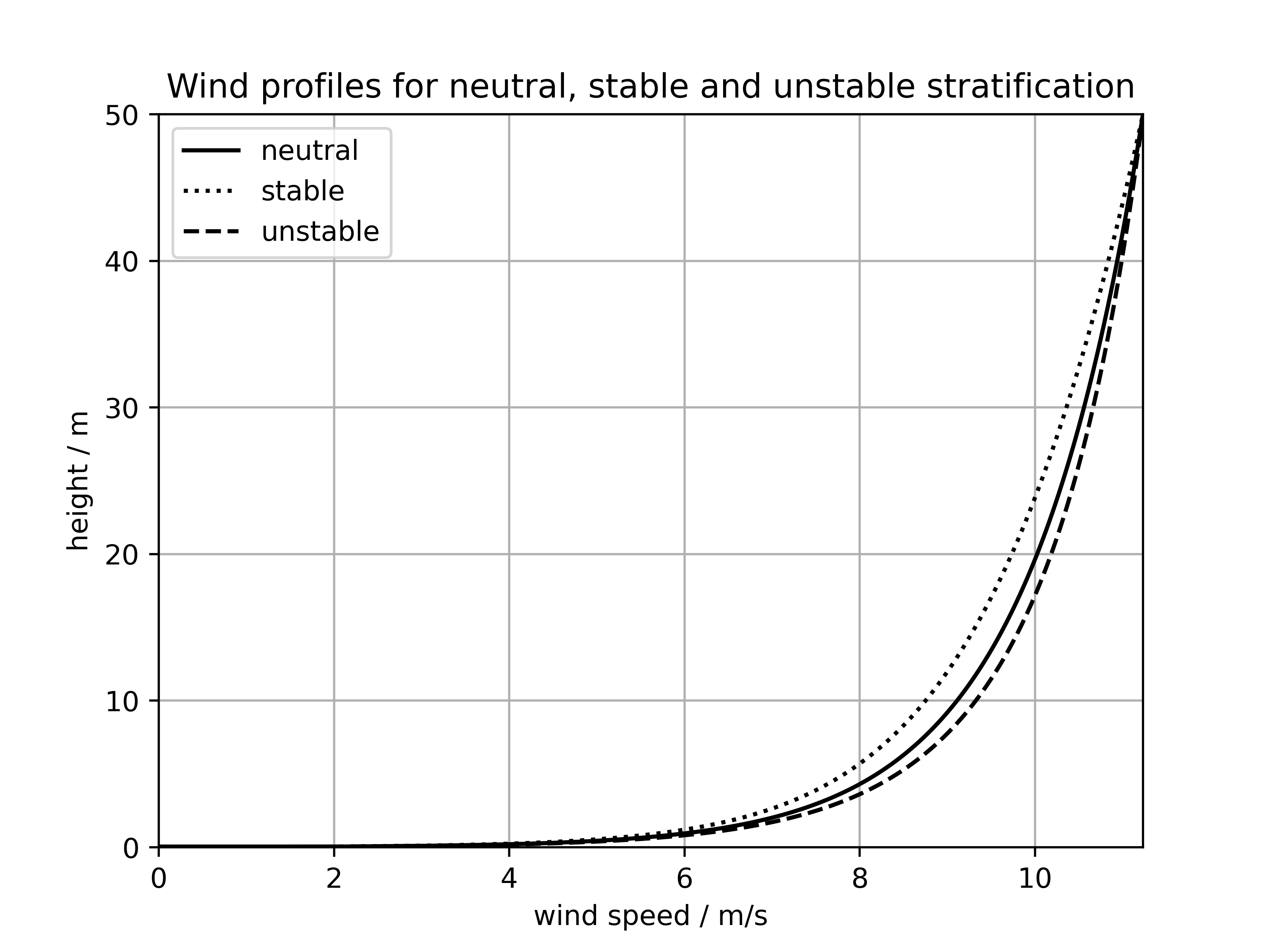
The derivations in this section so far were made under the assumption of neutral stratification. In the case of unstable or stable stratification, the mixing length is no longer simply given by Eq. (17.40). In the case of unstable stratification the particles can oscillate farther in the vertical, i.e. $l>\kappa z$, in the case of stable stratification they can oscillate less far, i.e. $l<\kappa z$. In [8], expressions for this are derived from small-scale simulations; they read:
\[ \begin{align} l = \begin{cases} \frac{kz}{3,7},\:\zeta\geq 1,\\ \frac{kz}{1 + 2,7\zeta},\:0\leq\zeta<1,\\ kz\left(1 - 100\zeta\right)^{0,2},\:\zeta<0 \end{cases} \end{align} \]
with
\[ \begin{align} \zeta\coloneqq\frac{z}{L}, \end{align} \]
here $L$ is the Monin-Obukhov length.
One further generalizes Eq. (17.43) to
\[ \begin{align} \newoverline{u}\left(z\right) = \frac{u_\star}{k}\left[\ln\left(\frac{z}{z_0}\right) - \psi_m\left(\zeta\right)\right],\tag{17.48}\label{eq:wind_profile_pbl} \end{align} \]
$\psi_m$ is here an auxiliary function that modifies the logarithmic wind profile. In the case of neutral stratification, $\psi_m = 0$. Fig. 17.1 shows wind profiles calculated with Eq. (17.48).
The friction velocity results from this:
\[ \begin{align} u_\star = \frac{Uk}{\ln\left(\frac{z}{z_0}\right) - \psi_m\left(\frac{z}{L}\right)}.\tag{17.49}\label{eq:u_star} \end{align} \]
17.3 Ekman transport
The Ekman transport occurs wherever a geostrophic medium meets a horizontal boundary at which the adhesion condition applies. If one defines the eddy viscosity coefficient $K$ by
\[ \begin{align} K \coloneqq \frac{A_z}{\rho}, \end{align} \]
then Eq. (17.33) is written as
\[ \begin{align} \tau_{x, z} = K\rho\frac{\partial\newoverline{u}}{\partial z}. \end{align} \]
Under the assumption $\frac{\partial}{\partial z}\left(K\rho\right) = 0$, which is a useful assumption only above the Prandtl layer, one has
\[ \begin{align} \frac{1}{\rho}\frac{\partial\tau_{x, z}}{\partial z} = K\frac{\partial^2\newoverline{u}}{\partial z^2}. \end{align} \]
Eqs. (17.35) - (17.36) then become
\[ \begin{align} 0 = f\newtilde{v}+ K\frac{\partial^2\newoverline{u}}{\partial z^2}, & {} & 0 = -f\newtilde{u} + K\frac{\partial^2\newoverline{v}}{\partial z^2}. \end{align} \]
Here the definition
\[ \begin{align} \newtilde{u} \coloneqq \newoverline{u} - u_g, & {} & \newtilde{v} \coloneqq \newoverline{u} - v_g \end{align} \]
with $\mathbf{v}_{h, g} = \left(u_g, v_g\right)^T$ as the geostrophic wind was used. Neglecting the thermal wind, it follows
\[ \begin{align} 0 = f\newtilde{v}+ K\frac{\partial^2\newtilde{u}}{\partial z^2}, & {} & 0 = -f\newtilde{u} + K\frac{\partial^2\newtilde{v}}{\partial z^2} & {} & \Rightarrow \frac{if}{K}\left(\newtilde{u} + i\newtilde{v}\right) = \frac{\partial^2\left(\newtilde{u} + i\newtilde{v}\right)}{\partial z^2}. \end{align} \]
This is solved by
\[ \begin{align} \newtilde{u} + i\newtilde{v} &= C\exp\left(\sqrt{\frac{if}{K}}z\right) + C_2\exp\left(-\sqrt{\frac{if}{K}}z\right) \end{align} \]
with $C, C_2\in \mathbb{C}$. At the lower boundary of the atmosphere, the following boundary conditions hold in the northern hemisphere
\[ \begin{align} \lim_{z\to\infty}\newtilde{u} + i\newtilde{v} &= 0 \Rightarrow C = 0,\\ \left(\newtilde{u} + i\newtilde{v}\right)\left(z = 0\right) &= -u_g - iv_g \Rightarrow C_2 = -u_g - iv_g, \end{align} \]
and in the southern hemisphere
\[ \begin{align} \lim_{z\to\infty}\newtilde{u} + i\newtilde{v} &= 0 \Rightarrow C_2 = 0,\\ \left(\newtilde{u} + i\newtilde{v}\right)\left(z = 0\right) &= -u_g - iv_g \Rightarrow C = -u_g - iv_g, \end{align} \]
hence the solution north of the equator reads
\[ \begin{align} \newtilde{u} + i\newtilde{v} = -\left(u_g + iv_g\right)\exp\left(-\sqrt{\frac{if}{K}}z\right) = -\left(u_g + iv_g\right)\exp\left(-\sqrt{\frac{f}{2K}}z\right)\exp\left(-i\sqrt{\frac{f}{2K}}z\right) \end{align} \]
and south of it
\[ \begin{align} \newtilde{u} + i\newtilde{v} = -\left(u_g + iv_g\right)\exp\left(-\sqrt{\frac{\left|f\right|}{iK}}z\right) = -\left(u_g + iv_g\right)\exp\left(-\sqrt{\frac{\left|f\right|}{2K}}z\right)\exp\left(i\sqrt{\frac{\left|f\right|}{2K}}z\right). \end{align} \]
This can be generalized to:
\[ \begin{align} \newoverline{u} &= u_g - \left[\sign\left(f\right)v_g\sin\left(\sqrt{\frac{\left|f\right|}{2K}}z\right) + u_g\cos\left(\sqrt{\frac{\left|f\right|}{2K}}z\right)\right]\exp\left(-\sqrt{\frac{\left|f\right|}{2K}}z\right),\\ \newoverline{v} &= v_g + \left[\sign\left(f\right)u_g\sin\left(\sqrt{\frac{\left|f\right|}{2K}}z\right) - v_g\cos\left(\sqrt{\frac{\left|f\right|}{2K}}z\right)\right]\exp\left(-\sqrt{\frac{\left|f\right|}{2K}}z\right). \end{align} \]
One may assume, without loss of generality, $u_g > 0$ and $v_g = 0$. Then one has
\[ \begin{align} \newoverline{u} &= u_g - u_g\cos\left(\sqrt{\frac{\left|f\right|}{2K}}z\right)\exp\left(-\sqrt{\frac{\left|f\right|}{2K}}z\right),\tag{17.65}\label{eq:ekman_wind_u}\\ \newoverline{v} &= \sign\left(f\right)u_g\sin\left(\sqrt{\frac{\left|f\right|}{2K}}z\right)\exp\left(-\sqrt{\frac{\left|f\right|}{2K}}z\right).\tag{17.66}\label{eq:ekman_wind_v} \end{align} \]
$\sign\left(f\right)\rho\newoverline{v}$ is the mass-flux density into the low; therefore one computes, using integration by parts twice,
\[ \begin{align} \int_0^\infty\sin\left(\alpha z\right)\exp\left(-\beta z\right)dz &= \frac{\alpha}{\beta}\int_0^\infty\cos\left(\alpha z\right)\exp\left(-\beta z\right)dz = \frac{\alpha}{\beta^2} - \frac{\alpha^2}{\beta^2}\int_0^\infty\sin\left(\alpha z\right)\exp\left(-\beta z\right)dz\nonumber\\ \Rightarrow\int_0^\infty\sin\left(\alpha z\right)\exp\left(-\beta z\right)dz &= \frac{\frac{\alpha}{\beta^2}}{1 + \frac{\alpha^2}{\beta^2}} = \frac{\alpha}{\beta^2 + \alpha^2}. \end{align} \]
In an isothermal atmosphere, one has
\[ \begin{align} \alpha = \sqrt{\frac{\left|f\right|}{2K}},& {} & \beta = -\sqrt{\frac{\left|f\right|}{2K}} - \frac{1}{H}\\ \Rightarrow \alpha^2 + \beta^2 = \frac{\left|f\right|}{K} + \frac{1}{H^2} + \sqrt{\frac{2\left|f\right|}{KH^2}} & {} & \Rightarrow \frac{\alpha}{\beta^2 + \alpha^2} = \frac{1}{\sqrt{\frac{2\left|f\right|}{K}} + \sqrt{\frac{2K}{\left|f\right|H^4}} + \frac{2}{H}} = \frac{H}{2 + H\sqrt{\frac{2\left|f\right|}{K}} + \sqrt{\frac{2K}{fH^2}}} \end{align} \]
with $H \approx 8$ km as the scale height. From this it follows
\[ \begin{align} \sign\left(f\right)\int_0^\infty\rho\newoverline{v}dz = \frac{H}{2 + H\sqrt{\frac{2\left|f\right|}{K}} + \sqrt{\frac{2K}{fH^2}}} \end{align} \]
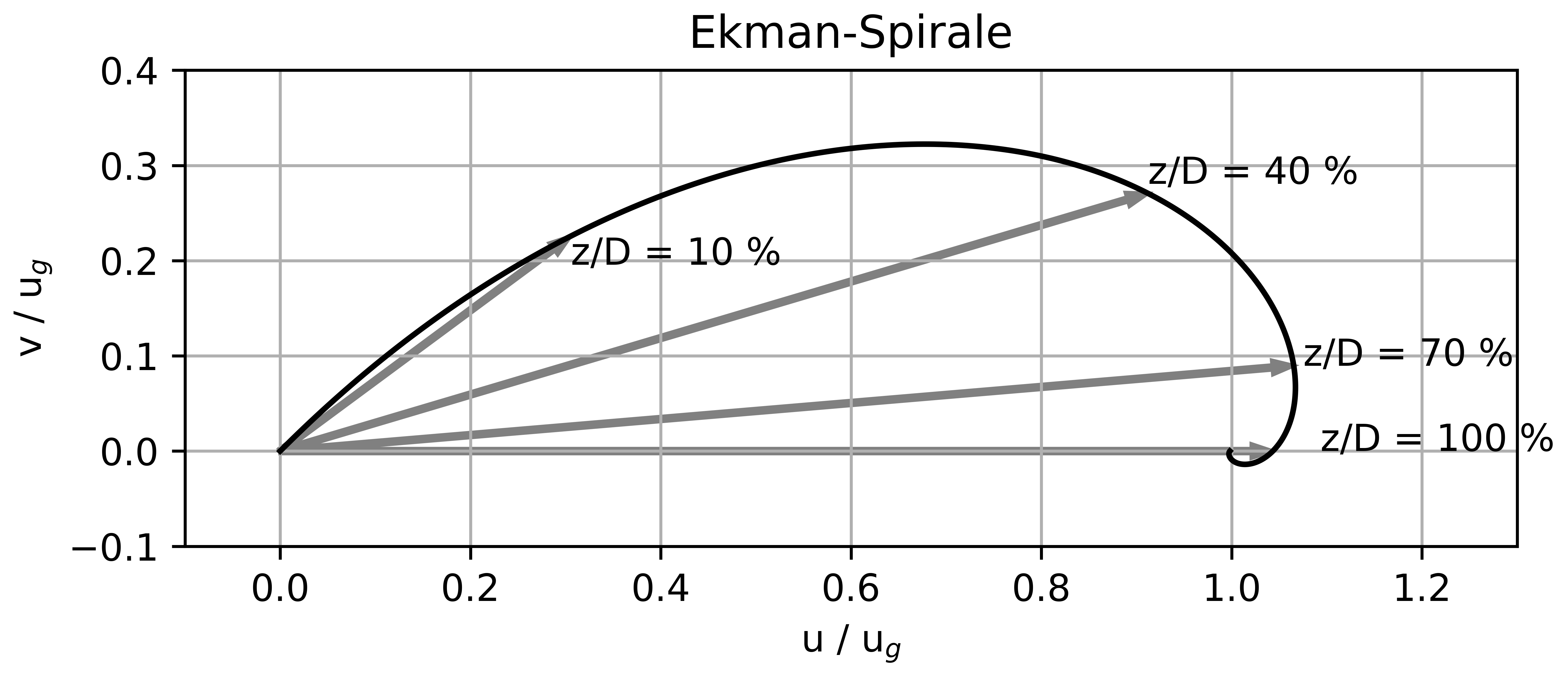
for the mass-flux density into the low. The height $D$ at which the wind is parallel to the geostrophic wind is often used as a technical definition of the boundary-layer thickness. One has
\[ \begin{align} D &= \sqrt{\frac{2K}{\left|f\right|}}\pi \end{align} \]
There the wind speed is slightly higher than the geostrophic speed, which is why this height is also referred to as the gradient wind height.
This allows the system of equations (17.65) - (17.66) to be written in the form
\[ \begin{align} \newoverline{u} &= u_g - u_g\cos\left(\frac{\pi}{D}z\right)\exp\left(-\frac{\pi}{D}z\right),\tag{17.72}\label{eq:ekman_wind_u_mod}\\ \newoverline{v} &= \sign\left(f\right)u_g\sin\left(\frac{\pi}{D}z\right)\exp\left(-\frac{\pi}{D}z\right).\tag{17.73}\label{eq:ekman_wind_v_mod} \end{align} \]
From observations one knows that at a height of approx. 1 km the wind approaches its geostrophic value, from which it follows
\[ \begin{align} K \approx \frac{\left|f\right|D^2}{2\pi^2} \approx 5\text{ m}^2/\text{s}.\tag{17.74}\label{sec:eddy_viscosity_vert_estimate} \end{align} \]
This is over five orders of magnitude above the kinematic viscosity value of $1.5\cdot 10^{-5}$ m$^2$/s. With Eq. (17.34), one obtains for the mixing length
\[ \begin{align} l = \sqrt{\frac{K}{\left|\frac{\partial\newoverline{\mathbf{v}_h}}{\partial z}\right|}} \sim \sqrt{\frac{KD}{u_g}} \sim 2\cdot 10^1\text{ m}.\tag{17.75}\label{eq:estimate_mix_len} \end{align} \]
This corresponds to the expectation that $l \ll D$ must hold for the mixing-length concept to be meaningful in the planetary boundary layer. With Eq. (17.40), a height $D_P$ of the Prandtl layer of about
\[ \begin{align} D_P = \frac{l}{k} = 50\text{ m} \end{align} \]
results, with $k = 0.4$. One defines the Ekman number $\Ek$ as the ratio of frictional to Coriolis terms, i.e.
where $H$ is the characteristic vertical extent of the phenomenon. At small Ekman numbers, the friction force can be balanced by the Coriolis force. In the boundary layer one obtains an Ekman number of $\Ek \sim 5$ %.
For a cyclone with radius $R$, the Ekman spiral leads to a pressure tendency $\frac{\partial p}{\partial t}$ of the order of magnitude
\[ \begin{align} \frac{\partial p}{\partial t} & \sim \frac{2g}{R}\frac{u_g\rho_0\alpha}{\beta^2 + \alpha^2}. \end{align} \]
With $u_g \sim 10$ m/s, $\rho_0 \approx 1.2$ kg/m$^3$ and $R \sim 500$ km
\[ \begin{align} \frac{\partial p}{\partial t} & \sim 2, 6\text{ }\frac{\text{hPa}}{\text{hr}}. \end{align} \]
This is significantly lower than the value estimated in Sect. 13.10.3. The upper limit of the boundary layer is also the upper limit of the Ekman layer.
17.3.1 Significance of the eddy viscosity
Eddy exchange coefficients $A_{i, j}$ and mixing lengths $l_x$, $l_y$, $l_z$ were introduced in order to describe the effects of turbulence, i.e. of subgrid-scale variability, on the resolved (averaged) fields. It is questionable how fundamental these quantities are, i.e. whether they are material properties or rather auxiliary quantities.
First of all, it can be stated that at very fine resolution the diffusion coefficients describe the molecular fluxes, i.e. converge to the molecular physical diffusion coefficients. At a coarser resolution, however, the diffusive terms also contain turbulent components. In this chapter, however, no explicit assumptions were made about the spatial or temporal scope of the averaging operators. Instead, it was implicitly assumed that the averaging operator is a Reynolds operator. This is only a realistic assumption if the turbulent fluctuations are small compared to the size of the averaging, but the averaging is not so extensive that synoptic-scale processes are affected. Such an averaging is, in a sense, distinguished among others, and so are the eddy exchange coefficients and mixing lengths obtained with it.
17.3.2 Monin-Obukhov length
The length
\[ \begin{align} L \coloneqq -\frac{\newoverline{\theta}u_\star^3}{kg\newoverline{\left(w'\theta'\right)}}\tag{17.80}\label{eq:mo_length} \end{align} \]
is called the Monin-Obukhov length.
17.3.3 Spin-down
If one assumes time independence of the density, it follows from the continuity equation
\[ \begin{align} \frac{\partial}{\partial z}\left(\rho w\right) = -\frac{\partial}{\partial x}\left(\rho u\right) - \frac{\partial}{\partial y}\left(\rho v\right). \end{align} \]
Integrating this from $z = 0$ to $z = D$ under the assumption $w\left(z = 0\right) = 0$ gives
\[ \begin{align} \left(\rho w\right)_D = -\int_0^D\frac{\partial}{\partial x}\left(\rho u\right) + \frac{\partial}{\partial y}\left(\rho v\right)dz. \end{align} \]
Substituting Eq. (17.73) here, one obtains
\[ \begin{align} \left(\rho w\right)_D = -\sign\left(f\right)\frac{\partial}{\partial y}\int_0^D\rho u_g\sin\left(\frac{\pi}{D}z\right)\exp\left(-\frac{\pi}{D}z\right)dz. \end{align} \]
Assuming a homogeneous density, one obtains from this
\[ \begin{align} w\left(D\right) = -\sign\left(f\right)\frac{\partial u_g}{\partial y}\int_0^D\sin\left(\frac{\pi}{D}z\right)\exp\left(-\frac{\pi}{D}z\right)dz. \end{align} \]
$\zeta_g = -\frac{\partial u_g}{\partial y}$ is the geostrophic vorticity, so it follows that
\[ \begin{align} w\left(D\right) = \sign\left(f\right)\zeta_g\int_0^D\sin\left(\frac{\pi}{D}z\right)\exp\left(-\frac{\pi}{D}z\right)dz. \end{align} \]
Again using integration by parts, one obtains
\[ \begin{align} &\int_0^D\sin\left(\frac{\pi}{D}z\right)\exp\left(-\frac{\pi}{D}z\right)dz = -\left[\frac{D}{\pi}\cos\left(\frac{\pi}{D}z\right)\exp\left(-\frac{\pi}{D}z\right)\right]_0^D - \int_0^D\cos\left(\frac{\pi}{D}z\right)\exp\left(-\frac{\pi}{D}z\right)dz\nonumber\\ &= \frac{D}{\pi}\left(1 + e^{-\pi}\right) - \int_0^D\cos\left(\frac{\pi}{D}z\right)\exp\left(-\frac{\pi}{D}z\right)dz\nonumber\\ &= \frac{D}{\pi}\left(1 + e^{-\pi}\right) - \left[\frac{D}{\pi}\sin\left(\frac{\pi}{D}z\right)\exp\left(-\frac{\pi}{D}z\right)\right]_0^D - \int_0^D\sin\left(\frac{\pi}{D}z\right)\exp\left(-\frac{\pi}{D}z\right)dz\nonumber\\ &\Rightarrow \int_0^D\sin\left(\frac{\pi}{D}z\right)\exp\left(-\frac{\pi}{D}z\right)dz = \frac{D}{2\pi}\left(1 + e^{-\pi}\right) \approx \frac{D}{2\pi} = \sqrt{\frac{K}{2f}}. \end{align} \]
Neglecting the approximation sign, this implies
Substituting $\zeta_g \sim 10^{-5}$, $f \sim 10^{-4}$, $K \sim 2$ here in SI units, one obtains
\[ \begin{align} w \sim 0,1 \text{ cm/s}. \end{align} \]
The quasi-geostrophic vorticity equation Eq. (13.219), transformed into the z-system and neglecting advection, reads
\[ \begin{align} \frac{\partial\zeta_g}{\partial t} = f\frac{\partial w}{\partial z}. \end{align} \]
Integrating this from $D$ to the tropopause height $z_T$, one obtains, under the assumption $w\left(z = z_T\right) = 0$,
\[ \begin{align} \int_D^{z_T}\frac{\partial\zeta_g}{\partial t}dz = -fw\left(D\right). \end{align} \]
Assuming that the geostrophic relative vorticity is independent of height, one has
\[ \begin{align} \frac{\partial\zeta_g}{\partial t} = -\frac{f}{z_T - D}w\left(D\right). \end{align} \]
Substituting Eq. (17.87) here, one obtains
\[ \begin{align} \frac{\partial\zeta_g}{\partial t} = -\frac{\zeta_g}{z_T - D}\sqrt{\frac{K\left|f\right|}{2}} \approx -\zeta_g\sqrt{\frac{K\left|f\right|}{2z_T^2}}. \end{align} \]
From this it follows, again neglecting the approximation sign,
\[ \begin{align} \zeta_g\left(t\right) = \zeta_g\left(0\right)\exp\left(-\sqrt{\frac{K\left|f\right|}{2z_T^2}}t\right) = \zeta_g\left(0\right)\exp\left(-\frac{t}{\tau}\right) \end{align} \]
with the spin-down time
\[ \begin{align} \tau \coloneqq z_T\sqrt{\frac{2}{K\left|f\right|}}. \end{align} \]
Substituting $z_T \sim 10^4$, $f \sim 10^{-4}$, $K \sim 2$ here in SI units, one obtains
\[ \begin{align} \tau \sim 10^6\text{ s} \sim 10\text{ d}. \end{align} \]
17.4 Isotropic turbulence
17.4.1 Spectral form of the Navier-Stokes equations
For the Fourier transform $\newtilde{\mathbf{v}}\left(\mathbf{k}, t\right)$ of a velocity field $\mathbf{v} = \mathbf{v}\left(\mathbf{r}, t\right)$, one has
\[ \begin{align} \newtilde{\mathbf{v}}\left(\mathbf{k}, t\right) = C^3\int_{\mathbb{R}^3}\mathbf{v}\left(\mathbf{r}, t\right)\exp\left(-i\mathbf{k}\cdot\mathbf{r}\right)d^3r. \end{align} \]
The inverse Fourier transform reads
\[ \begin{align} \mathbf{v}\left(\mathbf{r}, t\right) = \newtilde{C}^3\int_{\mathbb{R}^3}\newtilde{\mathbf{v}}\left(\mathbf{k}, t\right)\exp\left(i\mathbf{k}\cdot\mathbf{r}\right)d^3k.\tag{17.97}\label{eq:velocity_field_ft_inv} \end{align} \]
At this point one sets $\newtilde{C} = 1 \stackrel{\href{ch-39-orthogonal-function-systems.html#eq:ft_norm}{\text{Eq. (C.9)}}}{\Leftrightarrow} C = \frac{1}{2\pi}$ in order to shorten the notation, and neglects the $\mathbb{R}^3$ on the integral. The incompressible momentum equation reads
\[ \begin{align} \frac{\partial\mathbf{v}}{\partial t} = -\nabla\pi - \nabla\varphi - \left(\mathbf{v}\cdot\nabla\right)\mathbf{v} + \nu\Delta\mathbf{v}, \end{align} \]
where the abbreviation
\[ \begin{align} \pi\coloneqq\frac{p}{\rho} \end{align} \]
was used. The inverse Fourier transforms of the other fields that occur read
\[ \begin{align} \pi\left(\mathbf{r}, t\right) &= \int\newtilde{\pi}\left(\mathbf{k}, t\right)\exp\left(i\mathbf{k}\cdot\mathbf{r}\right)d^3k,\\ \varphi\left(\mathbf{r}\right) &= \int\newtilde{\varphi}\left(\mathbf{k}\right)\exp\left(i\mathbf{k}\cdot\mathbf{r}\right)d^3k. \end{align} \]
Furthermore, for the application of the differential operators to the fields, one has
\[ \begin{align} \frac{\partial\mathbf{v}}{\partial t} &= \int\frac{\partial\newtilde{\mathbf{v}}\left(\mathbf{k}, t\right)}{\partial t}\exp\left(i\mathbf{k}\cdot\mathbf{r}\right)d^3k,\\ -\nabla\pi &= -i\int\mathbf{k}\newtilde{\pi}\left(\mathbf{k}, t\right)\exp\left(i\mathbf{k}\cdot\mathbf{r}\right)d^3k,\\ -\nabla\varphi &= -i\int\mathbf{k}\newtilde{\varphi}\left(\mathbf{k}\right)\exp\left(i\mathbf{k}\cdot\mathbf{r}\right)d^3k,\\ \Delta\mathbf{v} &= -\int\mathbf{k}^2\newtilde{\mathbf{v}}\left(\mathbf{k}, t\right)\exp\left(i\mathbf{k}\cdot\mathbf{r}\right)d^3k. \end{align} \]
For the momentum advection, one has
\[ \begin{align} \left(\mathbf{v}\cdot\nabla\right)\mathbf{v} &= \left(\int\newtilde{\mathbf{v}}\left(\mathbf{k}, t\right)\exp\left(i\mathbf{k}\cdot\mathbf{r}\right)d^3k\cdot\nabla\right)\int\newtilde{\mathbf{v}}\left(\mathbf{k}, t\right)\exp\left(i\mathbf{k}\cdot\mathbf{r}\right)d^3k\nonumber\\ &= \left(\int\newtilde{\mathbf{v}}\left(\mathbf{k}', t\right)\exp\left(i\mathbf{k}'\cdot\mathbf{r}\right)d^3k'\cdot\nabla\right)\int\newtilde{\mathbf{v}}\left(\mathbf{k}'', t\right)\exp\left(i\mathbf{k}''\cdot\mathbf{r}\right)d^3k''\nonumber\\ &= \int\int\exp\left(i\mathbf{k}'\cdot\mathbf{r}\right)\left[\newtilde{\mathbf{v}}\left(\mathbf{k}', t\right)\cdot\nabla\right]\left[\newtilde{\mathbf{v}}\left(\mathbf{k}'', t\right)\exp\left(i\mathbf{k}''\cdot\mathbf{r}\right)\right]d^3k'd^3k''\nonumber\\ &= i\int\int\left[\newtilde{\mathbf{v}}\left(\mathbf{k}', t\right)\cdot\mathbf{k}''\right]\newtilde{\mathbf{v}}\left(\mathbf{k}'', t\right)\exp\left[i\left(\mathbf{k}' + \mathbf{k}''\right)\cdot\mathbf{r}\right]d^3k'd^3k''. \end{align} \]
This implies
\[ \begin{align} \left[\newtilde{\left(\mathbf{v}\cdot\nabla\right)\mathbf{v}}\right]\left(\mathbf{k}\right) &= \frac{i}{\left(2\pi\right)^3}\int\int\left[\newtilde{\mathbf{v}}\left(\mathbf{k}', t\right)\cdot\mathbf{k}''\right]\newtilde{\mathbf{v}}\left(\mathbf{k}'', t\right)\exp\left[i\left(-\mathbf{k} + \mathbf{k}' + \mathbf{k}''\right)\cdot\mathbf{r}\right]d^3k'd^3k''\nonumber\\ & \stackrel{\href{ch-37-derivations-of-some-mathematical-formula.html#eq:delta_distribution_prop_2}{\text{Eq. (A.86)}}}{=} i\int\int\left[\newtilde{\mathbf{v}}\left(\mathbf{k}', t\right)\cdot\mathbf{k}''\right]\newtilde{\mathbf{v}}\left(\mathbf{k}'', t\right)\delta\left(\mathbf{k}' + \mathbf{k}'' - \mathbf{k}\right)d^3k'd^3k''\nonumber\\ &= i\int\left[\newtilde{\mathbf{v}}\left(\mathbf{k}', t\right)\cdot\left(\mathbf{k} - \mathbf{k}'\right)\right]\newtilde{\mathbf{v}}\left(\mathbf{k} - \mathbf{k}', t\right)d^3k' \end{align} \]
From the incompressible continuity equation
\[ \begin{align} \nabla\cdot\mathbf{v} = 0 \end{align} \]
follows
With this, one obtains
\[ \begin{align} \left[\newtilde{\left(\mathbf{v}\cdot\nabla\right)\mathbf{v}}\right]\left(\mathbf{k}\right) &= i\int\left[\newtilde{\mathbf{v}}\left(\mathbf{k}', t\right)\cdot\mathbf{k}\right]\newtilde{\mathbf{v}}\left(\mathbf{k} - \mathbf{k}', t\right)d^3k' \end{align} \]
From the previous calculations one can assemble the expansion of the momentum equation in terms of plane waves:
\[ \begin{align} & \int\left(\frac{\partial}{\partial t} + \nu\mathbf{k}^2\right)\newtilde{\mathbf{v}}\left(\mathbf{k}, t\right)\exp\left(i\mathbf{k}\cdot\mathbf{r}\right)d^3k\nonumber\\ &= i\int\left\{-\mathbf{k}\newtilde{\pi}\left(\mathbf{k}, t\right) - \mathbf{k}\newtilde{\varphi}\left(\mathbf{k}\right) - \int\left[\newtilde{\mathbf{v}}\left(\mathbf{k}', t\right)\cdot\mathbf{k}\right]\newtilde{\mathbf{v}}\left(\mathbf{k} - \mathbf{k}', t\right)d^3k'\right\}\exp\left(i\mathbf{k}\cdot\mathbf{r}\right)d^3k \end{align} \]
This must hold at every point in spectral space, hence
\[ \begin{align} \left(\frac{\partial}{\partial t} + \nu\mathbf{k}^2\right)\newtilde{\mathbf{v}}\left(\mathbf{k}, t\right) &= -i\mathbf{k}\newtilde{\pi}\left(\mathbf{k}, t\right) - i\mathbf{k}\newtilde{\varphi}\left(\mathbf{k}\right) - i\int\left[\newtilde{\mathbf{v}}\left(\mathbf{k}', t\right)\cdot\mathbf{k}\right]\newtilde{\mathbf{v}}\left(\mathbf{k} - \mathbf{k}', t\right)d^3k'.\tag{17.112}\label{eq:turbulence_inc_spec} \end{align} \]
This is the spectral form of the incompressible momentum equation. From this it is apparent that the only term containing interactions between scales is the momentum advection.
17.4.2 Energy transfer function
As can be inferred from the Parseval identity Eq. (C.31), the specific kinetic energy associated with the wave vector $\mathbf{k}$ is described by the quantity
\[ \begin{align} \newtilde{e}\left(\mathbf{k}, t\right) = \frac{1}{2}\newtilde{\mathbf{v}}\left(\mathbf{k}, t\right)\newtilde{\mathbf{v}}\left(-\mathbf{k}, t\right) \end{align} \]
Writing Eq. (17.112) with the substitution $\mathbf{k} \to -\mathbf{k}$, one obtains
\[ \begin{align} \left(\frac{\partial}{\partial t} + \nu\mathbf{k}^2\right)\newtilde{\mathbf{v}}\left(-\mathbf{k}, t\right) &= i\mathbf{k}\newtilde{\pi}\left(-\mathbf{k}, t\right) + i\mathbf{k}\newtilde{\varphi}\left(-\mathbf{k}\right) + i\int\left[\newtilde{\mathbf{v}}\left(\mathbf{k}', t\right)\cdot\mathbf{k}\right]\newtilde{\mathbf{v}}\left(-\mathbf{k} - \mathbf{k}', t\right)d^3k'.\tag{17.114}\label{eq:deriv_turbulence_spec_0} \end{align} \]
Multiplying Eq. (17.114) by $\newtilde{\mathbf{v}}\left(\mathbf{k}, t\right)$ and using Eq. (17.109), one obtains
\[ \begin{align} \newtilde{\mathbf{v}}\left(\mathbf{k}, t\right)\cdot\left(\frac{\partial}{\partial t} + \nu\mathbf{k}^2\right)\newtilde{\mathbf{v}}\left(-\mathbf{k}, t\right) &= i\int\left[\newtilde{\mathbf{v}}\left(\mathbf{k}', t\right)\cdot\mathbf{k}\right]\left[\newtilde{\mathbf{v}}\left(\mathbf{k}, t\right)\cdot\newtilde{\mathbf{v}}\left(-\mathbf{k} - \mathbf{k}', t\right)\right]d^3k'.\tag{17.115}\label{eq:deriv_turbulence_spec_1} \end{align} \]
Multiplying, analogously, Eq. (17.112) by $\newtilde{\mathbf{v}}\left(-\mathbf{k}, t\right)$, one obtains
\[ \begin{align} \newtilde{\mathbf{v}}\left(-\mathbf{k}, t\right)\cdot\left(\frac{\partial}{\partial t} + \nu\mathbf{k}^2\right)\newtilde{\mathbf{v}}\left(\mathbf{k}, t\right) &= -i\int\left[\newtilde{\mathbf{v}}\left(\mathbf{k}', t\right)\cdot\mathbf{k}\right]\left[\newtilde{\mathbf{v}}\left(-\mathbf{k}, t\right)\cdot\newtilde{\mathbf{v}}\left(\mathbf{k} - \mathbf{k}', t\right)\right]d^3k'\tag{17.116}\label{eq:deriv_turbulence_spec_2} \end{align} \]
Adding Eqs. (17.115) and (17.116) and dividing by two, one obtains
\[ \begin{align} & \left(\frac{\partial}{\partial t} + 2\nu\mathbf{k}^2\right)\newtilde{e}\left(\mathbf{k}, t\right)\nonumber\\ &= \frac{i}{2}\int\left[\newtilde{\mathbf{v}}\left(\mathbf{k}', t\right)\cdot\mathbf{k}\right]\left[\newtilde{\mathbf{v}}\left(\mathbf{k}, t\right)\cdot\newtilde{\mathbf{v}}\left(-\mathbf{k} - \mathbf{k}', t\right)\right]d^3k' - \frac{i}{2}\int\left[\newtilde{\mathbf{v}}\left(\mathbf{k}', t\right)\cdot\mathbf{k}\right]\left[\newtilde{\mathbf{v}}\left(-\mathbf{k}, t\right)\cdot\newtilde{\mathbf{v}}\left(\mathbf{k} - \mathbf{k}', t\right)\right]d^3k'. \end{align} \]
Substituting in the first integral with $\mathbf{f}\left(\mathbf{k}'\right) = \mathbf{k}' - \mathbf{k}$ and in the second integral with $\mathbf{f}\left(\mathbf{k}'\right) = \mathbf{k} - \mathbf{k}'$, one obtains
\[ \begin{align} & \left(\frac{\partial}{\partial t} + 2\nu\mathbf{k}^2\right)\newtilde{e}\left(\mathbf{k}, t\right)\nonumber\\ &= \frac{i}{2}\int\left\{\left[\newtilde{\mathbf{v}}\left(\mathbf{k}' - \mathbf{k}, t\right)\cdot\mathbf{k}\right]\left[\newtilde{\mathbf{v}}\left(\mathbf{k}, t\right)\cdot\newtilde{\mathbf{v}}\left(-\mathbf{k}', t\right)\right] - \left[\newtilde{\mathbf{v}}\left(\mathbf{k} - \mathbf{k}', t\right)\cdot\mathbf{k}\right]\left[\newtilde{\mathbf{v}}\left(-\mathbf{k}, t\right)\cdot\newtilde{\mathbf{v}}\left(\mathbf{k}', t\right)\right]\right\}d^3k'. \end{align} \]
In the second integral, it should be noted that the minus sign that results from exchanging the integration limits cancels out the one that results from the derivation of the substituted function. One defines the energy transfer function $W = W\left(\mathbf{k}, \mathbf{k}', t\right)$ by
\[ \begin{align} W\left(\mathbf{k}, \mathbf{k}', t\right) &\coloneqq \frac{i\mathbf{k}}{2}\cdot\left\{\newtilde{\mathbf{v}}\left(\mathbf{k}' - \mathbf{k}, t\right)\left[\newtilde{\mathbf{v}}\left(\mathbf{k}, t\right)\cdot\newtilde{\mathbf{v}}\left(-\mathbf{k}', t\right)\right] - \newtilde{\mathbf{v}}\left(\mathbf{k} - \mathbf{k}', t\right)\left[\newtilde{\mathbf{v}}\left(-\mathbf{k}, t\right)\cdot\newtilde{\mathbf{v}}\left(\mathbf{k}', t\right)\right]\right\}.\tag{17.119}\label{eq:def_energy_tranfer_function} \end{align} \]
With this, one obtains the balance equation of the kinetic energy in spectral form
This shows that the friction $\propto\frac{1}{L^2}$ is scale-sensitive and in any case reduces the spectral specific kinetic energy. For the energy transfer function, one has
\[ \begin{align} W\left(\mathbf{k}', \mathbf{k}, t\right) &= \frac{i\mathbf{k}'}{2}\cdot\left\{\newtilde{\mathbf{v}}\left(\mathbf{k} - \mathbf{k}', t\right)\left[\newtilde{\mathbf{v}}\left(\mathbf{k}', t\right)\cdot\newtilde{\mathbf{v}}\left(-\mathbf{k}, t\right)\right] - \newtilde{\mathbf{v}}\left(\mathbf{k}' - \mathbf{k}, t\right)\left[\newtilde{\mathbf{v}}\left(-\mathbf{k}', t\right)\cdot\newtilde{\mathbf{v}}\left(\mathbf{k}, t\right)\right]\right\}\nonumber\\ &= -\frac{i\mathbf{k}'}{2}\cdot\left\{\newtilde{\mathbf{v}}\left(\mathbf{k}' - \mathbf{k}, t\right)\left[\newtilde{\mathbf{v}}\left(-\mathbf{k}', t\right)\cdot\newtilde{\mathbf{v}}\left(\mathbf{k}, t\right)\right] - \newtilde{\mathbf{v}}\left(\mathbf{k} - \mathbf{k}', t\right)\left[\newtilde{\mathbf{v}}\left(\mathbf{k}', t\right)\cdot\newtilde{\mathbf{v}}\left(-\mathbf{k}, t\right)\right]\right\}\nonumber\\ &= -\frac{i\mathbf{k}'}{2}\cdot\left\{\newtilde{\mathbf{v}}\left(\mathbf{k}' - \mathbf{k}, t\right)\left[\newtilde{\mathbf{v}}\left(\mathbf{k}, t\right)\cdot\newtilde{\mathbf{v}}\left(-\mathbf{k}', t\right)\right] - \newtilde{\mathbf{v}}\left(\mathbf{k} - \mathbf{k}', t\right)\left[\newtilde{\mathbf{v}}\left(-\mathbf{k}, t\right)\cdot\newtilde{\mathbf{v}}\left(\mathbf{k}', t\right)\right]\right\} \end{align} \]
From this it follows
\[ \begin{align} & W\left(\mathbf{k}', \mathbf{k}, t\right) + W\left(\mathbf{k}, \mathbf{k}', t\right)\nonumber\\ &= \frac{i\mathbf{k}}{2}\cdot\left\{\newtilde{\mathbf{v}}\left(\mathbf{k}' - \mathbf{k}, t\right)\left[\newtilde{\mathbf{v}}\left(\mathbf{k}, t\right)\cdot\newtilde{\mathbf{v}}\left(-\mathbf{k}', t\right)\right] - \newtilde{\mathbf{v}}\left(\mathbf{k} - \mathbf{k}', t\right)\left[\newtilde{\mathbf{v}}\left(-\mathbf{k}, t\right)\cdot\newtilde{\mathbf{v}}\left(\mathbf{k}', t\right)\right]\right\}\nonumber\\ & - \frac{i\mathbf{k}'}{2}\cdot\left\{\newtilde{\mathbf{v}}\left(\mathbf{k}' - \mathbf{k}, t\right)\left[\newtilde{\mathbf{v}}\left(\mathbf{k}, t\right)\cdot\newtilde{\mathbf{v}}\left(-\mathbf{k}', t\right)\right] - \newtilde{\mathbf{v}}\left(\mathbf{k} - \mathbf{k}', t\right)\left[\newtilde{\mathbf{v}}\left(-\mathbf{k}, t\right)\cdot\newtilde{\mathbf{v}}\left(\mathbf{k}', t\right)\right]\right\}\nonumber\\ &= \frac{i}{2}\left[\newtilde{\mathbf{v}}\left(\mathbf{k}, t\right)\cdot\newtilde{\mathbf{v}}\left(-\mathbf{k}', t\right)\right]\newtilde{\mathbf{v}}\left(\mathbf{k}' - \mathbf{k}, t\right)\cdot\left(\mathbf{k} - \mathbf{k}'\right)\nonumber\\ & -\frac{i}{2}\left[\newtilde{\mathbf{v}}\left(-\mathbf{k}, t\right)\cdot\newtilde{\mathbf{v}}\left(\mathbf{k}', t\right)\right]\newtilde{\mathbf{v}}\left(\mathbf{k} - \mathbf{k}', t\right)\cdot\left(\mathbf{k} - \mathbf{k}'\right)\nonumber\\ & \stackrel{\href{#eq:cont_incom_spec}{\text{Eq. (17.109)}}}{=} 0. \end{align} \]
The energy transfer function is therefore antisymmetric:
This is related to the conservation of energy: the energy gain of component $\mathbf{k}$ at the expense of component $\mathbf{k}'$ is equal to the energy loss of component $\mathbf{k}'$ due to component $\mathbf{k}$.
17.4.2.1 Isotropic form
Now one makes the assumption of isotropy, i.e. one assumes that spectral properties do not depend on the three components of the vector $\mathbf{k}$ but only on the magnitude of $k$, i.e.
\[ \begin{align} e\left(\mathbf{k}, t\right) \to \frac{\newtilde{e}\left(k, t\right)}{4\pi k^2}, & {} & W\left(\mathbf{k}, \mathbf{k}, t\right) \to \frac{W\left(k, k', t\right)}{4\pi k'^24\pi k^2}. \end{align} \]
Here a correction was made for the geometry of the spherical coordinates. Thus, Eq. (17.120) becomes
\[ \begin{align} \left(\frac{\partial}{\partial t} + 2\nu k^2\right)\frac{\newtilde{e}\left(k, t\right)}{4\pi k^2} &= \int\frac{W\left(k, k', t\right)}{4\pi k'^24\pi k^2}4\pi k'^2dk'\nonumber \end{align} \]
\[ \begin{align} \Rightarrow\left(\frac{\partial}{\partial t} + 2\nu k^2\right)\newtilde{e}\left(k, t\right) &= \int W\left(k, k', t\right)dk'. \end{align} \]
17.4.3 Heisenberg ansatz
The Heisenberg ansatz first assumes stationarity, i.e.
\[ \begin{align} 2\nu k^2\newtilde{e}\left(k\right) &= \int W\left(k, k'\right)dk'.\tag{17.126}\label{eq:heisenberg_turb_0} \end{align} \]
Furthermore, it is assumed that there is a cutoff wave number $k^\star$, which divides the spectrum into two regions:
The region $k < k^\star$ (larger wavelengths) is referred to as region 1. For geometric reasons, no isotropy can be assumed here. The Heisenberg ansatz makes no statements about this region.
The region $k \geq k^\star$ (smaller wavelengths) is called universality region. Isotropy can be assumed here and the flow is little influenced by boundary conditions.
The Heisenberg ansatz refers exclusively to the universality region. It is assumed that the smaller scales have a similar effect on the larger scales as the viscosity has on the smallest-scale eddies: they diffuse momentum. This is justified, since it can be assumed that the smaller-scale eddies diffuse momentum on average (reduce gradients of the velocity field). As a formula, the Heisenberg ansatz reads
\[ \begin{align} W\left(k, k'\right) = -2\kappa_Hk^2\newtilde{e}\left(k\right)g\left(k', \newtilde{e}\left(k'\right)\right), \end{align} \]
where $k, k' \geq k^\star$ and $k' > k$ are assumed.
\[ \begin{align} \kappa_H = 0,5\pm 0,03\tag{17.128}\label{eq:heisenberg_constant_value} \end{align} \]
[13] is a kind of dimensionless viscosity, the so-called Heisenberg constant. This formula is analogous to the molecular dissipative term $-2\nu k^2\newtilde{e}\left(k\right)$. The function $g\left(k', \newtilde{e}\left(k'\right)\right)$ describes how the smaller scale $k'$ acts on the scale $k$, whereby an explicit dependence on the energy $\newtilde{e}\left(k'\right)$ present at $k'$ was included. In the SI system, one has
\[ \begin{align} \left[\newtilde{e}\right] &= \frac{\text{J}}{\text{kg/m}} = \frac{\text{Jm}}{\text{kg}} = \frac{\text{Nm}^2}{\text{kg}} = \frac{\text{m}^3}{\text{s}^2}\\ \Rightarrow \left[\frac{\partial\newtilde{e}}{\partial t}\right] = \frac{\text{m}^3}{\text{s}^3}, & {} & \left[W\right] = \frac{\text{m}^4}{\text{s}^3}, & {} & \Rightarrow \left[k^2\newtilde{e}\left(k\right)\right] = \frac{\text{m}}{\text{s}^2} & {} & \Rightarrow \left[g\left(k', \newtilde{e}\left(k'\right)\right)\right] = \frac{\text{m}^3}{\text{s}}. \end{align} \]
As the ansatz for $g$, one now chooses
\[ \begin{align} g\left(k', \newtilde{e}\left(k'\right)\right) = \left(k'\right)^\alpha\newtilde{e}\left(k'\right)^\beta. \end{align} \]
This implies
\[ \begin{align} \beta &= \frac{1}{2}, \alpha = -\frac{3}{2}\\ \Rightarrow g\left(k', \newtilde{e}\left(k'\right)\right) &= \left(k'\right)^{-3/2}\newtilde{e}\left(k'\right)^{1/2} = \sqrt{\frac{\newtilde{e}\left(k'\right)}{\left(k'\right)^3}}. \end{align} \]
In summary, the Heisenberg ansatz thus reads
\[ \begin{align} T\left(k, k'\right) = \begin{cases} -2\kappa_Hk^2\newtilde{e}\left(k\right)\newtilde{e}\left(k'\right)^{1/2}\left(k'\right)^{-3/2},\text{ if }k' \geq k\text{ holds (energy loss to smaller scale),}\\ 2\kappa_Hk^2\newtilde{e}\left(k\right)\newtilde{e}\left(k'\right)^{1/2}\left(k'\right)^{-3/2},\text{ if }k' < k\text{ holds (energy gain from larger scale).} \end{cases}\tag{17.134}\label{eq:heisenberg-ansatz} \end{align} \]
In the context of stationarity, the kinetic energy lost through dissipation is compensated by the supply from the larger scales. The larger scales therefore have an energy loss to the smaller scales, which must be compensated for by a production $\sigma\left(k\right)$ of kinetic energy. The mechanism through which this happens is left open here. However, one assumes $\sigma\left(k\right) = 0$ for $k > k^\star$ in order to simplify the considerations in the universality region. Eq. (17.126) becomes
\[ \begin{align} 2\nu k^2\newtilde{e}\left(k\right) &= \int W\left(k, k'\right)dk' + \sigma\left(k\right).\tag{17.135}\label{eq:heisenberg_turb_1} \end{align} \]
17.4.4 Energy spectrum
Integrating Eq. (17.135) up to a wavenumber $k > k^\star$, one obtains
\[ \begin{align} 2\nu\int_0^k\left(k'\right)^2\newtilde{e}\left(k'\right)dk' &= \int_0^k\int_0^\infty W\left(k', k''\right)dk''dk' + \int_0^k\sigma\left(k'\right)dk'.\tag{17.136}\label{eq:heisenberg_turb_2} \end{align} \]
For $k = \infty$ one obtains
\[ \begin{align} 2\nu\int_0^\infty\left(k'\right)^2\newtilde{e}\left(k'\right)dk' &= \int_0^\infty\int_0^\infty W\left(k', k''\right)dk''dk' + \int_0^\infty\sigma\left(k'\right)dk'. \end{align} \]
Due to the antisymmetry of the energy transfer function $W\left(k', k''\right) = -W\left(k'', k'\right)$, one has
\[ \begin{align} \int_0^\infty\int_0^\infty W\left(k', k''\right)dk''dk' = 0. \end{align} \]
This corresponds to the fact that the energy transfer function redistributes kinetic energy, but does not produce or destroy kinetic energy. This leads to
\[ \begin{align} 2\nu\int_0^\infty\left(k'\right)^2\newtilde{e}\left(k'\right)dk' = \int_0^\infty\sigma\left(k'\right)dk'. \end{align} \]
This corresponds to the fact that under stationary conditions the energy input is equal to the energy loss. The energy loss is equal to the dissipation:
\[ \begin{align} \epsilon = 2\nu\int_0^\infty\left(k'\right)^2\newtilde{e}\left(k'\right)dk' \end{align} \]
Because $k > k^\star$ and $\sigma\left(k'\right) = 0$ for $k' > k^\star$, one has
\[ \begin{align} \int_0^k\sigma\left(k'\right)dk' = \int_0^\infty\sigma\left(k'\right)dk'. \end{align} \]
Thus, one can write Eq. (17.136) in the form
\[ \begin{align} 2\nu\int_0^k\left(k'\right)^2\newtilde{e}\left(k'\right)dk' &= \int_0^k\int_0^\infty W\left(k', k''\right)dk''dk' + \epsilon \end{align} \]
Again, because of the antisymmetry $W\left(k', k''\right) = -W\left(k'', k'\right)$, one has
\[ \begin{align} \int_0^k\int_0^kW\left(k', k''\right)dk''dk' = 0. \end{align} \]
Therefore, one has
\[ \begin{align} 2\nu\int_0^k\left(k'\right)^2\newtilde{e}\left(k'\right)dk' &= \int_0^k\int_k^\infty W\left(k', k''\right)dk''dk' + \epsilon\nonumber\\ \Leftrightarrow \epsilon &= 2\nu\int_0^k\left(k'\right)^2\newtilde{e}\left(k'\right)dk' - \int_0^k\int_k^\infty W\left(k', k''\right)dk''dk''. \end{align} \]
Substituting Eq. (17.134) here and noting $k'' > k'$, one obtains
\[ \begin{align} \epsilon &= 2\nu\int_0^k\left(k'\right)^2\newtilde{e}\left(k'\right)dk' - \int_0^k\int_k^\infty-2\kappa_H\left(k'\right)^2\newtilde{e}\left(k'\right)\newtilde{e}\left(k''\right)^{1/2}\left(k''\right)^{-3/2}dk''dk'\nonumber\\ \Leftrightarrow \epsilon &= 2\nu\int_0^k\left(k'\right)^2\newtilde{e}\left(k'\right)dk' + 2\kappa_H\int_0^k\int_k^\infty\left(k'\right)^2\newtilde{e}\left(k'\right)\newtilde{e}\left(k''\right)^{1/2}\left(k''\right)^{-3/2}dk''dk'\nonumber\\ \Leftrightarrow \epsilon &= 2\nu\int_0^k\left(k'\right)^2\newtilde{e}\left(k'\right)dk' + 2\kappa_H\int_k^\infty\newtilde{e}\left(k''\right)^{1/2}\left(k''\right)^{-3/2}dk''\int_0^k\left(k'\right)^2\newtilde{e}\left(k'\right)dk'\nonumber\\ \Leftrightarrow \epsilon &= 2\nu\int_0^k\left(k'\right)^2\newtilde{e}\left(k'\right)dk' + 2\kappa_H\int_k^\infty\sqrt{\frac{\newtilde{e}\left(k''\right)}{\left(k''\right)^3}}dk''\int_0^k\left(k'\right)^2\newtilde{e}\left(k'\right)dk'\nonumber\\ \Leftrightarrow\epsilon &= \left(2\nu + 2\kappa_H\int_k^\infty\sqrt{\frac{\newtilde{e}\left(k''\right)}{\left(k''\right)^3}}dk''\right)\int_0^k\left(k'\right)^2\newtilde{e}\left(k'\right)dk'\nonumber\\ \Leftrightarrow\epsilon &= \left(\nu + \kappa_H\int_k^\infty\sqrt{\frac{\newtilde{e}\left(k''\right)}{\left(k''\right)^3}}dk''\right)\int_0^k2\left(k'\right)^2\newtilde{e}\left(k'\right)dk'.\tag{17.145}\label{eq:heisenberg_turb_3} \end{align} \]
The quantity
\[ \begin{align} K \coloneqq \kappa_H\int_k^\infty\sqrt{\frac{\newtilde{e}\left(k'\right)}{\left(k'\right)^3}}dk'\tag{17.146}\label{eq:heisenberg_exchange} \end{align} \]
has the dimension of a viscosity and is called Heisenberg's exchange coefficient.
One now defines an auxiliary function
\[ \begin{align} f\left(k\right) \coloneqq 2\int_0^k\left(k'\right)^2\newtilde{e}\left(k'\right)dk' \Rightarrow f'\left(k\right) = 2k^2\newtilde{e}\left(k\right).\tag{17.147}\label{eq:heisenberg_turb_6} \end{align} \]
This allows Eq. (17.145) to be written in the form
\[ \begin{align} \frac{\epsilon}{f\left(k\right)} = \nu + \kappa_H\int_k^\infty\sqrt{\frac{\newtilde{e}\left(k'\right)}{\left(k'\right)^3}}dk' = \nu + \kappa_H\int_k^\infty\sqrt{\frac{f'\left(k'\right)}{2\left(k'\right)^5}}dk'\tag{17.148}\label{eq:heisenberg_turb_5} \end{align} \]
Differentiating this equation, one obtains
\[ \begin{align} -\frac{\epsilon f'\left(k\right)}{f\left(k\right)^2} = -\kappa_H\sqrt{\frac{f'\left(k\right)}{2k^5}} \Rightarrow \frac{\epsilon^2f'\left(k\right)^2}{f\left(k\right)^4} = \kappa_H^2\frac{f'\left(k\right)}{2k^5} \Leftrightarrow \frac{\epsilon^2f'\left(k\right)}{f\left(k\right)^4} = \frac{\kappa_H^2}{2k^5}. \end{align} \]
Integrating both sides over $k$, one obtains
\[ \begin{align} -\frac{\epsilon^2}{3f\left(k\right)^3} + C = -\frac{\kappa_H^2}{8k^4} \Leftrightarrow \frac{\epsilon^2}{3f\left(k\right)^3} = C + \frac{\kappa_H^2}{8k^4}\tag{17.150}\label{eq:heisenberg_turb_4} \end{align} \]
with an integration constant $C$. To determine it, one considers Eq. (17.150) for $k \to \infty$:
\[ \begin{align} C = \frac{\epsilon^2}{3f\left(\infty\right)^3} \end{align} \]
To determine $f\left(\infty\right)$, one evaluates Eq. (17.148) for $k \to \infty$:
\[ \begin{align} \frac{\epsilon}{f\left(\infty\right)} &= \nu \Rightarrow f\left(\infty\right) = \frac{\epsilon}{\nu}\nonumber\\ \Rightarrow C &= \frac{\epsilon^2}{3f\left(\infty\right)^3} = \frac{\nu^3}{3\epsilon} \end{align} \]
Substituting this into Eq. (17.150), one obtains
\[ \begin{align} \frac{\epsilon^2}{3f\left(k\right)^3} &= \frac{\nu^3}{3\epsilon} + \frac{\kappa_H^2}{8k^4}\nonumber\\ \Rightarrow f\left(k\right)^3 &= \frac{\epsilon^2}{3}\left(\frac{\kappa_H^2}{8k^4} + \frac{\nu^3}{3\epsilon}\right)^{-1}\nonumber\\ \Rightarrow f\left(k\right) &= \frac{\epsilon^{2/3}}{3^{1/3}}\left(\frac{\kappa_H^2}{8k^4} + \frac{\nu^3}{3\epsilon}\right)^{-1/3}. \end{align} \]
Differentiating this with respect to $k$, one obtains
\[ \begin{align} f'\left(k\right) &= \frac{\epsilon^{2/3}}{3^{1/3}}\frac{4}{3}\frac{\kappa_H^2}{8k^5}\left(\frac{\kappa_H^2}{8k^4} + \frac{\nu^3}{3\epsilon}\right)^{-4/3}. \end{align} \]
Substituting Eq. (17.147) here, one obtains
\[ \begin{align} 2k^2\newtilde{e}\left(k\right) &= \frac{\epsilon^{2/3}}{3^{1/3}}\frac{4}{3}\frac{\kappa_H^2}{8k^5}\left(\frac{\kappa_H^2}{8k^4} + \frac{\nu^3}{3\epsilon}\right)^{-4/3}\nonumber\\ \Leftrightarrow \newtilde{e}\left(k\right) &= \frac{\epsilon^{2/3}}{3^{1/3}}\frac{2}{3k^3}\frac{\kappa_H^2}{8k^4}\left(\frac{\kappa_H^2}{8k^4} + \frac{\nu^3}{3\epsilon}\right)^{-4/3}\nonumber\\ \Leftrightarrow \newtilde{e}\left(k\right) &= \frac{\epsilon^{2/3}}{3^{1/3}}\frac{2}{3k^3}\left(\frac{\kappa_H^2}{8k^4}\right)^{-1/3}\left(\frac{8k^4}{\kappa_H^2}\right)^{-4/3}\left(\frac{\kappa_H^2}{8k^4} + \frac{\nu^3}{3\epsilon}\right)^{-4/3}\nonumber\\ \Leftrightarrow \newtilde{e}\left(k\right) &= \frac{\epsilon^{2/3}}{3^{1/3}}\frac{2}{3k^3}\left(\frac{\kappa_H^2}{8k^4}\right)^{-1/3}\left(1 + \frac{8\nu^3k^4}{3\epsilon\kappa_H^2}\right)^{-4/3}\nonumber\\ \Leftrightarrow \newtilde{e}\left(k\right) &= \frac{\epsilon^{2/3}}{3^{1/3}}\frac{2}{3}\left(\frac{\kappa_H^2}{8}\right)^{-1/3}k^{-5/3}\left(1 + \frac{8\nu^3k^4}{3\epsilon\kappa_H^2}\right)^{-4/3}\nonumber\\ \Leftrightarrow \newtilde{e}\left(k\right) &= \left(\frac{8^2}{3^4\kappa_H^2}\right)^{1/3}\epsilon^{2/3}k^{-5/3}\left(1 + \frac{8\nu^3k^4}{3\epsilon\kappa_H^2}\right)^{-4/3}\nonumber \end{align} \]
17.4.5 Definitions and approximations
The starting point of this section is Eq. (17.155). First, one defines some abbreviations. One first defines
\[ \begin{align} k_c \coloneqq \left(\frac{\epsilon}{\nu^3}\right)^{1/4}. \end{align} \]
With this, Eq. (17.157) becomes
\[ \begin{align} \newtilde{e}\left(k\right) &= \left(\frac{8}{9\kappa_H}\right)^{2/3}\epsilon^{2/3}k^{-5/3}\left(1 + \frac{8k^4}{3\kappa_H^2k_c^4}\right)^{-4/3}.\tag{17.157}\label{eq:turb_iso_inc_spec_pre_1} \end{align} \]
Furthermore, one defines the Kolmogorov constant $\kappa_K$ by
\[ \begin{align} \kappa_K \coloneqq \left(\frac{8}{9\kappa_H}\right)^{2/3},\tag{17.158}\label{eq:def_kappa_k} \end{align} \]
the characteristic length $l_c$ by
\[ \begin{align} l_c \coloneqq \left(\frac{\nu^3}{\epsilon}\right)^{1/4}\tag{17.159}\label{eq:characteristic_length} \end{align} \]
as well as the characteristic time $t_c$ by
\[ \begin{align} t_c \coloneqq \left(\frac{\nu}{\epsilon}\right)^{1/2}. \end{align} \]
From this it follows
\[ \begin{align} k_c = \frac{1}{l_c}. \end{align} \]
Substituting this into Eq. (17.157), one obtains
Two further important limiting cases can be derived from this. For $k > \sqrt{\kappa_H}k_c$, one has
\[ \begin{align} \newtilde{e}\left(k\right) & \approx \left(\frac{8}{9\kappa_H}\right)^{2/3}\epsilon^{2/3}k^{-5/3}\left(\frac{8k^4l_c^4}{3\kappa_H^2}\right)^{-4/3} = \left(\frac{8\epsilon}{9\kappa_H}\right)^{2/3}\left(\frac{8\nu^3}{3\epsilon\kappa_H^2}\right)^{-4/3}k^{-7}\nonumber\\ &= \left(\frac{8\epsilon}{9\kappa_H}\right)^{2/3}\left(\frac{3\epsilon\kappa_H^2}{8\nu^3}\right)^{4/3}k^{-7}\nonumber \end{align} \]
\[ \begin{align} \Leftrightarrow\newtilde{e}\left(k\right) & \approx \left(\frac{\kappa_H\epsilon}{2\nu^2}\right)^{2}k^{-7}. \end{align} \]
This region of the spectrum ($k > k_c$) is called the dissipative range. In this range, the viscosity leads to a steep decay of the spectrum. In the case $k^\star < k \ll k_c$, one has
This region of the spectrum ($k^\star < k \ll k_c$) is called the inertial subrange.
17.5 Classical Smagorinsky model
The simplest approach to computing the turbulent horizontal diffusion coefficient $K$ is the so-called classical Smagorinsky model (CSM). The starting point for the derivation is Eq. (17.146), where the just barely resolved angular wavenumber $\frac{2\pi}{2\Delta} = \frac{\pi}{\Delta}$ is substituted for $k$:
\[ \begin{align} K\coloneqq\kappa_H\int_\frac{\pi}{\Delta}^\infty\sqrt{\frac{\newtilde{e}\left(k\right)}{k^3}}dk \end{align} \]
The relevant scale range of turbulent diffusion in the atmosphere is the inertial subrange ($k^\star < k \ll k_c$), in which Eq. (17.164) holds. From this it follows
\[ \begin{align} K &= \kappa_H\int_\frac{\pi}{\Delta}^\infty\sqrt{\frac{\kappa_K\epsilon^{2/3}k^{-5/3}}{k^3}}dk = \kappa_H\sqrt{\kappa_K}\epsilon^{1/3}\int_\frac{\pi}{\Delta}^\infty\sqrt{k^{-14/3}}dk\nonumber\\ \Leftrightarrow K &= \kappa_H\sqrt{\kappa_K}\epsilon^{1/3}\int_\frac{\pi}{\Delta}^\infty k^{-7/3}dk = \kappa_H\sqrt{\kappa_K}\epsilon^{1/3}\left[-\frac{3}{4}k^{-4/3}\right]_\frac{\pi}{\Delta}^\infty\nonumber\\ \Leftrightarrow K &= \frac{3}{4}\kappa_H\sqrt{\kappa_K}\epsilon^{1/3}\left(\frac{\pi}{\Delta}\right)^{-4/3} = \frac{3}{4}\kappa_H\sqrt{\kappa_K}\epsilon^{1/3}\left(\frac{\Delta}{\pi}\right)^{4/3}.\tag{17.166}\label{eq:csm_deriv} \end{align} \]
This result cannot yet be used directly for a numerical model because $\epsilon$ is not known. To determine an expression for $\epsilon$, one starts from Eq. (17.145):
\[ \begin{align} \epsilon &= \left(\nu + K\right)\int_0^\frac{\pi}{\Delta}2k^2\newtilde{e}\left(k\right)dk. \end{align} \]
Comparing this with Eq. , it follows
\[ \begin{align} \epsilon &= \left(\nu + K\right)S^2\nonumber. \end{align} \]
Because $\Delta \gg l_c$, one has to a good approximation
\[ \begin{align} \epsilon &= KS^2 \Rightarrow \epsilon^\frac{1}{3} = K^\frac{1}{3}S^\frac{2}{3}. \end{align} \]
Substituting this into Eq. (17.166), one obtains
\[ \begin{align} K &= \frac{3}{4}\kappa_H\sqrt{\kappa_K}K^\frac{1}{3}S^\frac{2}{3}\left(\frac{\Delta}{\pi}\right)^{4/3}\nonumber\\ \Leftrightarrow K^\frac{2}{3} &= \frac{3}{4}\kappa_H\sqrt{\kappa_K}S^\frac{2}{3}\left(\frac{\Delta}{\pi}\right)^{4/3}\nonumber\\ \Leftrightarrow K &= \kappa_K^\frac{3}{4}\left(\frac{3}{4}\kappa_H\right)^\frac{3}{2}S\left(\frac{\Delta}{\pi}\right)^2\nonumber\\ \Leftrightarrow K &= \frac{1}{\pi^2}\kappa_K^\frac{3}{4}\left(\frac{3}{4}\kappa_H\right)^\frac{3}{2}\Delta^2S. \end{align} \]
With the definition
\[ \begin{align} c_S^2 &\coloneqq \frac{1}{\pi^2}\kappa_K^\frac{3}{4}\left(\frac{3}{4}\kappa_H\right)^\frac{3}{2} \stackrel{\href{#eq:def_kappa_k}{\text{Eq. (17.158)}}}{=} \frac{1}{\pi^2}\left(\frac{8}{9\kappa_H}\right)^{1/2}\left(\frac{3}{4}\kappa_H\right)^\frac{3}{2} = \frac{\kappa_H}{\pi^2}\left(\frac{8}{9}\right)^{1/2}\left(\frac{3}{4}\right)^\frac{3}{2} = \frac{\kappa_H}{\pi^2}\left(\frac{8\cdot 9}{9\cdot 16}\right)^{1/2}\left(\frac{3}{4}\right)^\frac{1}{2}\nonumber\\ &= \frac{\sqrt{3}\kappa_H}{2\sqrt{2}\pi^2} \stackrel{\href{#eq:heisenberg_constant_value}{\text{Eq. (17.128)}}}{\approx} \frac{\sqrt{3}}{4\sqrt{2}\pi^2} \approx 0,03\nonumber\\ \Leftrightarrow c_S &= \left(\frac{3}{8}\right)^{1/4}\frac{\sqrt{\kappa_H}}{\pi} \approx \left(\frac{3}{8}\right)^{1/4}\frac{1}{\sqrt{2}\pi} \approx 0,176 \end{align} \]
one can write this in the form
\[ \begin{align} K &= c_S^2\Delta^2S \end{align} \]
From this it follows, in the case of two-dimensional flow,
From Eq. (17.166) an expression for the dissipation can also be derived if the diffusion coefficient is known:
\[ \begin{align} \frac{3}{4}\kappa_H\sqrt{\kappa_K}\epsilon^{1/3}\left(\frac{\Delta}{\pi}\right)^{4/3} &= K\nonumber\\ \Leftrightarrow\epsilon^{1/3} &= \frac{4}{3\kappa_H\sqrt{\kappa_K}}\left(\frac{\pi}{\Delta}\right)^{4/3}K\nonumber\\ \Leftrightarrow\epsilon &= \left(\frac{4}{3\kappa_H\sqrt{\kappa_K}}\right)^3\left(\frac{\pi}{\Delta}\right)^{4}K^{3} \approx 1039\cdot\frac{K^3}{\Delta^4} \end{align} \]
17.6 Turbulent kinetic energy
The so-called specific turbulent kinetic energy $k_s$ is the subscale part of the kinetic energy, in contrast to the resolved part, which is denoted here by $k_m$. A prognostic equation is to be derived for this quantity. One begins by writing down again the equation of the specific kinetic energy, Eq. (14.8):
\[ \begin{align} \frac{\partial k}{\partial t} = \frac{1}{2}\frac{\partial}{\partial t}\left(u^2 + v^2 + w^2\right) = -\mathbf{v}\cdot\nabla k -\frac{1}{\rho}\mathbf{v}\cdot\nabla p - wg - \epsilon = -\sum_{i,j=1}^3u_iu_j\frac{\partial u_j}{x_i} -\frac{1}{\rho}\mathbf{v}\cdot\nabla p - wg - \epsilon. \end{align} \]
The pressure gradient is expressed using the Exner pressure:
\[ \begin{align} \frac{\partial k}{\partial t} = -\sum_{i,j=1}^3u_iu_j\frac{\partial u_j}{x_i} - c^{(p)}\theta\mathbf{v}\cdot\nabla\Pi - wg - \epsilon.\tag{17.175}\label{eq:tke_deriv_tk} \end{align} \]
Furthermore, one writes down the momentum equation without friction:
\[ \begin{align} \frac{\partial u_i}{\partial t} = -\sum_{j=1}^3u_j\frac{\partial u_i}{x_j} - c^{(p)}\theta\frac{\partial\Pi}{\partial x_i} - g_i. \end{align} \]
Carrying out a Reynolds averaging here, one obtains
\[ \begin{align} \frac{\partial\newoverline{u_i}}{\partial t} = -\sum_{j=1}^3\newoverline{u_j}\frac{\partial\newoverline{u_i}}{x_j} - \sum_{j=1}^3\newoverline{u_j'\frac{\partial u_i'}{x_j}} - c^{(p)}\newoverline{\theta}\frac{\partial\newoverline{\Pi}}{\partial x_i} - c^{(p)}\newoverline{\theta'\frac{\partial\Pi'}{\partial x_i}} - g_i. \end{align} \]
Multiplying this equation by $\newoverline{u_i}$, one obtains
\[ \begin{align} \newoverline{u_i}\frac{\partial\newoverline{u_i}}{\partial t} = -\newoverline{u_i}\sum_{j=1}^3\newoverline{u_j}\frac{\partial\newoverline{u_i}}{x_j} - \newoverline{u_i}\sum_{j=1}^3\newoverline{u_j'\frac{\partial u_i'}{x_j}} - c^{(p)}\newoverline{u_i}\newoverline{\theta}\frac{\partial\newoverline{\Pi}}{\partial x_i} - c^{(p)}\newoverline{u_i}\newoverline{\theta'\frac{\partial\Pi'}{\partial x_i}} - \newoverline{u_i}g_i. \end{align} \]
Summing this equation over $i$, one obtains
\[ \begin{align} \frac{\partial k_m}{\partial t} &= -\sum_{i,j=1}^3\newoverline{u_i}\newoverline{u_j}\frac{\partial\newoverline{u_i}}{x_j} - \sum_{i,j=1}^3\newoverline{u_i}\newoverline{u_j'\frac{\partial u_i'}{x_j}} - c^{(p)}\newoverline{\theta}\newoverline{\mathbf{v}}\cdot\nabla\newoverline{\Pi} - c^{(p)}\newoverline{\mathbf{v}}\cdot\newoverline{\theta'\nabla\Pi'} + \newoverline{\mathbf{v}}\cdot\mathbf{g}\nonumber\\ &= -\sum_{j=1}^3\newoverline{u_j}\sum_{i=1}^3\newoverline{u_i}\frac{\partial\newoverline{u_i}}{x_j} - \sum_{i,j=1}^3\newoverline{u_i}\newoverline{u_j'\frac{\partial u_i'}{x_j}} - c^{(p)}\newoverline{\theta}\newoverline{\mathbf{v}}\cdot\nabla\newoverline{\Pi} - c^{(p)}\newoverline{\mathbf{v}}\cdot\newoverline{\theta'\nabla\Pi'} + \newoverline{\mathbf{v}}\cdot\mathbf{g}\nonumber\\ &= -\sum_{j=1}^3\newoverline{u_j}\frac{\partial k_m}{x_j} - \sum_{i,j=1}^3\newoverline{u_i}\newoverline{u_j'\frac{\partial u_i'}{x_j}} - c^{(p)}\newoverline{\theta}\newoverline{\mathbf{v}}\cdot\nabla\newoverline{\Pi} - c^{(p)}\newoverline{\mathbf{v}}\cdot\newoverline{\theta'\nabla\Pi'} + \newoverline{\mathbf{v}}\cdot\mathbf{g}\nonumber\\ &= -\newoverline{\mathbf{v}}\cdot\nabla{k_m} - \sum_{i,j=1}^3\newoverline{u_i}\newoverline{u_j'\frac{\partial u_i'}{x_j}} - c^{(p)}\newoverline{\theta}\newoverline{\mathbf{v}}\cdot\nabla\newoverline{\Pi} - c^{(p)}\newoverline{\mathbf{v}}\cdot\newoverline{\theta'\nabla\Pi'} + \newoverline{\mathbf{v}}\cdot\mathbf{g}. \end{align} \]
Here
\[ \begin{align} k_m \coloneqq \frac{1}{2}\left(\newoverline{u}^2 + \newoverline{v}^2 + \newoverline{w}^2\right) \end{align} \]
is the mean kinetic energy. If one further assumes that the background state is hydrostatically balanced, i.e. $-c^{(p)}\newoverline{\theta}\nabla\newoverline{\Pi} + \mathbf{g} = \mathbf{0}$, it follows
\[ \begin{align} \frac{\partial k_m}{\partial t} = -\newoverline{\mathbf{v}}\cdot\nabla{k_m} - \sum_{i,j=1}^3\newoverline{u_i}\newoverline{u_j'\frac{\partial u_i'}{x_j}} - c^{(p)}\newoverline{\mathbf{v}}\cdot\newoverline{\theta'\nabla\Pi'}.\tag{17.181}\label{eq:tke_deriv_ke} \end{align} \]
The subscale or turbulent kinetic energy is
\[ \begin{align} k_s &\coloneqq k' = \frac{1}{2}\frac{\partial}{\partial t}\left(u'^2 + v'^2 + w'^2\right). \end{align} \]
Substituting this into Eq. (17.175), one obtains
\[ \begin{align} \frac{\partial k_m}{\partial t} + \frac{\partial k_s}{\partial t} = -\sum_{i,j=1}^3u_iu_j\frac{\partial u_j}{x_i} - c^{(p)}\theta\mathbf{v}\cdot\nabla\Pi - wg - \epsilon. \end{align} \]
Carrying out a Reynolds averaging here, one obtains
\[ \begin{align} \frac{\partial k_m}{\partial t} + \frac{\partial k_s}{\partial t} &= -\newoverline{\mathbf{v}}\cdot\nabla{k_m} - \sum_{i,j=1}^3\newoverline{u_i}\newoverline{u_j'\frac{\partial u_i'}{x_j}} - c^{(p)}\newoverline{\mathbf{v}}\cdot\newoverline{\theta'\nabla\Pi'}\nonumber\\ &-\sum_{i,j=1}^3\newoverline{u_i'u_j'}\frac{\partial\newoverline{u_i}}{x_j} - \sum_{i,j=1}^3\newoverline{u_j}\newoverline{u_i'\frac{\partial u_i'}{x_j}} - c^{(p)}\newoverline{\theta'\mathbf{v}'}\cdot\nabla\newoverline{\Pi} - c^{(p)}\newoverline{\theta}\newoverline{\mathbf{v}'\cdot\nabla\Pi'} - \newoverline{\epsilon}\nonumber\\ &= -\newoverline{\mathbf{v}}\cdot\nabla{k_m} - \sum_{i,j=1}^3\newoverline{u_i}\newoverline{u_j'\frac{\partial u_i'}{x_j}} - c^{(p)}\newoverline{\mathbf{v}}\cdot\newoverline{\theta'\nabla\Pi'}\nonumber\\ &-\sum_{i,j=1}^3\newoverline{u_i'u_j'}\frac{\partial\newoverline{u_i}}{x_j} - \newoverline{\mathbf{v}}\cdot\nabla{k_s} - c^{(p)}\newoverline{\theta'w'}\frac{\partial\newoverline{\Pi}}{\partial z} - c^{(p)}\newoverline{\theta}\newoverline{\mathbf{v}'\cdot\nabla\Pi'} - \newoverline{\epsilon}. \end{align} \]
Using Eq. (17.181), one obtains the so-called TKE equation:
\[ \begin{align} \frac{\partial k_s}{\partial t} = -\newoverline{\mathbf{v}}\cdot\nabla{k_s} - \sum_{i,j=1}^3\newoverline{u_i'u_j'}\frac{\partial\newoverline{u_i}}{x_j} - c^{(p)}\newoverline{\theta'w'}\frac{\partial\newoverline{\Pi}}{\partial z} - c^{(p)}\newoverline{\theta}\newoverline{\mathbf{v}'\cdot\nabla\Pi'} - \newoverline{\epsilon}\tag{17.185}\label{eq:tke} \end{align} \]
With
\[ \begin{align} -c^{(p)}\newoverline{\theta}\frac{\partial\newoverline{\Pi}}{\partial z} = g \end{align} \]
one can reformulate this as
\[ \begin{align} \frac{\partial k_s}{\partial t} + \newoverline{\mathbf{v}}\cdot\nabla{k_s} = \underbrace{-\sum_{i,j=1}^3\newoverline{u_i'u_j'}\frac{\partial\newoverline{u_i}}{x_j}}_{\text{dynamic production}} + \underbrace{g\newoverline{\frac{\theta'}{\newoverline{\theta}}w'}}_{\text{buoyancy flux}} - c^{(p)}\newoverline{\theta}\newoverline{\mathbf{v}'\cdot\nabla\Pi'} - \newoverline{\epsilon}. \end{align} \]
The dynamic production describes the production of TKE through the dissipation of large-scale motions.
In the dynamic production term, only the vertical shear terms of the horizontal wind are usually taken into account. The third term, which represents the correlation between velocity and pressure fluctuations, is usually neglected. This leads to
\[ \begin{align} \frac{\partial k_s}{\partial t} + \newoverline{\mathbf{v}}\cdot\nabla{k_s} = -\newoverline{u'w'}\frac{\partial\newoverline{u}}{\partial z} - \newoverline{v'w'}\frac{\partial\newoverline{v}}{\partial z} + g\newoverline{\frac{\theta'}{\newoverline{\theta}}w'} - \newoverline{\epsilon}. \end{align} \]
Multiplying this equation by $\rho$ and the continuity equation by $k_s$ and adding the results, one obtains the TKE equation in flux form:
\[ \begin{align} \frac{\partial\left(\rho k_s\right)}{\partial t} + \nabla\cdot\left(\rho k_s\newoverline{\mathbf{v}}\right) = -\rho\newoverline{u'w'}\frac{\partial\newoverline{u}}{\partial z} - \rho\newoverline{v'w'}\frac{\partial\newoverline{v}}{\partial z} + \rho g\newoverline{\frac{\theta'}{\newoverline{\theta}}w'} - \rho\newoverline{\epsilon}.\tag{17.189}\label{eq:tke_fluss} \end{align} \]
17.7 Geostrophic turbulence
Applying the operator $\nabla\times$ to Eq. (17.97) in two dimensions, one obtains
\[ \begin{align} \zeta &= \mathbf{e}_z\cdot\nabla\times\mathbf{v} = \mathbf{e}_z\cdot\nabla\times\int_{\mathbb{R}^2}\newtilde{\mathbf{v}}\left(\mathbf{k}\right)\exp\left(i\mathbf{k}\cdot\mathbf{r}\right)d^2r = \mathbf{e}_z\cdot\int_{\mathbb{R}^2}\nabla\times\left[\newtilde{\mathbf{v}}\left(\mathbf{k}\right)\exp\left(i\mathbf{k}\cdot\mathbf{r}\right)\right]d^2r\nonumber\\ &\stackrel{\href{ch-38-vector-analysis.html#eq:diff_op_harmonic_rule_1}{\text{Eq. (B.60)}}}{=} \mathbf{e}_z\cdot\int_{\mathbb{R}^2}i\newtilde{\mathbf{v}}\left(\mathbf{k}\right)\exp\left(i\mathbf{k}\cdot\mathbf{r}\right)\times\mathbf{k}d^2r = \int_{\mathbb{R}^2}\mathbf{e}_z\cdot\left[i\newtilde{\mathbf{v}}\left(\mathbf{k}\right)\times\mathbf{k}\right]\exp\left(i\mathbf{k}\cdot\mathbf{r}\right)d^2r. \end{align} \]
From this it follows
\[ \begin{align} \newtilde{\zeta}\left(\mathbf{k}\right) = \mathbf{e}_z\cdot\left[i\newtilde{\mathbf{v}}\left(\mathbf{k}\right)\times\mathbf{k}\right]. \end{align} \]
From the Parseval identity Eq. (C.31), one obtains
\[ \begin{align} \newtilde{\zeta^2}\left(\mathbf{k}\right) &= -4\pi^2i\left(\newtilde{\mathbf{v}}\left(-\mathbf{k}\right)\times\mathbf{k}\right)\cdot i\left(\newtilde{\mathbf{v}}\left(\mathbf{k}\right)\times\mathbf{k}\right) = 4\pi^2\left(\newtilde{\mathbf{v}}\left(-\mathbf{k}\right)\times\mathbf{k}\right)\cdot\left(\newtilde{\mathbf{v}}\left(\mathbf{k}\right)\times\mathbf{k}\right)\nonumber\\ &= 4\pi^2\left(\newtilde{\mathbf{v}}\left(\mathbf{k}\right)^\star\times\mathbf{k}\right)\cdot\left(\newtilde{\mathbf{v}}\left(\mathbf{k}\right)\times\mathbf{k}\right) \end{align} \]
In polar coordinates this gives
\[ \begin{align} \newtilde{\zeta^2}\left(k, \phi\right) &= 4\pi^2\newtilde{\mathbf{v}}\left(k, \phi\right)^\star k\sin\left(\phi\right)\newtilde{\mathbf{v}}\left(k, \phi\right)k\sin\left(\phi\right) = 4\pi^2\left|\newtilde{\mathbf{v}}\left(k, \phi\right)\right|^2k^2\sin\left(\phi\right)^2. \end{align} \]
For isotropy ($\newtilde{\mathbf{v}}\left(k, \phi\right) \to \newtilde{\mathbf{v}}\left(k\right)$), one has
\[ \begin{align} \int_0^{2\pi}4\pi^2\left|\newtilde{\mathbf{v}}\left(k\right)\right|^2k^2\sin\left(\phi\right)^2d\phi &= 4\pi^2\left|\newtilde{\mathbf{v}}\left(k\right)\right|^2k^2\int_0^{2\pi}\sin\left(\phi\right)^2d\phi = 4\pi^2\left|\newtilde{\mathbf{v}}\left(k\right)\right|^2k^2\pi = 4\pi^3\left|\newtilde{\mathbf{v}}\left(k\right)\right|^2k^2. \end{align} \]
This means for enstrophy
\[ \begin{align} \left|\Omega\subseteq\mathbb{R}^2\right|\newoverline{\zeta^2} = \int_{\Omega}\zeta^2d^2r = \int_{\mathbb{R}^2}\newtilde{\zeta^2}\left(k_x, k_y\right)d^2k = \int_0^\infty 4\pi^3\left|\newtilde{\mathbf{v}}\left(k\right)\right|^2k^2dk. \end{align} \]
17.8 Energy cascade
17.9 Flux resistances
The concept of the flux resistance is first explained using the horizontal momentum. The frictional acceleration in general reads
\[ \begin{align} \frac{\partial v_{N_L}}{\partial t} = \frac{1}{\rho}\frac{\tau_{N_L} - \tau_{N_L+1}}{\Delta z_{N_L}}. \end{align} \]
Here $N_L$ is the number of layers. For the turbulent flux at the surface, one now writes
\[ \begin{align} \tau_{N_L+1} \hastobe \rho\frac{v_{N_L+1}}{r_M}. \end{align} \]
This is the defining equation for the flux resistance of momentum $r_M$. From this one thus obtains
\[ \begin{align} r_M = \rho\frac{v_{N_L+1}}{\tau_{N_L+1}}. \end{align} \]
From the defining equation of the friction velocity Eq. (17.39), one obtains
\[ \begin{align} \tau_{N_L+1} = \rho u_\star^2. \end{align} \]
From this it follows
\[ \begin{align} r_M = \frac{v_{N_L+1}}{u_\star^2}. \end{align} \]
For neutral stratification, the logarithmic wind profile according to Eq. (17.43) holds; from this it follows
\[ \begin{align} r_M = \frac{u_\star}{ku_\star^2}\ln\left(\frac{z_{N_L+1}}{z_0}\right) = \frac{1}{ku_\star}\ln\left(\frac{z_{N_L+1}}{z_0}\right). \end{align} \]
The relationships discussed in Sect. 24.5.3 are often also dealt with in the context of convection parameterizations.
17.9.1 Evaporation rates
Evaporation occurs at water surfaces. For the net mass flux into the atmosphere, one has
\[ \begin{align} \text{net mass flux} = \text{evaporation} - \text{condensation}. \end{align} \]
If the vapor pressure is equal to the saturation vapor pressure, the two terms on the right cancel each other and the net evaporation rate is zero. The exact calculation of the two terms on the right-hand side for given conditions $\left(p_v, T\right)$ will not be discussed here. From now on, the term evaporation rate $Q$ will be used for the net evaporation rate.
It can be assumed that the air in the laminar sublayer is saturated, since it exchanges with the air above only molecularly and diffusively, and therefore slowly. The following question is therefore important for an atmospheric model:
How quickly does the water vapor pass through the upper boundary of the laminar sublayer?
The answer to this could be determined from the diffusion laws, but after averaging, turbulent covariance terms arise that must be parameterized.
One first writes
\[ \begin{align} Q = \frac{\rho_v^{(s)} - \rho_v}{r_H}, \end{align} \]
Here $\rho_v^{(s)}$ is the absolute saturation humidity at SST (sea surface temperature), $\rho_v$ is the actual absolute humidity in the lowest model layer and $r_H$ is the flux resistance of the sensible heat.