22 Radiation transport
The central quantity in radiation transport is the spectral radiance $L_\kappa\left(\mathbf{r}, \mathbf{n}, t\right)$, here $\kappa$ is the wave number and $\mathbf{n}$ is a direction vector. From it you can, among other things: Thermal power densities can be derived.
22.1 Simple models
22.1.1 Planet without an atmosphere
The solar constant $S_0$ is the radiant flux density of the solar radiation that hits the Earth. Since the ratio of the surface to the cross-sectional area of a sphere is $4$, on average the radiation flux density $\frac{S_0}{4}$ occurs at the upper edge of the atmosphere. Assuming that the Earth is a black body, in the equilibrium case with the Stefan-Boltzmann law Eq. (5.320)
\[ \begin{align} \frac{S_0}{4} = \sigma T_\text{rad}^4, \end{align} \]
here $T_\text{rad}$ is the so-called radiation temperature. This can be extended by assuming a wavelength-independent emissivity $\epsilon$ and an albedo $\alpha \coloneqq 1 - \epsilon$:
\[ \begin{align} \frac{S_0}{4}\left(1 - \alpha\right) = \epsilon\sigma T_\text{rad}^4 \end{align} \]
Under the simplifying assumption that the long-wave (LW) and short-wave (SW) spectral ranges are separated from each other, one can use sizes $\epsilon_\text{SW}$, $\alpha_\text{SW}$, $\epsilon_\text{LW}$, $\alpha_\text{LW}$:
\[ \begin{align} \frac{S_0}{4}\left(1 - \alpha_\text{SW}\right) &= \epsilon_\text{LW}\sigma T_\text{rad}^4\nonumber\\ T_\text{rad} &= \left[\frac{S_0}{4\epsilon_\text{LW}\sigma}\left(1 - \alpha_\text{SW}\right)\right]^{1/4} \end{align} \]
This is referred to as:
\[ \begin{align} \alpha_p \coloneqq \alpha_\text{SW} \end{align} \]
as planetary albedo.
22.1.2 One-layer atmosphere
Now a homogeneous atmosphere, which consists of only a single layer, is included in the model. Atmospheric properties are denoted by the index $A$, while surface properties are denoted by the index $S$. Every subcomponent of the system (atmosphere, surface) is in thermal equilibrium. The applicable system of equations is therefore:
\[ \begin{align} S_A^{(\text{in})} &= S_A^{(\text{out})} \Leftrightarrow S_{A, \text{SW}}^{(\text{in})} + S_{A, \text{LW}}^{(\text{in})} = S_{A, \text{SW}}^{(\text{out})} + S_{A, \text{LW}}^{(\text{out})},\tag{22.5}\label{eq:rad_atmos_single_layer_0}\\ S_S^{(\text{in})} &= S_S^{(\text{out})} \Leftrightarrow S_{S, \text{SW}}^{(\text{in})} + S_{S, \text{LW}}^{(\text{in})} = S_{S, \text{SW}}^{(\text{out})} + S_{S, \text{LW}}^{(\text{out})}.\tag{22.6}\label{eq:rad_atmos_single_layer_1} \end{align} \]
Now make the following assumptions:
- The atmosphere does not interact with short-wave radiation, so it transmits 100
- The earth's surface reflects a portion $\alpha_{S, \text{SW}}$ of the short-wave radiation, the rest is absorbed. Since the reflected portion does not interact with the atmosphere, this energy propagates back into space.
- The atmosphere is imagined as a single bar of homogeneous temperature that has a lower and an upper surface. In this model, the atmosphere has two surfaces from which it can emit long-wave radiation.
- Within the short-wave or long-wave radiation range, the radiation properties are assumed to be independent of temperature and wavelength.
This results in the radiation flux densities
\[ \begin{align} S_{A, \text{SW}}^{(\text{in})} = 0,& {} & S_{A, \text{LW}}^{(\text{in})} = \epsilon_{A, \text{LW}}\epsilon_{S, \text{LW}}\sigma T_S^4,\\ S_{A, \text{SW}}^{(\text{out})} = 0,& {} & S_{A, \text{LW}}^{(\text{out})} = 2\epsilon_{A, \text{LW}}\sigma T_A^4,\\ S_{S, \text{SW}}^{(\text{in})} = \left(1 - \alpha_{S, \text{SW}}\right)\frac{S_0}{4},& {} & S_{S, \text{LW}}^{(\text{in})} = \epsilon_{A, \text{LW}}\sigma T_A^4,\\ S_{S, \text{SW}}^{(\text{out})} = 0,& {} & S_{S, \text{LW}}^{(\text{out})} = \epsilon_{S, \text{LW}}\sigma T_S^4. \end{align} \]
If you insert this into the equations (22.5) - (22.6), you get
\[ \begin{align} 0 + \epsilon_{A, \text{LW}}\epsilon_{S, \text{LW}}\sigma T_S^4 &= 0 + 2\epsilon_{A, \text{LW}}\sigma T_A^4,\\ \left(1 - \alpha_{S, \text{SW}}\right)\frac{S_0}{4} + \epsilon_{A, \text{LW}}\sigma T_A^4 &= 0 + \epsilon_{S, \text{LW}}\sigma T_S^4. \end{align} \]
Equivalence transformations result
\[ \begin{align} T_A^4 &= \frac{\epsilon_{S, \text{LW}}}{2}T_S^4,\tag{22.13}\label{eq:rad_single_layer_deriv_0}\\ \epsilon_{S, \text{LW}}\sigma T_S^4 - \epsilon_{A, \text{LW}}\sigma T_A^4 &= \left(1 - \alpha_{S, \text{SW}}\right)\frac{S_0}{4}.\tag{22.14}\label{eq:rad_single_layer_deriv_1} \end{align} \]
If you put Eq. (22.13) in Eq. (22.14), you get
\[ \begin{align} \epsilon_{S, \text{LW}}\sigma T_S^4 - \epsilon_{A, \text{LW}}\sigma\frac{\epsilon_{S, \text{LW}}}{2}T_S^4 &= \left(1 - \alpha_{S, \text{SW}}\right)\frac{S_0}{4}\nonumber\\ \Leftrightarrow\left(1 - \frac{\epsilon_{A, \text{LW}}}{2}\right)\epsilon_{S, \text{LW}}\sigma T_S^4 &= \left(1 - \alpha_{S, \text{SW}}\right)\frac{S_0}{4}\nonumber\\ \Leftrightarrow\left(1 - \frac{\epsilon_{A, \text{LW}}}{2}\right)T_S^4 &= \frac{S_0}{4\sigma\epsilon_{S, \text{LW}}}\left(1 - \alpha_{S, \text{SW}}\right)\nonumber\\ \Leftrightarrow T_S &= \left[\frac{S_0}{4\sigma\epsilon_{S, \text{LW}}\left(1 - \frac{\epsilon_{A, \text{LW}}}{2}\right)}\left(1 - \alpha_{S, \text{SW}}\right)\right]^{1/4} = T_\text{rad}\left(1 - \frac{\epsilon_{A, \text{LW}}}{2}\right)^{-1/4}. \end{align} \]
The inequality
\[ \begin{align} T_{S} > T_\text{rad} \end{align} \]
is called greenhouse effect. This is based on the assumptions $\epsilon_{A, \text{LW}} > 0$ and $\alpha_{A, \text{SW}} = 0$. The simplest clear justification for the greenhouse effect is that long-wave radiation is not emitted according to the temperature $T_S$, but rather according to the temperature $T_A < T_S$.
22.2 feedbacks
Interactions between subsets of the Earth system are referred to as feedback. A distinction is made between positive feedback, which reinforces itself, and negative feedback, which dampens itself.
22.2.1 Temperature-radiation feedback
According to the Stefan-Boltzmann law, the radiation from a body is proportional to the fourth power of the temperature. From this you get the following negative feedback:
Temperature increases $\rightarrow$ Radiation increases $\rightarrow$ Temperature decreases $\rightarrow$ Radiation decreases $\rightarrow$ Temperature increases
Ultimately, this process describes the leveling off at a temperature at which the body under consideration is in equilibrium with the radiation field. Such considerations are always to be understood conceptually, which means that the oscillation suggested here does not necessarily have to take place.
22.2.2 Temperature-ice-albedo feedback
The planetary albedo $\alpha_p$ depends on the Earth's ice coverage: the higher the ice-covered portion, the more solar radiation is reflected. The feedback can be conceptualized in the form
Temperature increases $\rightarrow$ Ice melts $\rightarrow$ Planetary albedo decreases $\rightarrow$ more solar radiation is absorbed $\rightarrow$ Temperature increases
or
Temperature drops $\rightarrow$ Water freezes $\rightarrow$ Planetary albedo increases $\rightarrow$ Less solar radiation is absorbed $\rightarrow$ Temperature drops
formulate. So it is a positive feedback.
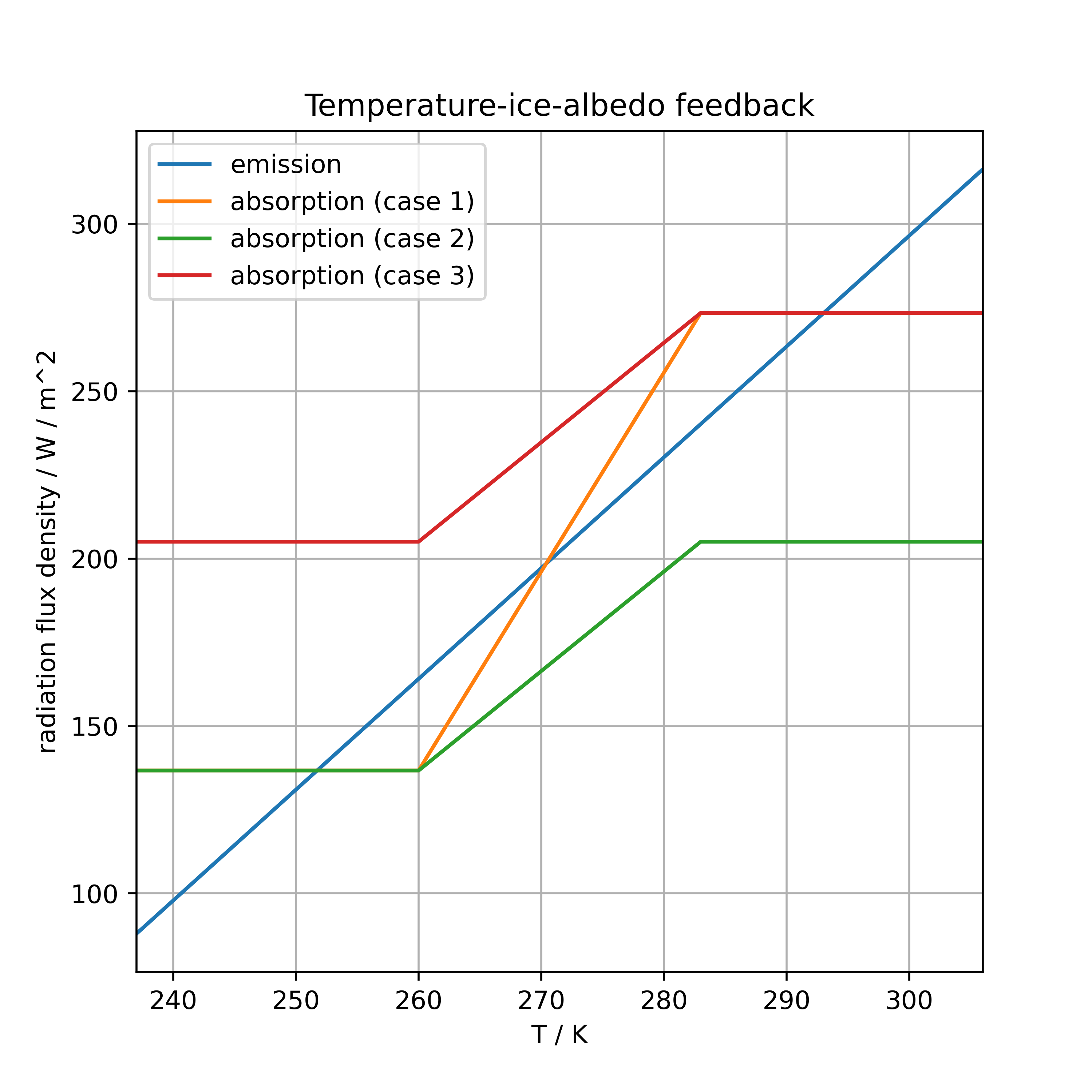
To quantify this, two temperatures $T_0 < T_1$ are introduced and the temperature-dependent planetary albedo is set
\[ \begin{align} \alpha_p\left(T\right) = \begin{cases} \alpha_\text{max}, T < T_0\\ \alpha_\text{max} + \left(T - T_0\right)\frac{\alpha_\text{min} - \alpha_\text{max}}{T_1 - T_0}, T_0 \leq T \leq T_1\\ \alpha_\text{min}, T > T_1 \end{cases} \end{align} \]
with $0 \leq \alpha_\text{min} < \alpha_\text{max} \leq 1$. For the temperature-dependent radiation $S = S\left(T\right)$ of the planet we continue
\[ \begin{align} S\left(T\right) = a + b\left(T - \newoverline{T}\right) \end{align} \]
This corresponds to a linear development of the Stefan-Boltzmann law, so it applies
\[ \begin{align} a &= \sigma T_\text{rad}^4,\\ b &= 4\sigma T_\text{rad}^3. \end{align} \]
Here are
\[ \begin{align} \newoverline{T} \coloneqq \frac{T_0 + T_1}{2} \end{align} \]
the approximate temperature of the earth as well
\[ \begin{align} T_\text{rad} \coloneqq 0,9\newoverline{T} \end{align} \]
a radiation temperature. In equilibrium now applies
\[ \begin{align} \frac{S_0}{4}\left(1 - \alpha_p\left(T\right)\right) &= a + b\left(T - \newoverline{T}\right). \end{align} \]
with the solar constant $S_0$. This equation has between one and three solutions depending on $T_0, T_1, \alpha_\mathrm{min}$ and $\alpha_\mathrm{max}$, as shown in Fig. 22.1. The equilibria in cases 2 and 3 are stable, while in case 1 the middle equilibrium is unstable and the outer two are stable.
22.3 Calculation of scattering and absorption coefficients
22.3.1 Effective radius
The effective radius is a size measure for condensates that well represents the properties they have in relation to their interaction with radiation. Assuming that all condensates are spherical and have radius $r_\text{eff}$,
\[ \begin{align} \frac{V}{A} = \frac{N\frac{4}{3}\pi r_\text{eff}^3}{N\pi r_\text{eff}^2} = \frac{4}{3}r_\text{eff}. \end{align} \]
Here $V$ is the total volume of the condensates, $A$ is their summed cross-sectional area (ignoring overlap) and $N$ is the number of condensates in the volume under consideration. From this it follows
\[ \begin{align} r_\text{eff} = \frac{3V}{4A}. \end{align} \]
The effective radius therefore links the size V (bulk size) that can be derived from the average density with the size of the cross-sectional area, which is important for alternating working with radiation.
22.4 Approximations
The spectral radiance depends on six real numbers in addition to the time. Common fields depend on three coordinates. A first problem is the amount of storage space that is necessary to store even a very roughly discretized radiation state of an atmosphere. However, solving the radiation transfer equation is much more problematic. Therefore, rigorous approximations are necessary.
22.4.1 Plan-parallel atmosphere
This approximation assumes that the atmosphere within a certain area is horizontally homogeneous, so the properties only vary vertically. This is motivated by the fact that in the atmosphere on large scales, horizontal gradients are at least two orders of magnitude smaller than vertical ones.
22.4.2 Horizontal decoupling
This approximation divides the atmosphere into independent columns and thereby greatly limits the horizontal interaction. However, such a column can consist of different sub-columns or horizontal interactions can be parameterized in another way within the columns. As computing capacity increases, the areas with horizontal interaction can be enlarged until, in the limit, the entire atmosphere is viewed as a single column.
22.5 Radiation balance
The radiation state of the atmosphere is completely described by the spectral radiance
\[ \begin{align} L = L\left(\mathbf{r}, \phi, \lambda, \omega, t\right). \end{align} \]
Many factors go into the evolution of this size. The aim of this section is to quantify the importance of subcomponents of the climate system for the radiation field. This is called radiation balance or also radiation balance.