23 Cloud microphysics
The so-called cloud microphysics is about answering the following questions:
How do clouds and precipitation form?
What size spectra do clouds and precipitation have?
What is the falling speed of clouds and precipitation?
What interactions exist between the condensates?
23.1 Köhler equation
The vapor pressure over a solution is given by equation (5.274):
\[ \begin{align} \ln\left(\frac{p_S\left(n_s\right)}{p_S^{(0)}}\right) &= -\frac{n_s}{n_w}. \end{align} \]
Here the notation has been adapted to the one customary in cloud physics.
The vapor pressure over a curved surface is given by equation (5.307):
\[ \begin{align} \ln\left(\frac{p_S\left(R\right)}{p_S^{(0)}}\right) &= \frac{2\gamma}{R_sTR\rho_w}. \end{align} \]
If both effects occur simultaneously, one obtains
\[ \begin{align} \ln\left(\frac{p_S\left(R,n_s\right)}{p_S^{(0)}}\right) &= \frac{2\gamma}{R_sTR\rho_w} - \frac{n_s}{n_w} \end{align} \]
as an equation for the vapor pressure over a curved surface within which a solution is located. For $n_w$, one has
\[ \begin{align} n_w = \frac{m_w}{M_w} = \frac{4\pi R^3\rho_w}{3M_w}. \end{align} \]
From this it follows
\[ \begin{align} \ln\left(\frac{p_S\left(R,n_s\right)}{p_S^{(0)}}\right) &= \frac{2\gamma}{R_sTR\rho_w} - \frac{3M_wn_s}{4\pi R^3\rho_w}. \end{align} \]
Using the diameter $D$ instead of the radius $R$, one obtains
\[ \begin{align} \ln\left(\frac{p_S\left(D,n_s\right)}{p_S^{(0)}}\right) &= \frac{4\gamma}{R_sTD\rho_w} - \frac{6M_wn_s}{\pi D^3\rho_w}. \end{align} \]
This equation is called the Köhler equation.
Differentiating this equation with respect to $D$ and setting the derivative equal to zero, one obtains
\[ \begin{align} 0 &= -\frac{4\gamma}{R_sTD_c^2\rho_w} + \frac{18M_wn_s}{\pi D_c^4\rho_w}\nonumber\\ \Leftrightarrow \frac{4\gamma}{R_sTD_c^2} &= \frac{18M_wn_s}{\pi D_c^4}\nonumber\\ \Leftrightarrow \frac{4\gamma D_c^2}{R_sT} &= \frac{18M_wn_s}{\pi}\nonumber\\ \Leftrightarrow D_c^2 &= \frac{9R_sTM_wn_s}{2\gamma\pi} = \frac{9RTn_s}{2\gamma\pi}. \end{align} \]
$D_c$ is called the critical diameter. The saturation vapor pressure is maximal at the critical diameter. Only drops with $D>D_c$ can continue to grow and become cloud and rain drops. Such drops form in the free atmosphere only for $p_v>p_S\left(D_c\right)$.
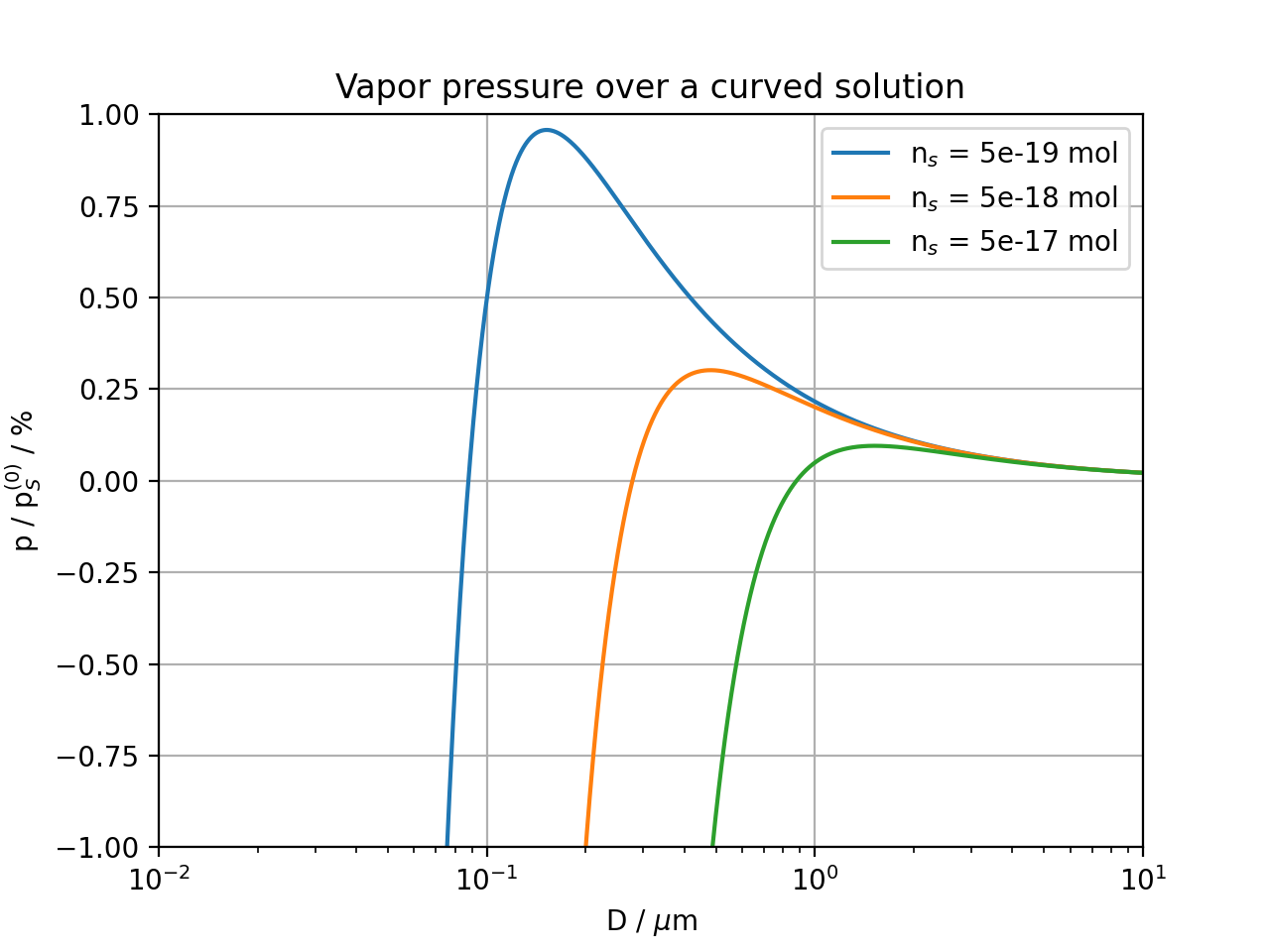
As can be seen from Fig. 23.1, the critical diameter increases with $n_s$, whereas the maximum saturation vapor pressure decreases.
23.2 Circulation around condensates
From the flow field around a condensate, one can derive the force acting on the condensate; equating it with the gravitational force then yields the falling speed.
23.2.1 Laminar flow
Imagine a sphere of radius $a$ centered at the origin of a Cartesian coordinate system. One now seeks solutions of the incompressible system of equations without momentum advection
with the boundary conditions
One restricts oneself to stationary, and hence in particular laminar, solutions. This turns the momentum equation Eq. (23.8) into
\[ \begin{align} \nabla p &= \eta\Delta\mathbf{v}.\tag{23.12}\label{eq:momentum_for_stokes_mod} \end{align} \]
The notation of $\mathbf{v}$ in spherical coordinates is
\[ \begin{align} \mathbf{v} &= v_r\mathbf{e}_r + v_\theta\mathbf{e}_\theta + v_\phi\mathbf{e}_\phi. \end{align} \]
Here $\theta$ is the angle with respect to the z-axis and $\phi$ the angle with respect to the xz-plane. Stationary solutions are rotationally symmetric about the z-axis, and moreover one has
\[ \begin{align} v_\phi = 0. \end{align} \]
For the friction force generated by the flow, which acts on the sphere, one has
\[ \begin{align} F = -2\pi a^2\int_0^\pi\left[p\cos\left(\theta\right) + \eta\sin\left(\theta\right)\frac{\partial v_\theta}{\partial r}\right]\sin\left(\theta\right)d\theta. \end{align} \]
Such a friction force is called Stokes friction. It is split into a force $F_p$ arising from the pressure $p$ and a force $F_v$ arising from the shear of the velocity field, i.e.
\[ \begin{align} F_p &\coloneqq -2\pi a^2\int_0^\pi p\cos\left(\theta\right)\sin\left(\theta\right)d\theta,\tag{23.16}\label{eq:stokes_friction_p}\\ F_v &\coloneqq -2\pi\eta a^2\int_0^\pi\frac{\partial v_\theta}{\partial r}\sin\left(\theta\right)^2d\theta.\tag{23.17}\label{eq:stokes_friction_v} \end{align} \]
Thus one has
\[ \begin{align} F = F_p + F_v.\tag{23.18}\label{eq:stokes_friction_split-up} \end{align} \]
According to the observations at the beginning of Chap. 15 and Eq. (23.9), $\mathbf{v}$ can be written in the form
\[ \begin{align} \mathbf{v} = \nabla\times\mathbf{A} \end{align} \]
by means of a velocity potential $\mathbf{A}$. According to Eq. (B.98), one has
\[ \begin{align} \nabla\times\mathbf{A} &= \frac{A_\theta}{r}\mathbf{e}_\phi + \frac{A_\phi}{r\tan\left(\theta\right)}\mathbf{e}_r - \frac{A_\phi}{r}\mathbf{e}_\theta + \mathbf{e}_r\left(\frac{1}{r}\frac{\partial A_\phi}{\partial\theta} - \frac{1}{r\sin\left(\theta\right)}\frac{\partial A_\theta}{\partial\phi}\right)\nonumber\\ & + \mathbf{e}_\theta\left(\frac{1}{r\sin\left(\theta\right)}\frac{\partial A_r}{\partial\phi} - \frac{\partial A_\phi}{\partial r}\right) + \mathbf{e}_\phi\left(\frac{\partial A_\theta}{\partial r} - \frac{1}{r}\frac{\partial A_r}{\partial\theta}\right). \end{align} \]
Due to rotational symmetry about the z-axis, $\mathbf{v}$ does not depend on $\phi$. This implies
\[ \begin{align} \nabla\times\mathbf{A} &= \frac{A_\theta}{r}\mathbf{e}_\phi + \frac{A_\phi}{r\tan\left(\theta\right)}\mathbf{e}_r - \frac{A_\phi}{r}\mathbf{e}_\theta + \mathbf{e}_r\frac{1}{r}\frac{\partial A_\phi}{\partial\theta} - \mathbf{e}_\theta\frac{\partial A_\phi}{\partial r} + \mathbf{e}_\phi\left(\frac{\partial A_\theta}{\partial r} - \frac{1}{r}\frac{\partial A_r}{\partial\theta}\right). \end{align} \]
By projecting onto the position-dependent basis elements of the spherical coordinates, one obtains
\[ \begin{align} v_r &= \frac{A_\phi}{r\tan\left(\theta\right)} + \frac{1}{r}\frac{\partial A_\phi}{\partial\theta},\\ v_\theta &= -\frac{A_\phi}{r} - \frac{\partial A_\phi}{\partial r},\\ v_\phi &= \frac{A_\theta}{r} + \frac{\partial A_\theta}{\partial r} - \frac{1}{r}\frac{\partial A_r}{\partial\theta}. \end{align} \]
The condition $v_\phi = 0$ can therefore be fulfilled by $A_\theta = A_r = 0$ without affecting the other components. Define
\[ \begin{align} \psi = \psi\left(r, \theta\right) \coloneqq -rA_\phi\sin\left(\theta\right), \end{align} \]
then one has
The rotation of the wind field is:
\[ \begin{align} \nabla\times\mathbf{v} &= \frac{v_\theta}{r}\mathbf{e}_\phi + \frac{v_\phi}{r\tan\left(\theta\right)}\mathbf{e}_r - \frac{v_\phi}{r}\mathbf{e}_\theta + \mathbf{e}_r\frac{1}{r}\frac{\partial v_\phi}{\partial\theta} - \mathbf{e}_\theta\frac{\partial v_\phi}{\partial r} + \mathbf{e}_\phi\left(\frac{\partial v_\theta}{\partial r} - \frac{1}{r}\frac{\partial v_r}{\partial\theta}\right). \end{align} \]
With $v_\phi = 0$, it follows that
\[ \begin{align} \zetabi = \nabla\times\mathbf{v} &= \frac{v_\theta}{r}\mathbf{e}_\phi + \mathbf{e}_\phi\left(\frac{\partial v_\theta}{\partial r} - \frac{1}{r}\frac{\partial v_r}{\partial\theta}\right) = \mathbf{e}_\phi\left(\frac{\partial v_\theta}{\partial r} - \frac{1}{r}\frac{\partial v_r}{\partial\theta} + \frac{v_\theta}{r}\right). \end{align} \]
Inserting the equations (23.26) - (23.27) here, one obtains
\[ \begin{align} \zetabi &= \nabla\times\mathbf{v} = \mathbf{e}_\phi\left(\frac{1}{r\sin\left(\theta\right)}\frac{\partial^2\psi}{\partial r^2} - \frac{1}{r^2\sin\left(\theta\right)}\frac{\partial\psi}{\partial r} - \frac{\cos\left(\theta\right)}{r^3\sin\left(\theta\right)^2}\frac{\partial\psi}{\partial\theta} + \frac{1}{r^3\sin\left(\theta\right)}\frac{\partial^2\psi}{\partial\theta^2} + \frac{1}{r^2\sin\left(\theta\right)}\frac{\partial\psi}{\partial r}\right)\nonumber\\ &= \mathbf{e}_\phi\left(\frac{1}{r\sin\left(\theta\right)}\frac{\partial^2\psi}{\partial r^2} - \frac{\cos\left(\theta\right)}{r^3\sin\left(\theta\right)^2}\frac{\partial\psi}{\partial\theta} + \frac{1}{r^3\sin\left(\theta\right)}\frac{\partial^2\psi}{\partial\theta^2}\right)\nonumber\\ &= \frac{\mathbf{e}_\phi}{r\sin\left(\theta\right)}\left(\frac{\partial^2\psi}{\partial r^2} - \frac{\cos\left(\theta\right)}{r^2\sin\left(\theta\right)}\frac{\partial\psi}{\partial\theta} + \frac{1}{r^2}\frac{\partial^2\psi}{\partial\theta^2}\right)\nonumber\\ &= \frac{\mathbf{e}_\phi}{r\sin\left(\theta\right)}\left[\frac{\partial^2}{\partial r^2} + \frac{\sin\left(\theta\right)}{r^2}\frac{\partial}{\partial\theta}\left(\frac{1}{\sin\left(\theta\right)}\frac{\partial}{\partial\theta}\right)\right]\psi \equiv \frac{\mathbf{e}_\phi}{r\sin\left(\theta\right)}E^2\psi \end{align} \]
with a differential operator
\[ \begin{align} E^2 \coloneqq \frac{\partial^2}{\partial r^2} - \frac{1}{r^2\tan\left(\theta\right)}\frac{\partial}{\partial\theta} + \frac{1}{r^2}\frac{\partial^2}{\partial\theta^2} = \frac{\partial^2}{\partial r^2} + \frac{\sin\left(\theta\right)}{r^2}\frac{\partial}{\partial\theta}\left(\frac{1}{\sin\left(\theta\right)}\frac{\partial}{\partial\theta}\right). \end{align} \]
From this it follows that:
\[ \begin{align} \zetabi &= \nabla\times\left(\nabla\times\mathbf{A}\right) = \nabla\times\left[\nabla\times\left(A_\phi\mathbf{e}_\phi\right)\right] = -\nabla\times\left[\nabla\times\left(\frac{\psi}{r\sin\left(\theta\right)}\mathbf{e}_\phi\right)\right]. \end{align} \]
For twice continuously differentiable scalar fields $\chi$, one therefore has
\[ \begin{align} -\nabla\times\left[\nabla\times\left(\frac{\chi}{r\sin\left(\theta\right)}\mathbf{e}_\phi\right)\right] &= \frac{\mathbf{e}_\phi}{r\sin\left(\theta\right)}E^2\chi. \end{align} \]
Eq. (B.54) reads
\[ \begin{align} \Delta\mathbf{v} &= \nabla\left(\nabla\cdot\mathbf{v}\right) - \nabla\times\left(\nabla\times\mathbf{v}\right) \stackrel{\href{#eq:incompressibility_stokes_fric}{\text{Eq. (23.9)}}}{=} -\nabla\times\left(\nabla\times\mathbf{v}\right) = -\nabla\times\zetabi. \end{align} \]
The momentum equation Eq. (23.12) can thus be written in the form
Applying the rotation to this once more, one obtains
\[ \begin{align} 0 = -\eta\nabla\times\left(\nabla\times\zetabi\right) = -\eta\nabla\times\left[\nabla\times\left(\frac{\mathbf{e}_\phi}{r\sin\left(\theta\right)}E^2\psi\right)\right] = \eta\frac{\mathbf{e}_\phi}{r\sin\left(\theta\right)}E^4\psi. \end{align} \]
One can thus use
as the differential equation for $\psi$. From the boundary condition Eq. (23.11), it follows that
\[ \begin{align} \frac{\partial\psi}{\partial r}\left(r = a\right) &= 0,\tag{23.38}\label{eq:stokes_psi_bc_4}\\ \frac{\partial\psi}{\partial\theta}\left(r = a\right) &= 0. \end{align} \]
So $\psi$ is constant along the surface of the sphere; without loss of generality, one can impose the boundary condition
\[ \begin{align} \psi\left(r = a\right) = 0\tag{23.40}\label{eq:stokes_psi_bc_1} \end{align} \]
The boundary condition Eq. (23.10) reads in spherical coordinates
\[ \begin{align} \lim_{\left|\mathbf{r}\right|\to\infty}v_r &= U\cos\left(\theta\right),\tag{23.41}\label{eq:stokes_psi_bc_2}\\ \lim_{\left|\mathbf{r}\right|\to\infty}v_\theta &= -U\sin\left(\theta\right).\tag{23.42}\label{eq:stokes_psi_bc_3} \end{align} \]
The pressure is required to converge at infinity to a homogeneous background pressure $p_0$:
\[ \begin{align} \lim_{\left|\mathbf{r}\right| \to \infty}p &= p_0 \end{align} \]
One has
\[ \begin{align} E^4\psi &= \left(\frac{\partial^2}{\partial r^2} - \frac{1}{r^2\tan\left(\theta\right)}\frac{\partial}{\partial\theta} + \frac{1}{r^2}\frac{\partial^2}{\partial\theta^2}\right)\left(\frac{\partial^2\psi}{\partial r^2} - \frac{1}{r^2\tan\left(\theta\right)}\frac{\partial\psi}{\partial\theta} + \frac{1}{r^2}\frac{\partial^2\psi}{\partial\theta^2}\right).\tag{23.44}\label{eq:stokes_e4} \end{align} \]
Now one makes the ansatz for $\psi$
\[ \begin{align} \psi\left(r,\theta\right) = -\frac{U\sin\left(\theta\right)^2}{2}\left(Ar + Br^2 + \frac{C}{r}\right).\tag{23.45}\label{eq:stokes_ansatz} \end{align} \]
From Eq. (23.41), it follows that
\[ \begin{align} \lim_{\left|\mathbf{r}\right| \to \infty}v_r &= -\lim_{\left|\mathbf{r}\right|\to\infty}\frac{1}{r^2\sin\left(\theta\right)}\frac{\partial\psi}{\partial\theta} = \lim_{\left|\mathbf{r}\right|\to\infty}\frac{1}{r^2\sin\left(\theta\right)}\frac{\partial}{\partial\theta}\frac{U\sin\left(\theta\right)^2}{2}\left(Ar + Br^2 + \frac{C}{r}\right)\nonumber\\ &= \lim_{\left|\mathbf{r}\right|\to\infty}\frac{1}{r^2\sin\left(\theta\right)}U\sin\left(\theta\right)\cos\left(\theta\right)\left(Ar + Br^2 + \frac{C}{r}\right)\nonumber\\ &= \lim_{\left|\mathbf{r}\right|\to\infty}U\cos\left(\theta\right)\left(\frac{A}{r} + B + \frac{C}{r^3}\right)\nonumber\\ &= \lim_{\left|\mathbf{r}\right|\to\infty}BU\cos\left(\theta\right) = BU\cos\left(\theta\right). \end{align} \]
Comparison with Eq. (23.41) implies
\[ \begin{align} B = 1. \end{align} \]
From Eq. (23.42), it follows that
\[ \begin{align} \lim_{\left|\mathbf{r}\right|\to\infty}v_\theta &= \lim_{\left|\mathbf{r}\right|\to\infty}\frac{1}{r\sin\left(\theta\right)}\frac{\partial\psi}{\partial r} = -\lim_{\left|\mathbf{r}\right|\to\infty}\frac{1}{r\sin\left(\theta\right)}\frac{\partial}{\partial r}\frac{U\sin\left(\theta\right)^2}{2}\left(Ar + Br^2 + \frac{C}{r}\right)\nonumber\\ &= -\lim_{\left|\mathbf{r}\right|\to\infty}\frac{1}{r\sin\left(\theta\right)}\frac{U\sin\left(\theta\right)^2}{2}\left(A + 2Br - \frac{C}{r^2}\right)\nonumber\\ &= -\lim_{\left|\mathbf{r}\right|\to\infty}U\sin\left(\theta\right)\left(\frac{A}{2r} + B - \frac{C}{2r^3}\right)\nonumber\\ &= -\lim_{\left|\mathbf{r}\right|\to\infty}U\sin\left(\theta\right)B = -BU\sin\left(\theta\right). \end{align} \]
Comparison with Eq. (23.42) again implies $B = 1$, so
\[ \begin{align} \psi\left(r,\theta\right) = -\frac{U\sin\left(\theta\right)^2}{2}\left(Ar + r^2 + \frac{C}{r}\right). \end{align} \]
From Eq. (23.40) one further obtains
\[ \begin{align} \psi\left(a,\theta\right) &= -\frac{U\sin\left(\theta\right)^2}{2}\left(Aa + a^2 + \frac{C}{a}\right) \hastobe 0\\ \Leftrightarrow Aa + a^2 + \frac{C}{a} &= 0\\ \Leftrightarrow Aa^2 + a^3 + C &= 0\\ \Leftrightarrow C &= -Aa^2 - a^3, \end{align} \]
so
\[ \begin{align} \psi\left(r,\theta\right) = -\frac{U\sin\left(\theta\right)^2}{2}\left(Ar + r^2 - \frac{Aa^2 + a^3}{r}\right). \end{align} \]
From this it follows
\[ \begin{align} \frac{\psi\left(r,\theta\right)}{\partial r} = -\frac{U\sin\left(\theta\right)^2}{2}\left(A + 2r + \frac{Aa^2 + a^3}{r^2}\right). \end{align} \]
From Eq. (23.38), it follows that
\[ \begin{align} A + 2a + \frac{Aa^2 + a^3}{a^2} = A + 2a + A + a &= 2A + 3a \hastobe 0\nonumber\\ \Leftrightarrow A &= -\frac{3a}{2}. \end{align} \]
The ansatz thus reads
\[ \begin{align} \psi\left(r,\theta\right) &= -\frac{U\sin\left(\theta\right)^2}{2}\left(-\frac{3a}{2}r + r^2 + \frac{3a^3}{2r} - \frac{a^3}{r}\right)\nonumber\\ &= -\frac{U\sin\left(\theta\right)^2}{2}\left(-\frac{3a}{2}r + r^2 + \frac{a^3}{2r}\right).\tag{23.57}\label{eq:stokes_ansatz_concrete} \end{align} \]
Now this is inserted into Eq. (23.44). As preparation, one computes
\[ \begin{align} \frac{\partial^2\psi}{\partial r^2} &= -\frac{U\sin\left(\theta\right)^2}{2}\left(2 + \frac{a^3}{r^3}\right),\\ -\frac{1}{r^2\tan\left(\theta\right)}\frac{\partial\psi}{\partial\theta} &= U\cos\left(\theta\right)^2\left(-\frac{3a}{2r} + 1 + \frac{a^3}{2r^3}\right),\\ \frac{1}{r^2}\frac{\partial^2\psi}{\partial\theta^2} &= -U\left(\cos\left(\theta\right)^2 - \sin\left(\theta\right)^2\right)\left(-\frac{3a}{2r} + 1 + \frac{a^3}{2r^3}\right). \end{align} \]
Adding these three terms gives
\[ \begin{align} E^2\psi &= \frac{\partial^2\psi}{\partial r^2} - \frac{1}{r^2\tan\left(\theta\right)}\frac{\partial\psi}{\partial\theta} + \frac{1}{r^2}\frac{\partial^2\psi}{\partial\theta^2} = -\frac{U\sin\left(\theta\right)^2}{2}\left(2 + \frac{a^3}{r^3}\right) + U\sin\left(\theta\right)^2\left(-\frac{3a}{2r} + 1 + \frac{a^3}{2r^3}\right)\\ &= -\frac{U\sin\left(\theta\right)^2}{2}\left(2 + \frac{a^3}{r^3} + \frac{3a}{r} - 2 - \frac{a^3}{r^3}\right)\\ &= -\frac{3aU\sin\left(\theta\right)^2}{2r}.\tag{23.63}\label{eq:stokes_e2} \end{align} \]
From this it follows
\[ \begin{align} \frac{\partial^2E^2\psi}{\partial r^2} &= -\frac{6aU\sin\left(\theta\right)^2}{2r^3} = -\frac{3aU\sin\left(\theta\right)^2}{r^3},\\ -\frac{1}{r^2\tan\left(\theta\right)}\frac{\partial E^2\psi}{\partial\theta} &= \frac{3aU\cos\left(\theta\right)^2}{r^3},\\ \frac{1}{r^2}\frac{\partial^2 E^2\psi}{\partial\theta^2} &= -\frac{3aU\left(\cos\left(\theta\right)^2 - \sin\left(\theta\right)^2\right)}{r^3}. \end{align} \]
Adding these three equations, one obtains
\[ \begin{align} E^4\psi = 0. \end{align} \]
Eq. (23.45) thus indeed solves Eq. (23.37).
It now remains to be shown that the ansatz Eq. (23.45) also solves Eq. (23.35). For this, one first computes
\[ \begin{align} \nabla\times\zetabi &= \nabla\times\left[\mathbf{e}_\phi\frac{E^2\psi}{r\sin\left(\theta\right)}\right] \stackrel{\href{ch-38-vector-analysis.html#eq:diff_op_rule_5}{\text{Eq. (B.51)}}}{=} -\mathbf{e}_\phi\times\nabla\frac{E^2\psi}{r\sin\left(\theta\right)} + \frac{E^2\psi}{r\sin\left(\theta\right)}\nabla\times\mathbf{e}_\phi. \end{align} \]
With
\[ \begin{align} \nabla\times\mathbf{e}_\phi &\stackrel{\href{ch-38-vector-analysis.html#eq:rot_sphere}{\text{Eq. (B.98)}}}{=} \frac{1}{r\tan\left(\theta\right)}\mathbf{e}_r - \frac{1}{r}\mathbf{e}_\theta \end{align} \]
it follows that
\[ \begin{align} \nabla\times\zetabi &= -\mathbf{e}_\phi\times\nabla\frac{E^2\psi}{r\sin\left(\theta\right)} + \frac{E^2\psi}{r\sin\left(\theta\right)}\left(\frac{1}{r\tan\left(\theta\right)}\mathbf{e}_r - \frac{1}{r}\mathbf{e}_\theta\right)\nonumber\\ &= -\mathbf{e}_\phi\times\nabla\frac{E^2\psi}{r\sin\left(\theta\right)} + \frac{\cos\left(\theta\right)E^2\psi}{r^2\sin\left(\theta\right)^2}\mathbf{e}_r - \frac{E^2\psi}{r^2\sin\left(\theta\right)}\mathbf{e}_\theta. \end{align} \]
Inserting Eq. (23.63) here, one obtains
\[ \begin{align} \nabla\times\zetabi &= -\frac{3aU}{2}\left(-\mathbf{e}_\phi\times\nabla\frac{\sin\left(\theta\right)}{r^2} + \frac{\cos\left(\theta\right)}{r^3}\mathbf{e}_r - \frac{\sin\left(\theta\right)}{r^3}\mathbf{e}_\theta\right).\tag{23.71}\label{eq:stokes_deriv_1} \end{align} \]
With Eq. (B.88), it follows that
\[ \begin{align} \nabla\frac{\sin\left(\theta\right)}{r^2} &= -\frac{2\sin\left(\theta\right)}{r^3}\mathbf{e}_r + \frac{\cos\left(\theta\right)}{r^3}\mathbf{e}_\theta. \end{align} \]
Therefore one has
\[ \begin{align} -\mathbf{e}_\phi\times\nabla\frac{\sin\left(\theta\right)}{r^2} &= \frac{2\sin\left(\theta\right)}{r^3}\mathbf{e}_\theta + \frac{\cos\left(\theta\right)}{r^3}\mathbf{e}_r. \end{align} \]
Inserting this into Eq. (23.71), one obtains
\[ \begin{align} \nabla\times\zetabi &= -\frac{3aU}{2}\left(\frac{2\sin\left(\theta\right)}{r^3}\mathbf{e}_\theta + \frac{\cos\left(\theta\right)}{r^3}\mathbf{e}_r + \frac{\cos\left(\theta\right)}{r^3}\mathbf{e}_r - \frac{\sin\left(\theta\right)}{r^3}\mathbf{e}_\theta\right)\nonumber\\ &= -\frac{3aU}{2}\left(\frac{\sin\left(\theta\right)}{r^3}\mathbf{e}_\theta + \frac{2\cos\left(\theta\right)}{r^3}\mathbf{e}_r\right). \end{align} \]
Inserting this into Eq. (23.35), one obtains
\[ \begin{align} \nabla p = \frac{3aU}{2}\frac{\eta\sin\left(\theta\right)}{r^3}\mathbf{e}_\theta + \frac{3aU}{2}\frac{2\eta\cos\left(\theta\right)}{r^2}\mathbf{e}_r, \end{align} \]
so
\[ \begin{align} \frac{\partial p}{\partial r} &= \frac{3aU}{2}\frac{2\eta\cos\left(\theta\right)}{r^3},\nonumber\\ \frac{\partial p}{\partial\theta} &= \frac{3aU}{2}\frac{\eta\sin\left(\theta\right)}{r^2}. \end{align} \]
This is solved by
\[ \begin{align} p = p_0 - \frac{3aU}{2}\frac{\eta\cos\left(\theta\right)}{r^2}. \end{align} \]
According to Eq. (23.16), this implies for the friction force created by the pressure
\[ \begin{align} F_p &= -2\pi a^2\int_0^\pi-\frac{3\eta aU\cos\left(\theta\right)}{2a^2}\cos\left(\theta\right)\sin\left(\theta\right)d\theta = \pi\int_0^\pi 3\eta aU\cos\left(\theta\right)\cos\left(\theta\right)\sin\left(\theta\right)d\theta\nonumber\\ &= 3\eta aU\pi\int_0^\pi\cos^2\left(\theta\right)\sin\left(\theta\right)d\theta = -3\eta aU\pi\left[\frac{1}{3}\cos\left(\theta\right)^3\right]_0^\pi = 2\eta aU\pi. \end{align} \]
For $v_\theta$ one obtains, using Eq. (23.27) and the ansatz Eq. (23.57),
\[ \begin{align} v_\theta &= \frac{1}{r\sin\left(\theta\right)}\frac{\partial\psi}{\partial r} = \frac{1}{r\sin\left(\theta\right)}\frac{\partial}{\partial r}\left[-\frac{U\sin\left(\theta\right)^2}{2}\left(-\frac{3a}{2}r + r^2 + \frac{a^3}{2r}\right)\right]\nonumber\\ &= \frac{1}{r}\frac{\partial}{\partial r}\left[\frac{U\sin\left(\theta\right)}{2}\left(\frac{3a}{2}r - r^2 - \frac{a^3}{2r}\right)\right] = \frac{1}{r}\frac{\partial}{\partial r}\left[\frac{Ua^2\sin\left(\theta\right)}{2}\left(\frac{3}{2a}r - \frac{r^2}{a^2} - \frac{a}{2r}\right)\right]\nonumber\\ &= \frac{1}{r}\left[\frac{Ua^2\sin\left(\theta\right)}{4}\left(-\frac{4r}{a^2} + \frac{3}{a} + \frac{a}{r^2}\right)\right] = \frac{Ua^2\sin\left(\theta\right)}{4}\left(-\frac{4}{a^2} + \frac{3}{ar} + \frac{a}{r^3}\right). \end{align} \]
From this it follows
\[ \begin{align} \frac{\partial v_\theta}{\partial r} &= -\frac{Ua^2\sin\left(\theta\right)}{4}\left(\frac{3}{ar^2} + \frac{3a}{r^4}\right). \end{align} \]
Evaluating this at $r = a$, one obtains
\[ \begin{align} \frac{\partial v_\theta}{\partial r}\left(r = a\right) &= -\frac{Ua^2\sin\left(\theta\right)}{4}\left(\frac{3}{a^3} + \frac{3}{a^3}\right) = -\frac{6U\sin\left(\theta\right)}{4a} = -\frac{3U\sin\left(\theta\right)}{2a}. \end{align} \]
Inserting this into Eq. (23.17), one obtains
\[ \begin{align} F_v &= -2\pi\eta a^2\int_0^\pi-\frac{3U\sin\left(\theta\right)}{2a}\sin\left(\theta\right)^2d\theta = 3U\pi\eta a\int_0^\pi\sin\left(\theta\right)^3d\theta. \end{align} \]
One now integrates
\[ \begin{align} \int_0^\pi\sin\left(\theta\right)^3d\theta &= \left[-\cos\left(\theta\right)\sin\left(\theta\right)^2\right]_0^\pi + 2\int_0^\pi\cos\left(\theta\right)^2\sin\left(\theta\right)d\theta\nonumber\\ &= 2\int_0^\pi\cos\left(\theta\right)^2\sin\left(\theta\right)d\theta = \frac{2}{3}\left[-\cos\left(\theta\right)^3\right]_0^\pi = \frac{2}{3}\left[\cos\left(\theta\right)^3\right]_\pi^0 = \frac{4}{3}. \end{align} \]
This implies
\[ \begin{align} F_v &= 3U\pi\eta a\frac{4}{3} = 4U\pi\eta a. \end{align} \]
Thus, according to Eq. (23.18), one has for the friction force
Equating this with the gravitational force
\[ \begin{align} F_g = mg = \frac{4}{3}\pi a^3\left(\rho_l' - \rho_h'\right)g\tag{23.86}\label{eq:gravity_on_condensate} \end{align} \]
equal, one obtains
as the formula for the equilibrium falling speed $v_F$. Here, the static buoyancy of the condensate has been subtracted in Eq. (23.86).
23.2.2 Turbulent flow
In the case of turbulent flow, the circulation around the condensate is time-dependent in an aperiodic manner. Here the friction force $F$ is proportional to the square of the speed $U$,
\[ \begin{align} F = \frac{1}{2}c_w\pi a^2\rho_h'U^2,\tag{23.88}\label{eq:turbulent_friction} \end{align} \]
where $c_w \geq 0$ is a constant depending on the shape of the object being flowed around, the so-called $c_w-$value. In English, this quantity is called the drag coefficient $c_d$. Equating this with the gravitational force according to Eq. (23.86), one obtains
\[ \begin{align} \frac{1}{2}c_w\pi a^2\rho_h'v_F^2 &= \frac{4}{3}\pi a^3\rho_l'g \Leftrightarrow v_F^2 = \frac{8a\rho_l'g}{3\rho_h'c_w} \end{align} \]
as the formula for the equilibrium falling speed $v_F$.
23.2.3 Combined formula for the falling speed
Small condensates are surrounded by laminar flow, larger ones by turbulent flow. The parameter $\alpha\in\left[0, 1\right]$ describes the fraction of turbulence in the friction force $F$, i.e.
\[ \begin{align} F = \alpha F_\text{turbulent} + \left(1 - \alpha\right)F_\text{laminar}. \end{align} \]
Inserting the equations (23.85) and (23.88) here, one obtains
\[ \begin{align} F = \alpha\frac{1}{2}c_w\pi a^2\rho_h'U^2 + \left(1 - \alpha\right)6\pi a\rho_h'\nu U. \end{align} \]
Here $c_w \approx 0.8$ is a realistic value. Equating this with the gravitational force according to Eq. (23.86), one obtains, assuming $\alpha \not= 0$,
\[ \begin{align} \left(1 - \alpha\right)6\pi a\rho_h'\nu v_F + \alpha\frac{1}{2}c_w\pi a^2\rho_h'v_F^2 &= \frac{4}{3}\pi a^3\rho_l'g\nonumber\\ \Leftrightarrow\alpha\frac{1}{2}c_w\pi a\rho_h'v_F^2 + \left(1 - \alpha\right)6\pi\rho_h'\nu v_F - \frac{4}{3}\pi a^2\rho_l'g &= 0\nonumber\\ \Leftrightarrow\alpha c_w\pi a\rho_h'v_F^2 + \left(1 - \alpha\right)12\pi\rho_h'\nu v_F - \frac{8\pi a^2\rho_l'g}{3} &= 0\nonumber\\ \Leftrightarrow\alpha c_w\pi av_F^2 + \left(1 - \alpha\right)12\pi\nu v_F - \frac{8\pi a^2\rho_l'g}{3\rho_h'} &= 0\nonumber\\ \Leftrightarrow \pi av_F^2 + \frac{\left(1 - \alpha\right)}{\alpha c_w}12\pi \nu v_F - \frac{8\pi a^2\rho_l'g}{3\alpha\rho_h'c_w} &= 0\nonumber\\ \Leftrightarrow v_F^2 + \frac{\left(1 - \alpha\right)}{a\alpha c_w}12\nu v_F - \frac{8a\rho_l'g}{3\alpha\rho_h'c_w} &= 0. \end{align} \]
It is to be expected that the transition from laminar to turbulent friction depends critically on the Reynolds number
\[ \begin{align} R \coloneqq \frac{U^2a^2}{\nu Ua} = \frac{Ua}{\nu} \end{align} \]
It is now assumed that the transition from laminar to turbulent friction occurs at a critical Reynolds number $R_k$. To determine the equilibrium falling speed, one can proceed as follows:
Calculate $v_F$ from Eq. (23.87).
Calculate the Reynolds number $R$ from this.
If the result is not greater than $R_k$, i.e. $R \leq R_k$, then $\alpha = 0$ and the result is already at hand. For spheres, one can assume $R_k = 10$.
Otherwise, $\alpha = 1$, and one uses (23.90) to determine the equilibrium falling speed. For spheres, one can assume $c_w = 1$.
23.3 Growth of condensates
23.3.1 Size distribution of raindrops
The most commonly used size distribution for raindrops is the Marshall-Palmer distribution [9], which has the form
\[ \begin{align} n\left(D\right) = n_0\exp\left(-\lambda D\right)\tag{23.95}\label{eq:marshall-palmer} \end{align} \]
Here $D$ is the diameter of the raindrops, $\lambda$ is a parameter and $n\left(D\right)$ is the number of drops with a diameter between $D$ and $D + dD$, divided by $dD$. $n_0 = 8\cdot 10^6\text{ m}^{-4}$ is taken as a constant. This emerges empirically. The parameter $\lambda$ can be linked to the density of liquid water $\rho_l$. To this end, one integrates
\[ \begin{align} \rho_l = \int_0^\infty n\left(D\right)mdD = \int_0^\infty n\left(D\right)\frac{4}{3}\pi\left(\frac{D}{2}\right)^3\rho_l'dD = \frac{\pi}{6}\int_0^\infty n\left(D\right)D^3\rho_l'dD = \frac{\pi}{6}\rho_l'n_0\int_0^\infty \exp\left(-\lambda D\right)D^3dD,\tag{23.96}\label{eq:marshall_palmer_deriv_1} \end{align} \]
here $\rho_l'$ is the microscopic density of water. For the integral, one obtains with Eq. (A.98)
\[ \begin{align} \int_0^\infty\exp\left(-\lambda D\right)D^3dD &= \frac{6}{\lambda^4}. \end{align} \]
Inserting this into Eq. (23.96), one obtains
\[ \begin{align} \rho_r = \frac{\pi}{6}\rho_l'n_0\int_0^\infty \exp\left(-\lambda D\right)D^3dD = \frac{\pi\rho_l'n_0}{\lambda^4},\tag{23.98}\label{eq:marshall_palmer_deriv_2} \end{align} \]
from this it follows
For the mean diameter $D_0$ it follows, again with Eq. (A.98),
\[ \begin{align} D_0 = \frac{\int_0^\infty\exp\left(-\lambda D\right)DdD}{\int_0^\infty\exp\left(-\lambda D\right)dD} = \frac{1}{\lambda},\tag{23.100}\label{eq:marshall-palmer_d_lambda} \end{align} \]
so
\[ \begin{align} D_0 = \left(\frac{\rho_r}{\pi\rho_l'n_0}\right)^{1/4}. \end{align} \]
This formula can be used to diagnostically derive a mean diameter of raindrops from the density of the rainwater.
From Eq. (23.100), using the substitution rule Eq. (A.88), one further obtains
\[ \begin{align} D_0 &= \frac{\int_0^\infty n_D\left(D\right)DdD}{\int_0^\infty n_D\left(D\right)dD} = \frac{\int_0^{\frac{\infty}{2}}n_D\left(2D\right)2D\cdot 2\cdot dD}{\int_0^{\frac{\infty}{2}}n_D\left(2D\right)\cdot 2\cdot dD} = 2\frac{\int_0^{\infty}2n_D\left(2r\right)rdr}{\int_0^{\infty}2n_D\left(2r\right)dr} = 2\frac{\int_0^\infty n_r\left(r\right)rdr}{\int_0^\infty n_r\left(r\right)dr} = 2r_0. \end{align} \]
The mean diameter is therefore twice the mean radius, regardless of the size distribution. Here, the spectrum as a function of the radius $n_r\left(r\right)$ was deliberately distinguished from the spectrum as a function of the diameter $n_D\left(D\right)$, and $n_r\left(r\right) = 2n_D\left(2r\right)$ was used. Analogously, one has
\[ \begin{align} \newoverline{D^n} &= 2^n\newoverline{r^n}. \end{align} \]
23.3.1.1 Application to snow
Empirically it has been shown that Marshall-Palmer distributions also approximate the size spectra of snowflakes well [34].Although ice crystals below a certain diameter are no longer referred to as snow but as cloud ice, across the entire size spectrum the Marshall-Palmer distribution is nevertheless the most suitable among the distributions that can be described by a single parameter (here $\lambda$). Here,
\[ \begin{align} n_0 = 4,6\cdot 10^{6}\text{ m}^{-4}. \end{align} \]
23.3.1.2 Application to graupel and hail
Empirically, it is found that Marshall-Palmer distributions also approximate the size spectra of graupel and hailstones well [34].See the previous footnote. Here, one usually makes the ansatz
\[ \begin{align} n_0 = A\lambda^b \end{align} \]
with $b = 3.63$ and $A = 115\frac{1}{1000^{b-1}} = 1.481\cdot 10^{-6}$. Inserting this into Eq. (23.98), one obtains
\[ \begin{align} \rho_g = \frac{\pi\rho_i'n_0}{\lambda^4} = \frac{\pi\rho_i'A\lambda^b}{\lambda^4} = \frac{\pi\rho_i'A}{\lambda^{4 - b}}, \end{align} \]
here $\rho_g$ is the density of graupel or hail and $\rho_i'$ is the microscopic density of ice. Solving this for $D_0 = 1/\lambda$, one obtains
\[ \begin{align} D_0 = \left(\frac{\rho_g}{\pi\rho_i'A}\right)^{\frac{1}{4 - b}}. \end{align} \]
23.3.2 Autoconversion
The so-called autoconversion denotes the formation of precipitation through the growth of cloud particles: several cloud particles combine to form a single precipitation particle. This is the first step of precipitation formation.
23.3.2.1 Bergeron-Findeisen process
23.3.3 Diffusion
Condensates can grow or shrink through diffusion. The diffusive flux arises because the vapor pressure at the surface of the condensate, which equals the saturation vapor pressure over water or ice at the respective temperature, differs from the ambient vapor pressure. To this end, one starts from the diffusion equation Eq. (5.212) and from a stationary state:
\[ \begin{align} 0 = \psi\Delta\rho_v. \end{align} \]
Here it is assumed that the diffusion coefficient of water vapor in moist air $\psi$ and the density of dry air $\rho_d$ are homogeneous near the drop, which are justified assumptions given the small size of drops.
Since this is a radially symmetric problem, one can make the ansatz $\rho_v = \rho_v\left(r\right)$. Using the Laplace operator in spherical coordinates, Eq. (B.91), one thus obtains
\[ \begin{align} \psi\Delta\rho_v = \psi\frac{1}{r^2}\frac{\partial}{\partial r}\left(r^2\frac{\partial\rho_v}{\partial r}\right) = \psi\left(\frac{2}{r}\frac{\partial\rho_v}{\partial r} + \frac{\partial^2\rho_v}{\partial r^2}\right) = 0. \end{align} \]
This equation is to be solved with the boundary conditions
\[ \begin{align} \rho_v\left(a\right) &= \rho_{v,a},\\ \rho_v\left(r\to\infty\right) &= \rho_{v,\infty} \end{align} \]
where $a$ is the radius of the drop. The solution reads
\[ \begin{align} \rho_v\left(a\right) = \rho_{v,\infty} + \left(\rho_{v,a} - \rho_{v,\infty}\right)\frac{a}{r}, \end{align} \]
as can be easily verified:
\[ \begin{align} \frac{2}{r}\frac{\partial\rho_v}{\partial r} + \frac{\partial^2\rho_v}{\partial r^2} &= \left(\rho_{v,a} - \rho_{v,\infty}\right)\left(-\frac{2a}{r^3} + \frac{2a}{r^3}\right) = 0,\\ \rho_v\left(a\right) &= \rho_{v,\infty} + \left(\rho_{v,a} - \rho_{v,\infty}\right)\frac{a}{a} = \rho_{v,a},\\ \rho_v\left(r\to\infty\right) &= \rho_{v,\infty} + \left(\rho_{v,a} - \rho_{v,\infty}\right)\frac{a}{\infty} = \rho_{v,\infty}. \end{align} \]
The corresponding mass flux density into the drop at the surface therefore reads, according to Eq. (5.208),
\[ \begin{align} j &= \psi\frac{\partial\rho_v}{\partial r} = -\psi\left(\rho_{v,a} - \rho_{v,\infty}\right)\frac{a}{a^2} = -\psi\left(\rho_{v,a} - \rho_{v,\infty}\right)\frac{1}{a}. \end{align} \]
Integrating this over the entire surface, one obtains the growth rate of the mass of a drop:
\[ \begin{align} \frac{dm}{dt} &= 4\pi a^2j = -4\pi a^\psi\left(\rho_{v,a} - \rho_{v,\infty}\right)\frac{1}{a} = 4\pi a\psi\left(\rho_{v,\infty} - \rho_{v,a}\right) \end{align} \]
Here, $\rho_{v,a}$ is the absolute saturation humidity $\rho_{S}\left(T\right)$ at temperature $T$ and $\rho_{v,\infty}$ is the ambient vapor pressure, which is denoted by $\rho_v$ from now on:
\[ \begin{align} \frac{dm}{dt} &= 4\pi a\psi\left(\rho_v - \rho_{S}\left(T\right)\right). \end{align} \]
Owing to the phase transition continually taking place at the surface of the drop, the drop does not have the ambient temperature $T$ but the temperature $T_s$:
\[ \begin{align} \frac{dm}{dt} &= 4\pi a\psi\left(\rho_v - \rho_{S}\left(T_s\right)\right).\tag{23.119}\label{eq:diff_growth_deriv_1} \end{align} \]
For $\rho_{S}\left(T_s\right)$, one now performs a first-order Taylor expansion and uses the Clausius-Clapeyron equation Eq. (5.237)
\[ \begin{align} \rho_{S}\left(T_s\right) &\approx \rho_{S}\left(T\right) + \frac{\partial\rho_S}{\partial T}\left(T_s - T\right) \approx \rho_{S}\left(T\right) + \frac{1}{R_vT}\frac{dp_S}{dT}\left(T_s - T\right) \approx \rho_{S}\left(T\right) + \frac{p_S}{R_vT}\frac{L_v}{R_vT^2}\left(T_s - T\right)\nonumber\\ &= \rho_{S}\left(T\right) + \rho_{S}\left(T\right)\frac{L_v}{R_vT^2}\left(T_s - T\right).\tag{23.120}\label{eq:diff_growth_deriv_2} \end{align} \]
Now an expression for the surface temperature $T_s$ must be derived. The basic idea for this is the assumption that the heat released by the phase transition is compensated by heat transfer at the surface of the drop. The heat transfer at the surface of the drop is likewise a diffusive process, so that, generalizing Eq. (23.119), one has
\[ \begin{align} \frac{dT_s}{dt} &= \frac{4\pi ak_h}{mc_l^{(p)}}\left(T - T_s\right).\tag{23.121}\label{eq:heat_conduc_to_sphere} \end{align} \]
Here, $c_l^{(p)}$ is the specific heat capacity of water and $k_h = c_h^{(p)}\rho_h\kappa_h$ is the thermal conductivity of moist air with $\kappa_h$ the thermal diffusivity. The temperature tendency due to the phase transition reads:
\[ \begin{align} \frac{dT_s}{dt} &= \frac{L_v}{mc_l^{(p)}}\frac{dm}{dt}. \end{align} \]
The sum of these two temperature tendencies is zero, whence one obtains
\[ \begin{align} \frac{4\pi ak_h}{mc_l^{(p)}}\left(T - T_s\right) &= -\frac{L_v}{mc_l^{(p)}}\frac{dm}{dt} \Leftrightarrow T_s - T = \frac{L_v}{4\pi ak_h}\frac{dm}{dt}. \end{align} \]
Inserting this into Eq. (23.120), one obtains
\[ \begin{align} \rho_{S}\left(T_s\right) &\approx \rho_{S}\left(T\right) + \rho_{S}\left(T\right)\frac{L_v^2}{R_vT^24\pi ak_h}\frac{dm}{dt}. \end{align} \]
Inserting this into Eq. (23.119), it follows that
\[ \begin{align} \frac{dm}{dt} &= 4\pi a\psi\left(\rho_v - \rho_{S}\left(T\right) - \rho_{S}\left(T\right)\frac{L_v^2}{R_vT^24\pi ak_h}\frac{dm}{dt}\right)\nonumber\\ \Leftrightarrow\frac{dm}{dt}\left(1 + \rho_{S}\left(T\right)\frac{L_v^2\psi}{R_vT^2k_h}\right) &= 4\pi aD\left(\rho_v - \rho_{S}\left(T\right)\right)\nonumber\\ \Leftrightarrow\frac{dm}{dt} &= \frac{4\pi a\psi}{1 + \rho_{S}\left(T\right)\frac{L_v^2\psi}{R_vT^2k_h}}\left(\rho_v - \rho_{S}\left(T\right)\right) = \frac{4\pi a}{\frac{1}{\psi} + \rho_{S}\left(T\right)\frac{L_v^2}{R_vT^2k_h}}\left(\rho_v - \rho_{S}\left(T\right)\right)\nonumber \end{align} \]
23.3.3.1 Ventilation coefficient
The derivations in this section so far refer to drops that do not move relative to the surrounding air. If they fall through the air, however, the growth rate increases by a factor
\[ \begin{align} f_v \coloneqq \frac{dm/dt}{\left(dm/dt\right)_0}, \end{align} \]
where $\left(dm/dt\right)_0$ denotes the growth rate of the non-moving drop. $f_v$ is the ventilation coefficient. For $f_v$, the following formula
\[ \begin{align} f_v = 0,78 + 0,308\cdot S_c^{1/3}N_\text{Re}^{1/2}\tag{23.127}\label{eq:ventilation_rate} \end{align} \]
was derived from experimental data [5]. Here, $S_c\coloneqq\frac{\nu}{\psi}$ is the Schmidt number ($\approx 0.71$ for air [34]) and $N_\text{Re} = \frac{U2r}{\nu}$ the Reynolds number.
Assuming that the ventilation effect is the same for heat and mass, one multiplies Eq. (23.125) by Eq. (23.127) to obtain the diffusive growth rate of a falling drop:
23.3.3.2 Integration across the spectrum
In order to derive a source term per volume from Eq. (23.128), one must integrate over the size spectrum of the drops:
\[ \begin{align} Q_{d,p} &= \int_0^\infty\frac{dm}{dt}n\left(r\right)dr = \int_0^\infty\frac{dm}{dt}n\left(D\right)dD\nonumber\\ &= \frac{2\pi}{\frac{1}{\psi\rho_{S}\left(T\right)} + \frac{L_v^2}{R_vT^2k_h}}\left(\frac{\rho_v}{\rho_{S}\left(T\right)} - 1\right)\int_0^\infty\left(0,78D + 0,308DS_c^{1/3}N_\text{Re}^{1/2}\right)n\left(D\right)dD\nonumber\\ &= \frac{2\pi}{\frac{1}{\psi\rho_{S}\left(T\right)} + \frac{L_v^2}{R_vT^2k_h}}\left(\frac{\rho_v}{\rho_{S}\left(T\right)} - 1\right)\left(0,78\int_0^\infty Dn\left(D\right)dD + 0,308S_c^{1/3}\int_0^\infty DN_\text{Re}^{1/2}n\left(D\right)dD\right)\nonumber\\ &= \frac{2\pi}{\frac{1}{\psi\rho_{S}\left(T\right)} + \frac{L_v^2}{R_vT^2k_h}}\left(\frac{\rho_v}{\rho_{S}\left(T\right)} - 1\right)n_{0,p}\left(0,78\int_0^\infty D\exp\left(-\lambda_pD\right)dD + 0,308S_c^{1/3}\nu^{-1/2}\int_0^\infty D^{3/2}v_F^{1/2}\exp\left(-\lambda_pD\right)dD\right). \end{align} \]
From this it follows with Eq. (A.98)
\[ \begin{align} Q_{d,p} &= \frac{2\pi}{\frac{1}{\psi\rho_{S}\left(T\right)} + \frac{L_v^2}{R_vT^2k_h}}\left(\frac{\rho_v}{\rho_{S}\left(T\right)} - 1\right)n_{0,p}\left(0,78\lambda_p^{-2} + 0,308S_c^{1/3}\nu^{-1/2}\int_0^\infty D^{3/2}v_F^{1/2}\exp\left(-\lambda_pD\right)dD\right).\tag{23.130}\label{eq:diff_growth_source_gen} \end{align} \]
23.3.3.3 Application to rain
Inserting Eq. (23.90) for the falling speed into Eq. (23.130), one obtains
\[ \begin{align} Q_{d,r} &= \frac{2\pi}{\frac{1}{\psi\rho_{S,l}\left(T\right)} + \frac{L_v^2}{R_vT^2k_h}}\left(\frac{\rho_v}{\rho_{S,l}\left(T\right)} - 1\right)n_{0,r}\left(0,78\lambda_r^{-2} + 0,308S_c^{1/3}\nu^{-1/2}\int_0^\infty D^{3/2}\left(\frac{4D\rho_l'g}{3\rho_h'c_w}\right)^{1/4}\exp\left(-\lambda_rD\right)dD\right)\nonumber\\ &= \frac{2\pi}{\frac{1}{\psi\rho_{S,l}\left(T\right)} + \frac{L_v^2}{R_vT^2k_h}}\left(\frac{\rho_v}{\rho_{S,l}\left(T\right)} - 1\right)n_{0,r}\left(0,78\lambda_r^{-2} + 0,308S_c^{1/3}\nu^{-1/2}\left(\frac{4\rho_l'g}{3\rho_h'c_w}\right)^{1/4}\int_0^\infty D^{7/4}\exp\left(-\lambda_rD\right)dD\right)\nonumber\\ &= \frac{2\pi}{\frac{1}{\psi\rho_{S,l}\left(T\right)} + \frac{L_v^2}{R_vT^2k_h}}\left(\frac{\rho_v}{\rho_{S,l}\left(T\right)} - 1\right)n_{0,r}\left(0,78\lambda_r^{-2} + 0,308S_c^{1/3}\nu^{-1/2}\left(\frac{4\rho_l'g}{3\rho_h'c_w}\right)^{1/4}\lambda_r^{-11/4}\Gamma\left(\frac{11}{4}\right)\right).\tag{23.131}\label{eq:diff_growth_rain} \end{align} \]
Since $Q_{d,r}$ is a phase transition from gaseous to liquid ($\rho_v>\rho_{S,l}$, supersaturation) or from liquid to gaseous ($\rho_v<\rho_{S,l}$, undersaturation), a phase transition heat flux density is associated with this.
23.3.3.4 Application to snow
Inserting Eq. (34.47) for the falling speed into Eq. (23.130), one obtains
\[ \begin{align} Q_{d,s} &= \frac{2\pi}{\frac{1}{\psi\rho_{S,i}\left(T\right)} + \frac{L_v^2}{R_vT^2k_h}}\left(\frac{\rho_v}{\rho_{S,i}\left(T\right)} - 1\right)n_{0,i}\left(0,78\lambda_s^{-2} + 0,308S_c^{1/3}\nu^{-1/2}\int_0^\infty D^{3/2}\left(aD^b\right)^{1/2}\exp\left(-\lambda_sD\right)dD\right)\nonumber\\ &= \frac{2\pi}{\frac{1}{\psi\rho_{S,i}\left(T\right)} + \frac{L_v^2}{R_vT^2k_h}}\left(\frac{\rho_v}{\rho_{S,i}\left(T\right)} - 1\right)n_{0,i}\left(0,78\lambda_s^{-2} + 0,308S_c^{1/3}\nu^{-1/2}a^{1/2}\int_0^\infty D^{(3+b)/2}\exp\left(-\lambda_sD\right)dD\right)\nonumber\\ &= \frac{2\pi}{\frac{1}{\psi\rho_{S,i}\left(T\right)} + \frac{L_v^2}{R_vT^2k_h}}\left(\frac{\rho_v}{\rho_{S,i}\left(T\right)} - 1\right)n_{0,i}\left(0,78\lambda_s^{-2} + 0,308S_c^{1/3}\nu^{-1/2}a^{1/2}\lambda_s^{-(5+b)/2}\Gamma\left(\frac{5+b}{2}\right)\right). \end{align} \]
Since $Q_{d,s}$ is a phase transition from gaseous to solid ($\rho_v>\rho_{S,i}$, supersaturation) or from solid to gaseous ($\rho_v<\rho_{S,i}$, undersaturation), a phase transition heat flux density is associated with this.
23.3.3.5 Application to graupel
For the diffusive growth or sublimation of graupel, one obtains analogously to Eq. (23.131)
\[ \begin{align} Q_{d,g} &= \frac{2\pi}{\frac{1}{\psi\rho_{S,i}\left(T\right)} + \frac{L_v^2}{R_vT^2k_h}}\left(\frac{\rho_v}{\rho_{S,i}\left(T\right)} - 1\right)n_{0,g}\left(0,78\lambda_g^{-2} + 0,308S_c^{1/3}\nu^{-1/2}\left(\frac{4\rho_i'g}{3\rho_h'c_w}\right)^{1/4}\lambda_g^{-11/4}\Gamma\left(\frac{11}{4}\right)\right). \end{align} \]
Since $Q_{d,g}$ is a phase transition from gaseous to solid ($\rho_v>\rho_{S,i}$, supersaturation) or from solid to gaseous ($\rho_v<\rho_{S,i}$, undersaturation), a phase transition heat flux density is associated with this.
23.3.4 Accretion
The so-called accretion denotes the growth of precipitation particles $p$ through collisions with cloud droplets or cloud ice particles. The terms coalescence and coagulation are sometimes also used for this, although not always with an entirely uniform meaning. Coalescence is mostly used synonymously with accretion, often with reference to raindrops (Sect. 23.3.4.1). Coagulation is in principle likewise synonymous with accretion and coalescence, but usually refers to the growth of snow at the expense of other condensate classes (Sect. 23.3.4.2). In this text, therefore, only accretion is spoken of.
To determine the corresponding source density $Q_{a,p}$, one assumes that cloud particles have no falling speed and precipitation particles have a falling speed $v_p = v_p\left(r\right)>0$. First, the simplifying assumption is made that all precipitation particles have radius $r$: \[ \begin{align} Q_{a,p} = E_{p,c}n_p\pi r^2v_p\left(r\right)\rho_c.\tag{23.134}\label{eq:accretion_deriv_1} \end{align} \]
Here, $\rho_c$ and $n_p$ are the particle densities of the cloud and precipitation particles, and $E_{p,c}$ is the probability that two particles merge into one after a collision. From now on it is neglected, i.e. set equal to one:
\[ \begin{align} Q_{a,p} = n_p\pi r^2v_p\left(r\right)\rho_c. \end{align} \]
If, on the other hand, one assumes a size distribution $n_p\left(r\right)$ of the raindrops, one obtains
\[ \begin{align} Q_{a,p} = \int_0^\infty n_p\left(r\right)\pi r^2v_p\left(r\right)\rho_cdr = \pi\rho_c\int_0^\infty n_p\left(r\right)r^2v_p\left(r\right)dr = \pi\rho_c\int_0^\infty n_p\left(r\right)r^2v_p\left(r\right)dr. \end{align} \]
Inserting Eq. (23.95), one obtains
23.3.4.1 Application to rain
Inserting Eq. (23.90) for the falling speed as well as $n_{0,p} = n_{0,r}$ and $E_{r,c} = 1$ into Eq. (23.137), one obtains
\[ \begin{align} Q_{a,r,l} &= \frac{n_{0,r}\pi\rho_l}{4}\int_0^\infty\exp\left(-\lambda_r D\right)D^2\sqrt{\frac{4D\rho_l'g}{3\rho_h'c_w}}dD = \frac{n_{0,r}\pi\rho_l}{4}\sqrt{\frac{4\rho_l'g}{3\rho_h'c_w}}\int_0^\infty\exp\left(-\lambda_r D\right)D^{5/2}dD\nonumber\\ &= \frac{n_{0,r}\pi\rho_c}{4\lambda_r^{7/2}}\sqrt{\frac{4\rho_l'g}{3\rho_h'c_w}}\Gamma\left(\frac{7}{2}\right) = \frac{n_{0,r}\pi\rho_l}{\lambda_r^{7/2}}\sqrt{\frac{\rho_l'g}{12\rho_h'c_w}}\Gamma\left(\frac{7}{2}\right).\tag{23.138}\label{eq:q_arl} \end{align} \]
Analogously, one obtains
\[ \begin{align} Q_{a,r,i} &= \frac{n_{0,r}\pi\rho_i}{\lambda_r^{7/2}}\sqrt{\frac{\rho_l'g}{12\rho_h'c_w}}\Gamma\left(\frac{7}{2}\right).\tag{23.139}\label{eq:q_ari} \end{align} \]
Since the ice particles at $T<T_0$ cause supercooled raindrops to freeze upon collision, this is a source density for snow. $Q_{a,r,i}$ is not accompanied by a phase-transition heat, since the ice crystals are already frozen upon impact. The accretion of ice by rain is a three-component process, since the collision of particles of two condensate classes leads to the formation of a third.
For the accretion of rain by ice crystals (mass of rain per unit volume and time that collides with ice crystals), one obtains
\[ \begin{align} Q_{a,i,r} &= \frac{n_{0,r}\pi\rho_i}{4M_i}\sqrt{\frac{4\rho_l'g}{3\rho_h'c_w}}\int_0^\infty\exp\left(-\lambda_r D\right)D^{5/2}\frac{D^3}{6}\pi\rho_l'dD = \frac{n_{0,r}\pi^2\rho_l'\rho_i}{6M_i\lambda_r^{13/2}}\sqrt{\frac{\rho_l'g}{12\rho_h'c_w}}\Gamma\left(\frac{13}{2}\right). \end{align} \]
Here, $M_i$ is an assumed mass of all ice crystals. Since supercooled rain freezes when colliding with ice crystals, $Q_{a,i,r}$ is a source density for snow. This is accompanied by a phase transition heat flux density, as a phase transition from liquid to solid takes place.
For the accretion of snow by rain, one first modifies Eq. (23.134) as follows:
\[ \begin{align} Q_{a,r,s} &= E_{r,s}n_r\pi\left(r_r + r_s\right)^2\left|v_r - v_s\right|\rho_s = E_{r,s}n_rn_s\pi\left(r_r + r_s\right)^2\left|v_r - v_s\right|\frac{4}{3}\pi r_s^3\rho_i'\nonumber\\ &= E_{r,s}n_rn_s\pi\frac{1}{24}\left(D_r + D_s\right)^2\left|v_r - v_s\right|\pi D_s^3\rho_i'\nonumber\\ &= E_{r,s}\rho_i'n_rn_s\pi^2\left|v_r - v_s\right|\frac{1}{24}\left(r_s^3r_r^2 + 2r_s^4r_r + r_s^5\right). \end{align} \]
It was assumed that all raindrops have radius $r_r$ and all snowflakes radius $r_s$. Now one inserts Marshall-Palmer distributions, Eq. (23.95), and integrates over the entire size spectrum. For the relative speed, the mass-weighted falling speed is used:
\[ \begin{align} Q_{a,r,s} &= E_{r,s}\rho_i'\pi^2\left|v_r - v_s\right|\frac{1}{24}\int_{D_s=0}^\infty\int_{r_r=0}^\infty n_{0,r}n_{0,s}\exp\left(-\lambda_rD_g - \lambda_sD_s\right)\left(D_s^3D_g^2 + 2D_s^4D_g + D_s^5\right)dr_rdD_s\nonumber\\ &= E_{r,s}\rho_i'\pi^2n_{0,r}n_{0,s}\left|v_r - v_s\right|\frac{1}{24}\int_{D_s=0}^\infty\int_{r_r=0}^\infty\exp\left(-\lambda_rr_r - \lambda_sD_s\right)\left(D_s^3r_r^2 + 2D_s^4r_r + D_s^5\right)dr_rdD_s\\ &= E_{r,s}\rho_i'\pi^2n_{0,r}n_{0,s}\left|v_r - v_s\right|\frac{1}{24}\int_{D_s=0}^\infty\exp\left(-\lambda_sD_s\right)\int_{D_g=0}^\infty\exp\left(-\lambda_r r_r\right)\left(D_s^3r_r^2 + 2D_s^4D_g + D_s^5\right)dr_rdD_s. \end{align} \]
From this it follows with Eq. (A.98)
\[ \begin{align} Q_{a,r,s} &= E_{r,s}\rho_i'\pi^2n_{0,r}n_{0,s}\left|v_r - v_s\right|\frac{1}{24}\int_{D_s=0}^\infty\exp\left(-\lambda_sD_s\right)\left(\frac{2D_s^3}{\lambda_r^3} + \frac{D_s^4}{\lambda_r^2} + \frac{D_s^5}{\lambda_r}\right)dD_s\nonumber\\ &= E_{r,s}\rho_i'\pi^2n_{0,r}n_{0,s}\left|v_r - v_s\right|\frac{1}{24}\left(\frac{2\cdot 3!}{\lambda_r^3\lambda_s^4} + \frac{2\cdot 4!}{\lambda_r^2\lambda_s^5} + \frac{5!}{\lambda_r\lambda_s^6}\right)\nonumber\\ &= E_{r,s}\rho_i'\pi^2n_{0,r}n_{0,s}\left|v_r - v_s\right|\left(\frac{1}{2\lambda_r^3\lambda_s^4} + \frac{2}{\lambda_r^2\lambda_s^5} + \frac{5}{\lambda_r\lambda_s^6}\right).\tag{23.144}\label{eq:q_ars} \end{align} \]
For the collision efficiency $E_{r,s}$ one assumes $E_{r,s} = 1$ [6]. A phase transition heat flux density is associated with $Q_{a,r,s}$, as a phase transition from solid to liquid occurs.
23.3.4.2 Application to snow
Inserting Eq. (34.47) as well as $n_{0,p} = n_{0,s}$ into Eq. (23.137) and taking for the collision efficiency
\[ \begin{align} E_{s,i} = \exp\left[0,025\cdot\left(T - T_0\right)\right] \end{align} \]
[6], one obtains
\[ \begin{align} Q_{a,s,i} &= \frac{E_{s,i}n_{0,s}\pi\rho_i}{4}\int_0^\infty\exp\left(-\lambda_s D\right)D^2\frac{a}{2^b}D^bdD = \frac{E_{s,i}n_{0,s}\pi\rho_ia}{4\cdot 2^b}\int_0^\infty\exp\left(-\lambda_s D\right)D^{2+b}dD\nonumber\\ &= E_{s,i}\frac{n_{0,s}\pi\rho_ia\Gamma\left(3 + b\right)}{4\cdot 2^b\lambda_s^{3+b}}. \end{align} \]
Analogously, one obtains for the accretion of cloud water by snow
\[ \begin{align} Q_{a,s,l} &= E_{s,l}\frac{n_{0,s}\pi\rho_la\Gamma\left(3 + b\right)}{4\cdot 2^b\lambda_s^{3+b}}. \end{align} \]
Here,
\[ \begin{align} E_{s,l} = 1 \end{align} \]
is assumed [6]. A phase transition heat flux density is associated with $Q_{a,s,l}$, since a phase transition from liquid to solid occurs.
Analogously to Eq. (23.144), one obtains for the accretion of rain by snow
\[ \begin{align} Q_{a,s,r} &= E_{s,r}\rho_l'\pi^2n_{0,r}n_{0,s}\left|v_r - v_s\right|\left(\frac{1}{2\lambda_s^3\lambda_r^4} + \frac{2}{\lambda_s^2\lambda_r^5} + \frac{5}{\lambda_s\lambda_r^6}\right).\tag{23.149}\label{eq:q_asr} \end{align} \]
For the collision efficiency $E_{s,r}$ one assumes $E_{s,r} = 1$ [6]. A phase transition heat flux density is associated with $Q_{a,s,r}$ because a phase transition from liquid to solid occurs.
23.3.4.3 Application to graupel
For the accretion of snow by hail, one obtains analogously to Eq. (23.144)
\[ \begin{align} Q_{a,g,s} &= E_{g,s}\rho_i'\pi^2n_{0,g}n_{0,s}\left|v_g - v_s\right|\left(\frac{1}{2\lambda_g^3\lambda_s^4} + \frac{2}{\lambda_g^2\lambda_s^5} + \frac{5}{\lambda_g\lambda_s^6}\right). \end{align} \]
The following ansatz is chosen for the collision efficiency [6]:
\[ \begin{align} E_{g,s} = \begin{cases} \exp\left[0,01\left(T - T_0\right)\right], T<T_0,\\ 1,\text{ otherwise.} \end{cases} \end{align} \]
For the accretion of snow by rain, one obtains analogously to Eq. (23.144)
\[ \begin{align} Q_{a,g,r} &= E_{g,r}\rho_l'\pi^2n_{0,g}n_{0,r}\left|v_g - v_r\right|\left(\frac{1}{2\lambda_g^3\lambda_r^4} + \frac{2}{\lambda_g^2\lambda_r^5} + \frac{5}{\lambda_g\lambda_r^6}\right).\tag{23.152}\label{eq:q_agr} \end{align} \]
The collision efficiency $E_{g,r}$ is set to $1$ [6]. $Q_{a,g,r}$ is accompanied by a phase transition heat flux density at $T<T_0$, since a phase transition from liquid to solid then takes place.
For the accretion of liquid cloud water by graupel, one obtains analogously to Eq. (23.138)
\[ \begin{align} Q_{a,g,l} = E_{g,l}\frac{n_{0,g}\pi\rho_l}{\lambda_g^{7/2}}\sqrt{\frac{\rho_l'g}{12\rho_h'c_w}}\Gamma\left(\frac{7}{2}\right).\tag{23.153}\label{eq:q_agl} \end{align} \]
The collision efficiency $E_{g,l}$ is set to $1$ [6]. $Q_{a,g,l}$ is accompanied by a phase transition heat flux density at $T<T_0$, since a phase transition from liquid to solid then takes place.
Analogously to Eq. (23.139), one obtains for the accretion of cloud ice by graupel
\[ \begin{align} Q_{a,g,i} &= E_{g,i}\frac{n_{0,g}\pi\rho_i}{\lambda_g^{7/2}}\sqrt{\frac{\rho_i'g}{12\rho_h'c_w}}\Gamma\left(\frac{7}{2}\right).\tag{23.154}\label{eq:q_agi} \end{align} \]
For the collision efficiency $E_{g,i}$, the following ansatz is made [6]:
\[ \begin{align} E_{g,i} = \begin{cases} 0,1, T<T_0,\\ 1,\text{ otherwise.} \end{cases} \end{align} \]
23.4 Phase transitions of precipitation
In this section, equations for the mass source densities resulting from phase transitions of precipitation particles are derived.
23.4.1 Freezing of raindrops
For the probability that a drop of volume $V'$ in air at temperature $T$ freezes within a time $t$, one chooses the stochastic ansatz [3]
\[ \begin{align} P &= 1 - \exp\left\{-B'V't\left[\exp\left(A'\left(T_0 - T\right)\right) - 1\right]\right\}. \end{align} \]
Here, $A' = 0.66\text{K}^{-1}$ and $B' = 100\frac{1}{\text{m}^3\text{s}}$ are empirical coefficients. From this it follows
\[ \begin{align} 1 - P &= \exp\left\{-B'V't\left[\exp\left(A'\left(T_0 - T\right)\right) - 1\right]\right\}\nonumber\\ \Leftrightarrow\ln\left(1 - P\right) &= -B'V't\left[\exp\left(A'\left(T_0 - T\right)\right) - 1\right]\nonumber\\ \Leftrightarrow P &\approx B'V't\left[\exp\left(A'\left(T_0 - T\right)\right) - 1\right]. \end{align} \]
From this, the rate of change of the number of raindrops can easily be derived:
\[ \begin{align} \frac{dN_r}{dt} = -NB'V'\left[\exp\left(A'\left(T_0 - T\right)\right) - 1\right] \end{align} \]
If these drops have a diameter $D$, it follows
\[ \begin{align} \frac{dN_r}{dt} = -NB'\frac{\pi D^3}{6}\left[\exp\left(A'\left(T_0 - T\right)\right) - 1\right]. \end{align} \]
For the source density of hail or snow $Q_{f,g,r}$ resulting from this process, one obtains, using Eq. (A.98),
\[ \begin{align} Q_{f,g,r} &= B'\frac{\pi}{6}\left[\exp\left(A'\left(T_0 - T\right)\right) - 1\right]\int_0^D\rho_l'\pi\frac{D^3}{6}D^3N\left(D\right)dD\nonumber\\ &= \rho_l'B'\frac{\pi^2}{6^2}\left[\exp\left(A'\left(T_0 - T\right)\right) - 1\right]n_{0,r}\int_0^D\exp\left(-\lambda_rD\right)D^6dD\nonumber\\ &= \rho_l'B'\frac{\pi^2}{6^2}\left[\exp\left(A'\left(T_0 - T\right)\right) - 1\right]n_{0,r}\frac{6!}{\lambda_r^7}\nonumber\\ &= \rho_l'B'\frac{\pi^2}{6}\left[\exp\left(A'\left(T_0 - T\right)\right) - 1\right]n_{0,r}\frac{5!}{\lambda_r^7}\nonumber \end{align} \]
\[ \begin{align} \Leftrightarrow Q_{f,g,r} &= \rho_l'B'20\pi^2\left[\exp\left(A'\left(T_0 - T\right)\right) - 1\right]\frac{n_{0,r}}{\lambda_r^7}. \end{align} \]
Since this process involves a phase transition from liquid to solid, a phase transition heat flux density is associated with this.
23.4.2 Melting of solid precipitation
Melting of snow or graupel occurs at $T>T_0$ if and only if the sum of the other heat fluxes is positive:
\[ \begin{align} L_sQ_{s,r,p} &= c_l^{(p)}\left(T - T_0\right)\left(Q_{a,g,l} + Q_{a,g,r}\right) + c_v^{(p)}\left(T - T_0\right)Q_\text{conduction} - L_vQ_\text{sublimation}\nonumber\\ \Leftrightarrow Q_{s,r,p} &= \frac{c_l^{(p)}}{L_s}\left(T - T_0\right)\left(Q_{a,g,l} + Q_{a,g,r}\right) + \frac{1}{L_s}\left[c_v^{(p)}\left(T - T_0\right)Q_\text{conduction} - L_vQ_\text{sublimation}\right]. \end{align} \]
$Q_{a,g,l}$ and $Q_{a,g,r}$ are known from Eq. (23.153) and Eq. (23.152), respectively. $Q_\text{sublimation}$ arises from the sublimation at the surface of the precipitation particle; this term can be taken from Eq. (23.130), where the second term in the denominator drops out, since here the heat flux density is not compensated by the phase transition of sublimation but by that of melting:
\[ \begin{align} Q_{s,r,p} &= \frac{c_l^{(p)}}{L_s}\left(T - T_0\right)\left(Q_{a,g,l} + Q_{a,g,r}\right)\nonumber\\ &+ \frac{1}{L_s}\Big[L_v\frac{2\pi}{\frac{1}{\psi\rho_{S}\left(T\right)}}\left(\frac{\rho_v}{\rho_{S}\left(T\right)} - 1\right)n_{0,p}\left(0,78\lambda_p^{-2} + 0,308S_c^{1/3}\nu^{-1/2}\int_0^\infty D^{3/2}v_F^{1/2}\exp\left(-\lambda_pD\right)dD\right)\nonumber\\ &+ c_v^{(p)}\left(T - T_0\right)Q_\text{conduction}\Big]\nonumber \end{align} \] \[ \begin{align} &= \frac{c_l^{(p)}}{L_s}\left(T - T_0\right)\left(Q_{a,g,l} + Q_{a,g,r}\right)\nonumber\\ &+ \frac{1}{L_s}\Big[L_v2\pi\psi\left(\rho_v - \rho_{S}\left(T\right)\right)n_{0,p}\left(0,78\lambda_p^{-2} + 0,308S_c^{1/3}\nu^{-1/2}\int_0^\infty D^{3/2}v_F^{1/2}\exp\left(-\lambda_pD\right)dD\right)\nonumber\\ &+ c_v^{(p)}\left(T - T_0\right)Q_\text{conduction}\Big]. \end{align} \]
To determine $c_v^{(p)}\left(T - T_0\right)Q_\text{conduction}$, one uses Eq. (23.121):
\[ \begin{align} mc_l^{(p)}\frac{dT_s}{dt} = 2\pi Dk_h\left(T - T_0\right). \end{align} \]
This results in a term analogous to Eq. (23.130) with the replacement
\[ \begin{align} L_v\psi\left(\rho_v - \rho_{S}\left(T\right)\right) \to k_h\left(T - T_0\right). \end{align} \]
From this it follows
\[ \begin{align} Q_{s,r,p} &= \frac{c_l^{(p)}}{L_s}\left(T - T_0\right)\left(Q_{a,g,l} + Q_{a,g,r}\right)\nonumber\\ &+ \frac{2\pi}{L_s}\left[L_v\psi\left[\rho_v - \rho_{S}\left(T\right) + k_h\left(T - T_0\right)\right]n_{0,p}\left(0,78\lambda_p^{-2} + 0,308S_c^{1/3}\nu^{-1/2}\int_0^\infty D^{3/2}v_F^{1/2}\exp\left(-\lambda_pD\right)dD\right)\right].\tag{23.165}\label{eq:q_sp} \end{align} \]
Since $Q_{s,r,p}$ is associated with a phase transition from solid to liquid, a phase transition heat flux density is associated with this.
23.4.2.1 Application to snow
Applying Eq. (23.165) to snow yields
\[ \begin{align} Q_{s,r,s} &= \frac{c_l^{(p)}}{L_s}\left(T - T_0\right)\left(Q_{a,s,l} + Q_{a,s,r}\right)\nonumber\\ &+ \frac{2\pi}{L_s}\left[L_v\psi\left[\rho_v - \rho_{S,i}\left(T\right) + k_h\left(T - T_0\right)\right]n_{0,s}\left(0,78\lambda_s^{-2} + 0,308S_c^{1/3}\nu^{-1/2}a^{1/2}\lambda_s^{-(5+b)/2}\Gamma\left(\frac{5+b}{2}\right)\right)\right].\tag{23.166}\label{eq:q_ss} \end{align} \]
23.4.2.2 Application to graupel
Applying Eq. (23.165) to graupel yields
\[ \begin{align} Q_{s,r,g} &= \frac{c_l^{(p)}}{L_s}\left(T - T_0\right)\left(Q_{a,g,l} + Q_{a,g,r}\right)\nonumber\\ &+ \frac{2\pi}{L_s}\left[L_v\psi\left[\rho_v - \rho_{S,i}\left(T\right) + k_h\left(T - T_0\right)\right]n_{0,g}\left(0,78\lambda_g^{-2} + 0,308S_c^{1/3}\nu^{-1/2}\left(\frac{4\rho_i'g}{3\rho_h'c_w}\right)^{1/4}\lambda_g^{-11/4}\Gamma\left(\frac{11}{4}\right)\right)\right].\tag{23.167}\label{eq:q_sg} \end{align} \]